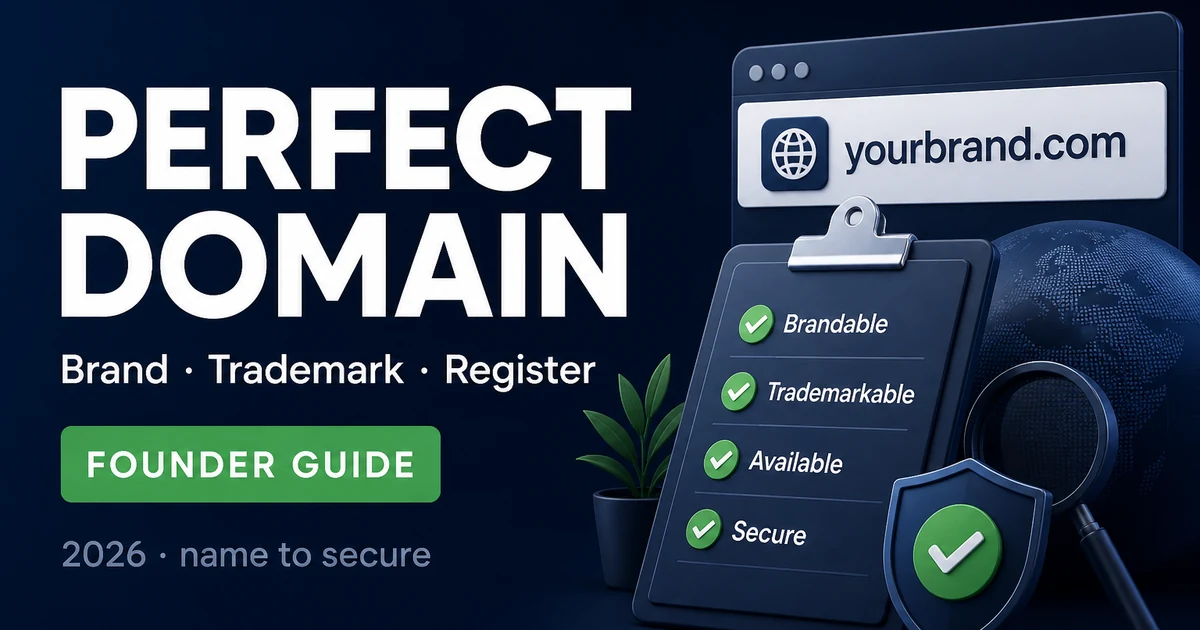
I lost a client-ready name once because we skipped trademark screening while celebrating a clean .com WHOIS. Full disclosure: the .com was available. The USPTO was not. That week still stings. If you want the perfect domain name in 2026, treat naming and securing it as one pipeline — not a Friday afternoon search followed by logo mockups.
This is the end-to-end path I run for startups: brainstorm with constraints, shortlist like an investor, clear legal noise, pick the extension for your buyer, register or broker-buy with adult transfer mechanics — no AI-only remake, no "just add .io" default.
Start with startup naming when .com is taken if your first-choice .com is gone — then return here for the full secure-the-name workflow. Cross-check availability on NameBio when you price aftermarket alternatives, and read Google's SEO starter guide before you assume the domain alone ranks you.
Quick answer: how do you name a brand and secure the perfect domain name?
Write positioning in one plain sentence, generate ten to fifteen name candidates that fit it, kill anything you cannot say once on a bad Zoom call, run trademark screens, pick the extension your buyers trust, then register or buy through escrow with auto-renew and lock enabled immediately.
| Stage | Time box | Output | Common mistake |
|---|---|---|---|
| Positioning | 1–2 hours | One-sentence job story | Starting with random word lists |
| Shortlist | 1 day | 5–7 speakable candidates | Falling for hyphens and doubles |
| Legal screen | 1–2 days | USPTO + basic web search | Assuming .com free = TM clear |
| Extension pick | Same day | .com / .app / .ai decision | Defaulting .io without buyer test |
| Secure | Same day | Registration or escrow buy | Wire without transfer plan |
How do teams avoid naming committee death?
Time-box brainstorm to one day, star three finalists, kill the rest. Committees that keep fifteen names alive for six weeks are avoiding positioning decisions, not refining them. I have sat in those rooms. They are expensive.
Include one skeptical engineer and one customer-facing seller in the final round — not twelve marketers. Engineers catch pronunciation traps. Sellers catch "would you take a call from this company?" failures.
Document why you rejected names — prevents relitigating DeadName three months later when someone new joins.
What about social handles and app store names?
Perfect domain name without handle alignment is still workable — many successful companies mismatch @ handles. Document mismatch early so marketing does not panic launch week. Do not let Instagram availability veto a strong domain without a fight.
Premium broker buys versus registrar handreg — decision tree
Handreg when budget tight, launch flexible, name is coined or long-tail available. Premium when launch fixed, category crowded, and confusion costs exceed domain check. Compare app domain market value for .app premium bands.
Broker negotiation: open with comps from NameBio, set walk-away, use escrow, never wire to personal Gmail instructions.
Post-secure checklist — DNS, email, analytics
After registration: enable 2FA, lock domain, set DNS for marketing site, configure email forwarding or Workspace, add analytics and Search Console — see app domain SEO launch checklist for .app specifics.
Store auth code offline. Add renewal calendar invite six weeks before expiry — registrars email spam filters eat renewal warnings.
International founders — extra screens
Check pronunciation in your top three revenue geographies. Check trademark classes in operating countries, not only USPTO if you sell EU or UK. .com still helps global trust; .app helps software trust — extension choice interacts with market.
My confession: I once pushed a founder toward a "perfect" premium .com that failed the phone test in India — their top market. We pivoted to a shorter coined .app and shipped. Perfect domain name means perfect for your buyers, not perfect in abstract.
Use domain tools for sweeps; FAQ for transfers; premium domains when speed beats search fatigue.
Speed matters, but skipping legal and pronunciation steps is how founders rebrand at month nine. Not fun.
Method 1: Position and brainstorm — build a real candidate list
Before you touch a registrar, write the plain sentence your product does — not the pitch deck adjectives. "We help nurses schedule locum shifts on mobile" beats "workforce optimization platform." Names should fit that sentence, not a mood board.
How to run the brainstorm — step by step
- Write the one-sentence positioning — Outcome for a specific user, no jargon.
- List five verbs and five nouns from that sentence — raw material, not final brands.
- Combine into ten to fifteen candidates — coinings, two-word compounds, single dictionary words if available.
- Say each name out loud — Kill anything you spell twice on a call.
- Search Google and LinkedIn for collisions — Common words need extra clearance work.
- Check primary TLD availability — Use domain tools for quick sweeps across .com, .app, .ai.
- Star three finalists only — More than three finalists is procrastination wearing a workshop hat.
Method 2: Trademark and conflict screening — before money moves
Available in WHOIS does not mean clear in trademark law. I am not your lawyer — hire one for high-stakes categories — but every founder should run basic USPTO and web conflict screens before registering or wiring.
How to run a basic screen
- Search USPTO TESS for exact and similar marks in your class — see USPTO trademark search for the official tool.
- Search app stores and Product Hunt for colliding product names.
- Check social handles — mismatch is not fatal, but document it.
- Google the finalist with "software" and "inc" — Obvious conflicts surface fast.
- Pause if a public company owns the lane — Rebrand cost dwarfs domain savings.
Method 3: Pick the extension your buyers already trust
.com still wins for broad consumer and enterprise identity when you can afford it. .app wins for software trust and HTTPS-by-default signaling — read building AI SaaS brand on .app domains. .ai wins when category signal matters and your buyer pool is tech-native — not because Twitter said so.
Coined product names like Aifolio.app show how .app clarity ships without six-figure .com fights. If .com is taken, read startup naming when .com is taken before you panic-buy a hyphen.
Method 4: Register or buy premium — secure for real
Handreg path: reputable registrar, auto-renew ON, registrar lock ON, privacy if appropriate, save auth codes offline. Premium path: escrow, written transfer timeline, verify seller controls the name — our acquisition FAQ covers wire mistakes I have seen repeat.
How to complete a clean registration
- Create registrar account with 2FA — No exceptions in 2026.
- Register primary domain and key typo variant if cheap — Skip typo variants if broke; never skip 2FA.
- Enable auto-renew and lock — Expiry lapses are embarrassing rebrands.
- Point DNS only after you own the name — Obvious, yet people ship landing pages on unpaid carts.
- Store credentials in a team vault — Founders get hit by buses; companies get hit by attrition.
When is a premium domain worth it over handreg?
When launch is this quarter, your buyers judge credibility from the URL bar, and the premium string saves six months of confusion — not when you want a flex.
Compare app domain market value if you are pricing .app premium tiers. Compare Stan.com if you wonder why short .com commands extreme checks — you may not need that tier to ship.
What if the perfect domain name is taken but listed for sale?
Make a realistic offer through escrow, parallel-run a strong .app or coined alternative, and do not stall product work for six months of negotiation theater.
I have seen founders lose markets while haggling five-thousand-dollar differences on names that matter less than shipping. Set a walk-away number. Execute.
How does SEO fit naming — without myth?
Exact-match domain SEO is not 2010. Brand clarity and typed traffic matter more than keyword stuffing in the URL. For metadata discipline after you secure the name, read domain metadata SEO — separate job from picking the string.
My close: the perfect domain name is the one you can say once, defend legally enough to sleep, and secure with adult mechanics — then get back to building the product people actually want.
What should you verify before you act on this comp?
I rechecked NameBio and DNJournal rows in August 2026 before publishing — date, venue, and exact spelling still matter when you negotiate. Forum screenshots are mood; ledgers are math.
Speakability filters still decide outcomes. A headline sale does not upgrade random inventory in the same extension without a buyer story you can say out loud once.
What should you verify before you act on this comp?
I rechecked NameBio and DNJournal rows in August 2026 before publishing — date, venue, and exact spelling still matter when you negotiate. Forum screenshots are mood; ledgers are math.
Speakability filters still decide outcomes. A headline sale does not upgrade random inventory in the same extension without a buyer story you can say out loud once.