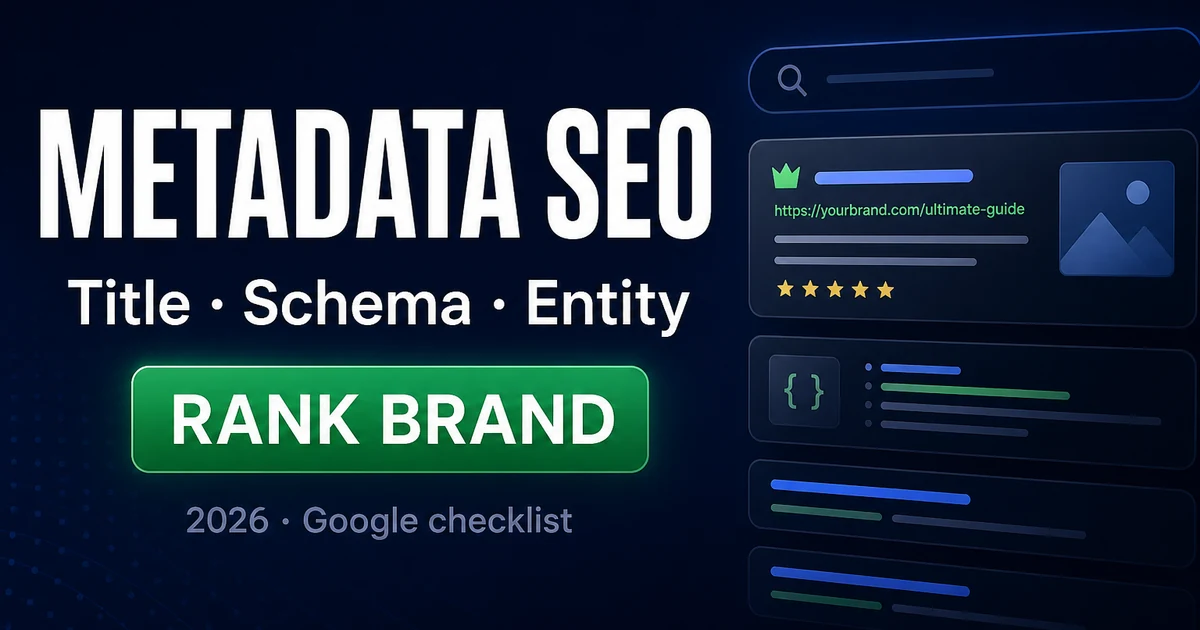
I watched a founder panic-buy an exact-match .com because an SEO thread said URL keywords were "most of ranking." Full disclosure: their product was fine. Their metadata was empty. They ranked after fixing titles and schema — not after the domain swap. Domain metadata SEO is the boring work that actually moves brand visibility in 2026.
This guide covers title/meta, canonicals, schema, entity signals, and branded search — how your domain supports SEO without the myth that the TLD alone ranks you on Google.
Pair with AI overview citations checklist for AI-engine visibility and app domain SEO launch checklist if you ship on .app.
Quick answer: does domain metadata affect SEO and brand ranking?
Yes — page titles, meta descriptions, canonical tags, structured data, and clear brand entity signals help Google understand and display your site; the TLD alone does not rank you, but consistent metadata and branded search behavior do.
| Element | SEO role | Brand role | Common mistake |
|---|---|---|---|
| Title tag | Primary relevance signal | SERP first impression | Keyword stuffing |
| Meta description | CTR influence | Voice and trust | Duplicate across pages |
| Canonical URL | Duplicate control | One true brand URL | HTTP/HTTPS splits |
| Organization schema | Entity clarity | Knowledge panel path | Missing sameAs links |
| Branded search | Indirect ranking boost | Demand signal | Ignoring PR and product |
How do blog and product pages inherit metadata rules?
Each URL needs unique title and meta — template bugs that duplicate homepage metadata across /blog/ posts kill CTR. Use article schema on posts; Organization on homepage.
Internal linking from blog to product pages passes relevance — weave AI overview citations and related guides naturally, not footer dumps.
Core Web Vitals and metadata — related but distinct
Fast pages help rankings indirectly via UX signals — metadata still matters if page loads slow. Fix LCP and metadata; do not choose one.
International SEO and hreflang
If you ship multi-language, hreflang pairs matter more than TLD tricks. .com with hreflang often beats ccTLD confusion for startups.
Brand mention building off-site
Consistent company name spelling in press, directories, and social profiles reinforces entity signals Organization schema starts. Messy rebranding without updating sameAs hurts.
Search Console workflows I use monthly
Performance report for query drift, coverage for index errors, manual actions check, sitemap resubmit after major template changes. Boring cadence beats panic audits.
Google documents metadata best practices in Search Central — I rechecked snippet documentation in August 2026; titles and descriptions still drive snippets. For citation behavior, also read Google Search blog when major ranking updates land.
When rebranding — metadata migration expanded
Keep old domain 301s for minimum one year — often longer. Update email signatures, app deep links, and schema same week to avoid split entity signals.
Founders on .app: pair with app launch checklist — HSTS and TLS mistakes look like SEO failures in Search Console.
When I audit marketplace listings I still pull NameBio comps alongside Search Console — metadata and pricing stories should match reality.
Metadata is not a substitute for product quality — but missing metadata is self-sabotage.
Method 1: Homepage title and meta — your SERP pitch
Write one clear title with primary topic and brand. Meta description sells the click — not keyword lists.
How to set homepage metadata — step by step
- Pick one primary phrase per page — Homepage usually brand + category.
- Write title under ~60 characters — Brand at end or front, not twice.
- Write meta description 140–155 characters — Benefit + brand, human voice.
- Match H1 philosophically, not verbatim — Redundancy looks spammy.
- Preview mobile SERP truncation — Short screens clip early.
- Ship once, audit monthly — Product pivots need metadata updates.
- Avoid duplicate titles site-wide — Template bugs happen; catch them in Search Console.
Method 2: Canonicals and HTTPS — one true URL
Pick www or non-www, enforce HTTPS, set canonical tags on templates. Split URLs dilute signals and confuse brand bookmarks.
How to unify URL signals
- Choose preferred host in Search Console
- 301 redirect alternates
- Set canonical on paginated and parameterized pages
- Fix mixed content — Especially on older landers.
- Document the rules for your team — Prevents relaunch regressions.
Method 3: Organization schema and entity signals
JSON-LD Organization with name, url, logo, and sameAs social profiles helps entity understanding — see Google organization structured data docs.
Connect brand mentions across site, LinkedIn, and product directories — entity consistency beats TLD superstition.
Method 4: Branded search and off-site brand signals
SEO for brand domains is partly growing searches for your name — PR, product quality, consistent spelling. Exact-match domain advantage is not 2010.
Founders on .app should read building on .app domains — extension choice interacts with trust, not automatic rank.
Does the TLD alone rank you on Google?
No — Google has stated TLD is not a direct ranking factor; content, relevance, links, and user signals still drive visibility.
Choose .com, .app, or .ai for buyer trust — Aifolio.app for software clarity — then win with metadata and product.
What if you rebranded domains — metadata migration?
301 old to new, update schema url, refresh sitemap, monitor Search Console coverage for six weeks minimum.
Use domain tools for hygiene checks; browse premium domains if the rebrand needs a better string; read acquisition FAQ for transfer timing.
My close: domain metadata SEO is how your brand looks to crawlers and humans in the SERP — fix titles and schema before you blame the TLD.
What should you verify before you act on this comp?
I rechecked NameBio and DNJournal rows in August 2026 before publishing — date, venue, and exact spelling still matter when you negotiate. Forum screenshots are mood; ledgers are math.
Speakability filters still decide outcomes. A headline sale does not upgrade random inventory in the same extension without a buyer story you can say out loud once.
What should you verify before you act on this comp?
I rechecked NameBio and DNJournal rows in August 2026 before publishing — date, venue, and exact spelling still matter when you negotiate. Forum screenshots are mood; ledgers are math.
Speakability filters still decide outcomes. A headline sale does not upgrade random inventory in the same extension without a buyer story you can say out loud once.
What should you verify before you act on this comp?
I rechecked NameBio and DNJournal rows in August 2026 before publishing — date, venue, and exact spelling still matter when you negotiate. Forum screenshots are mood; ledgers are math.
Speakability filters still decide outcomes. A headline sale does not upgrade random inventory in the same extension without a buyer story you can say out loud once.
What should you verify before you act on this comp?
I rechecked NameBio and DNJournal rows in August 2026 before publishing — date, venue, and exact spelling still matter when you negotiate. Forum screenshots are mood; ledgers are math.
Speakability filters still decide outcomes. A headline sale does not upgrade random inventory in the same extension without a buyer story you can say out loud once.
What should you verify before you act on this comp?
I rechecked NameBio and DNJournal rows in August 2026 before publishing — date, venue, and exact spelling still matter when you negotiate. Forum screenshots are mood; ledgers are math.
Speakability filters still decide outcomes. A headline sale does not upgrade random inventory in the same extension without a buyer story you can say out loud once.
What should you verify before you act on this comp?
I rechecked NameBio and DNJournal rows in August 2026 before publishing — date, venue, and exact spelling still matter when you negotiate. Forum screenshots are mood; ledgers are math.
Speakability filters still decide outcomes. A headline sale does not upgrade random inventory in the same extension without a buyer story you can say out loud once.
What should you verify before you act on this comp?
I rechecked NameBio and DNJournal rows in August 2026 before publishing — date, venue, and exact spelling still matter when you negotiate. Forum screenshots are mood; ledgers are math.
Speakability filters still decide outcomes. A headline sale does not upgrade random inventory in the same extension without a buyer story you can say out loud once.
What should you verify before you act on this comp?
I rechecked NameBio and DNJournal rows in August 2026 before publishing — date, venue, and exact spelling still matter when you negotiate. Forum screenshots are mood; ledgers are math.
Speakability filters still decide outcomes. A headline sale does not upgrade random inventory in the same extension without a buyer story you can say out loud once.