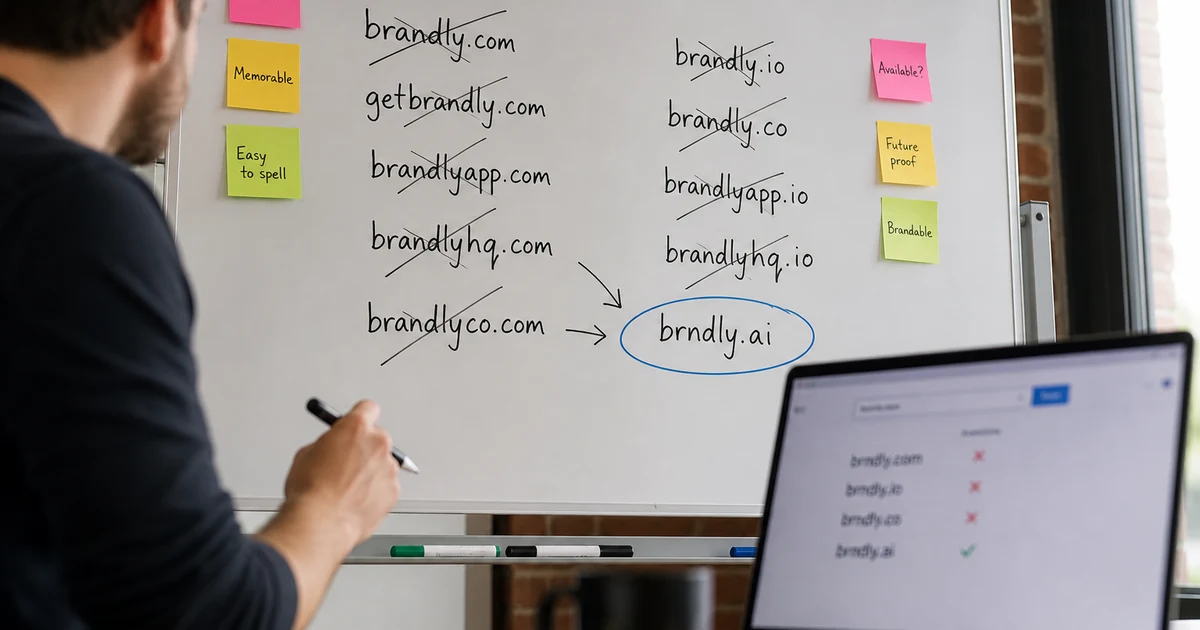
Every founder hits the same wall: the perfect brand on .com is taken, parked, or priced like a beachfront mortgage. Startup naming when .com is taken isn't a consolation prize anymore — it's the default path in 2026.
I've helped dozens of teams choose between aftermarket buys, credible alt extensions, and renamed compounds. The winners share one trait: they decide fast and ship with conviction. The losers refresh WHOIS for six months while competitors launch.
This playbook is what I wish every first-time founder had before they burned a sprint on names they can't own.
Why is .com still the first reflex?
Because investors, customers, and your parents all trust it. Verisign data still shows .com as the largest single extension by far — north of 150 million registrations — and that gravity doesn't disappear because startups got creative.
But reflex isn't strategy. Plenty of funded companies operate on .app, .co, or acquired .com variants without bleeding credibility. The question isn't "can we live without .com?" It's "what's the cheapest path to trust on day one?"
Sometimes that's a $9,500 aftermarket buy. Sometimes it's a short .app like NoLu.app that reads clean on mobile and passes the investor sniff test.
A taken .com is a market signal — not a stop sign.
What are your real options when .com is gone?
I rank them in this order for most SaaS teams:
- Buy a credible aftermarket name on .com or .app if budget allows ($3,000–$25,000 typical for serious brands).
- Choose a strong alt extension — usually .app for software, .com for broad consumer if you can get it.
- Modify the brand with a prefix, suffix, or compound that keeps pronunciation simple.
- Rename entirely if trademark screens fail or the modified string looks cheap.
What I don't recommend: hyphens, awkward spellings, or country codes you don't understand. They save registration fees and cost trust forever.
Our SaaS domain hub is built around options two and three done right — short, pronounceable, category-clear.
How do you evaluate an aftermarket .com buy?
Start with closed comps on NameBio, not the seller's fantasy anchor. Then run trademark clearance on USPTO before you negotiate.
Ask: will this name survive a pitch deck? Will legal sign off? Can we afford it without starving product? If the answer to any is no, the .com isn't "available at a price" — it's unavailable to you.
Negotiation tip: open with data, move in shrinking increments, and be willing to walk. I've seen founders save $4,000 on a $14,000 name just by waiting one week after the first counter.
Read our investor diligence piece before you wire — VCs will ask the same questions you should.
The .app path when cash is tight
Google's .app extension ships with HTTPS preloading and reads as software-native. For mobile-first launches, that's often a feature upgrade over a mediocre .com.
Compare brand.io at $40/year with zero brand equity versus a premium .app with meaning. Registration cost is irrelevant next to memorability.
We wrote a full breakdown in short .app brands for mobile-first launches — read it if your product lives on phones.
Should you tweak the spelling and move on?
Almost never. Creative spelling taxes every conversation: "That's with a K," "no vowel," "double Z." Investors notice. Support tickets multiply. Voice assistants fail.
If the .com is taken and the .app is available for $20, buy the .app. If both are taken, change the word — don't mutilate it.
Exception: intentional coined brands with marketing budget to teach pronunciation. That's rare at seed stage. Default to clarity.
How fast should you decide?
Faster than feels comfortable. Naming paralysis burns runway. I tell teams: give yourselves five business days, shortlist three ownable options, pick one, buy DNS, and return to product.
TechCrunch coverage of 2026 launches shows the same pattern — teams that ship with a good-enough name beat teams polishing a perfect one.
Use our domain tools and FAQ to compare options. When you're ready, NoLu.app is an example of a short SaaS-ready brand that didn't need a .com crutch.
Building a shortlist that won't collapse
Start with twenty candidates, kill half on trademark pre-screen, kill half the remainder on pronunciation, negotiate two seriously. Founders who negotiate five names lightly lose use on all of them.
Include at least one .app option and one aftermarket target in every shortlist. Forces comparison on total cost of credibility, not extension religion.
Budget bands by stage
Pre-seed: $500–$3,000 total domain spend is typical unless the name is the product. Seed: $3,000–$15,000 for category-defining brands is rational when it accelerates fundraising narrative.
Series A: rebrands can justify $15,000–$40,000 if migration is planned and board-approved. Above that, you need a specific strategic reason — not ego.
Social handle alignment
Check X, LinkedIn, GitHub org, and app store names before you wire. A perfect domain with mismatched handles confuses agents and users alike in 2026.
NoLu works because it's short across surfaces — domain, icon text, and spoken intro align. That coherence is part of naming quality.
What if the .com owner never responds?
Assume non-response means not for sale at your price or ever. Budget two broker attempts, then move on. Waiting six months for a parked page to wake up is how competitors eat your market.
Broker fees hurt less than a delayed launch. If brokers fail, execute option two or three from the playbook — don't haunt WHOIS.
Pronunciation testing with real users
Before you wire, say the name to five people cold. If three need spelling, shorten or change. Phone calls and podcasts are part of GTM now.
Record a mock voicemail intro. Awkward pauses cost more than a slightly higher domain price.
NoLu passes the phone test — two syllables, no spelling lesson. That's the bar for mobile-first SaaS in 2026.
International founders and .com scarcity
Global teams often assume .com is mandatory because US investors prefer it. Reality in 2026 is more nuanced — credible .app brands clear bars if paperwork is clean.
Lead with trust signals: HTTPS, polished site, consistent handles. Extension matters less when execution looks professional.
When to bring legal into naming
Before finalizing, not after. A $500 clearance conversation beats a $50,000 rebrand. Legal doesn't pick your brand — they flag landmines.
If legal says proceed with risk, document the decision. Investors prefer informed bets over accidental exposure.
Founder psychology and naming attachment
Founders attach to names like they're children. That's human — and expensive. Set a decision deadline and honor it even if the .com owner finally replies on day nineteen.
Attachment to an unavailable .com often masks fear of shipping. Buying a strong .app is sometimes the braver move.
Press and launch sequencing
Coordinate press with DNS live. Journalists forgive early-stage messiness less than they did in 2018. Own the name before the TechCrunch tab opens.
Accelerator demo day pressure
Accelerators compress timelines. Founders present before they own DNS. Fix that — demo day URLs end up in investor inboxes permanently.
Buy the domain before you apply if branding is part of the pitch. $3,000–$8,000 is cheaper than explaining a typo domain in every follow-up meeting.
Comparing NoLu-style names across categories
Short coined brands work when the product is novel. Literal compounds work when category education is expensive. Pick the strategy that matches your GTM, not Twitter aesthetics.
Your domain is the first feature users evaluate. Treat naming with the same urgency as shipping v1 — because for many users, it is v1.
When in doubt, choose the name you can explain in one breath on a crowded elevator. That test never fails.
Ship with NoLu-class clarity, then iterate product — not the other way around.
Founders who ship on strong .app names rarely regret speed. Founders who wait on silent .com owners often regret delay.
Pick a name, buy it, build — the market rewards motion.
Read our SaaS hub and choose from names that are actually available to close this week.
Naming is a business decision with a price tag — make it deliberately, not accidentally.
Email deliverability and domain age
Founders forget that cold outreach from a brand-new domain can land in spam. A purchased aftermarket name with clean history sometimes beats a fresh registration — even on .app. Check blacklist status before you commit.
If you're migrating from a dev subdomain, warm up sending domains gradually. Marketing and naming decisions intersect more than engineers expect.
Competitor naming collisions
Search your shortlist plus "funding" and "Series A" before you buy. A name that collides with a better-funded peer in the same category creates permanent confusion in investor inboxes.
NoLu-style short brands reduce collision risk because they're distinctive without being obscure. That's a feature, not a compromise.
When to involve your cofounder
Naming fights destroy cofounder relationships when decisions drag. Agree on criteria — budget, extension, pronunciation — before you shortlist. Debate names, not values.
One founder should own the wire transfer and registrar account from day one. Split ownership is how startups lose domains in breakups.
Key Takeaways:
- Startup naming when .com is taken is normal — treat it as a sourcing problem, not a crisis.
- Rank options: aftermarket buy, strong extension, smart compound, full rename.
- Comp and trademark before you negotiate; investors will do the same.
- Avoid spelling hacks; clarity beats cleverness at seed stage.
- Decide in days, not months — speed is part of brand quality.
Need a name you can ship this week? Browse SaaS domains, explore full inventory, and read more founder guides on the blog.
- DN Detector editorial