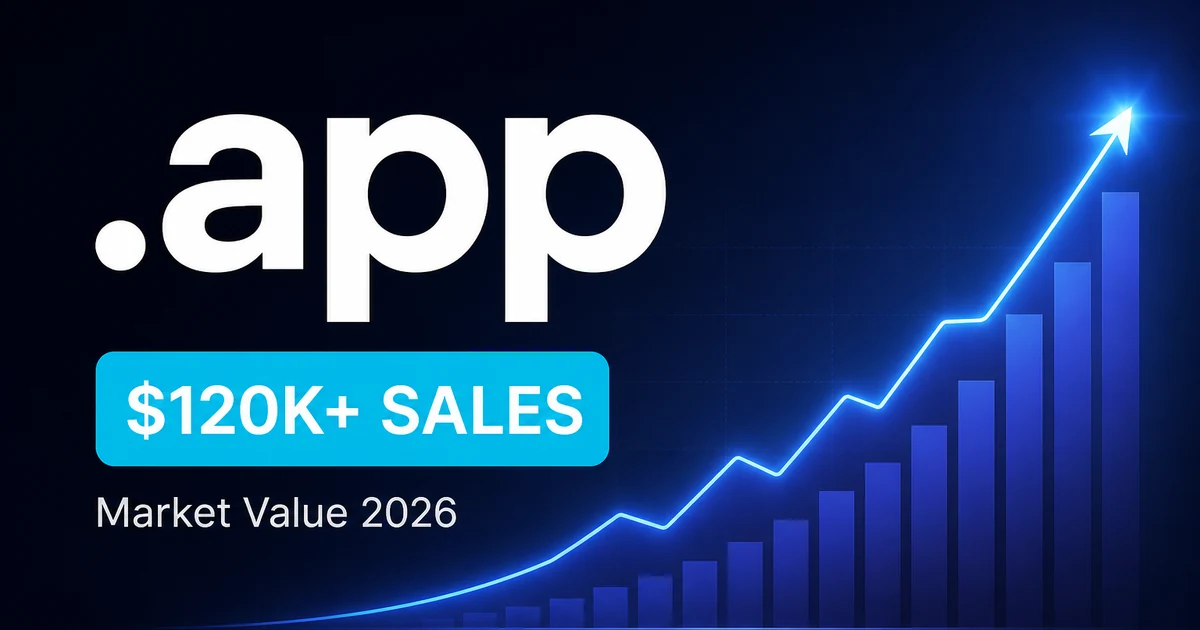
I used to treat app domain value like a polite fiction — pretty extension, modest comps, move on. August 2026 broke that habit. Prism.app at $120,000 in January, Exe.app at $35,000 via TOP.DOMAINS on August 4, 2026, and a 2025 tape that logged 302 reported sales for about $817,600 in dollar volume changed the conversation. Full disclosure: I renewed a mediocre compound .app last year on vibes alone. That renewal felt expensive the month after Purpose.app cleared $87,550. Lesson learned. Comps first. Feelings second.
If you hold premium .app inventory or you're a founder choosing between .app, .ai, and a hyphenated .com workaround, the August 2026 market is not asking you to believe a brochure — it's showing you price discovery on short, product-native strings while the extension itself overtakes .io on registration volume.
I pulled the public sales feed on NameBio, cross-checked the annual .app review on TLD Investors, and lined up our own building an AI SaaS brand on .app notes for founder context. Different articles. Same extension. This one is the market map — not the logo tutorial.
What is .app worth on the aftermarket in 2026?
Enough that serious investors track it weekly — and enough that founders should stop apologizing for launching on .app when the string is strong.
Public aftermarket summaries in 2026 place average .app resale prices near $42,718, up roughly 18.4% year over year in aggregated extension comparisons. That average is not your handreg ticket. It is the blend of sub-$1K retail flips and six-figure premiums. Still useful. It tells you liquidity exists beyond domain Twitter.
Zone size matters for narrative. Registrations crossed 1.9 million and passed .io as the largest developer-oriented TLD in multiple 2026 trackers — .app ahead by over 200,000 names in some public zone reports. Adoption creates buyer familiarity. Familiarity lowers friction on a Product Hunt launch or a seed deck footnote. Friction taxes price in both directions.
Google Registry launched .app in 2018 after winning the ICANN auction for $25,001,000 — still one of the highest gTLD auction results on record. HSTS preload baked HTTPS expectations into the extension before your first visitor arrives. That is not marketing fluff. It is a security posture enterprise buyers notice even when they cannot articulate why the padlock felt "serious."
| .app sale | Price | Date | Venue | Why it matters |
|---|---|---|---|---|
| Prism.app | $120,000 | Jan 2026 | TopDomains | Early 2026 six-figure anchor |
| Viral.app | $100,000 | May 2025 | Afternic | Single-word social/growth brand |
| Purpose.app | $87,550 | Sep 2025 | TOP.DOMAINS | Dictionary word premium |
| Grid.app | $69,888 | May 2025 | TOP.DOMAINS | Dev-tool semantic fit |
| Mega.app | $50,000 | Jun 2025 | Spaceship | Registrar-channel liquidity |
| Exe.app | $35,000 | 4 Aug 2026 | TOP.DOMAINS | Short tech-native stem |
| Vibe.app | $25,500 | Mar 2025 | Atom | Atom still clears .app retail |
Why does .app command higher average resale than .io right now?
Because product-native extensions with Google-scale marketing and HTTPS defaults beat legacy ccTLD fashion when founders want "this is software" in the URL itself — and because the best .app inventory is scarcer than the registration count suggests.
My take? .io still works. I am not declaring a funeral. But .app average resale near $42,718 versus .io near $24,661 in the same 2026 extension comparisons is a spread worth respecting. Buyers pay for semantic fit plus distribution. .app ships both for mobile-first products.
Compare with our .app vs .ai vs .com startup domain breakdown if you are choosing an extension this quarter. This article is the comp sheet. That one is the decision tree. Read both if you are raising on a name that has to survive due diligence.
I've watched teams buy weak .com compromises — extra syllables, awkward prefixes — because "investors only respect .com." Meanwhile Exe.app clears $35,000 and Prism.app sets a $120,000 headline. The market is voting with wires, not slogans.
What price band should you expect for a premium .app name?
Think in lanes — not one number for the whole extension.
Lane 1 — Handreg compounds and leftovers: often wholesale to low four figures if they move at all. Most should not have been registered. Harsh truth. I have dropped names in this bucket.
Lane 2 — Strong compounds and category fits: mid four figures to low five figures when the word work is obvious — Geo + Rank for local SEO, Send + Up for shipping workflows, Ai + Jet for speed-forward AI branding. Real products. Real buyers. This is where much of DN Detector's AI .app collection and SaaS .app listings live — priced for end users, not domainer lotto.
Lane 3 — Single-word dictionary and ultra-short: five figures to six figures when the word is universal and the renewal tier is survivable. Viral.app and Purpose.app are your north stars. Not your floor for every English word.
Lane 4 — Strategic registry premiums: withheld or tiered names with renewal quotes that can exceed $1,000/year on some dictionary classes. Read the tier before you celebrate a registration. Premium renewal math kills portfolios quietly.
How should founders use .app comps without overpaying?
Match string quality to the lane above — then verify venue and date on primary sales data before you stretch your budget.
- Pull NameBio rows for like-for-like words — single-word vs compound vs coined hybrid. Do not price GeoRank.app like Prism.app because both end in .app.
- Run the phone test out loud — if you spell it twice on a call, tax the price down. Speakability still drives .app retail.
- Model renewal at tier, not promo — Google Registry premium classes persist. A cheap year-one registration can still be a $280–$1,000+ annual renewal on some dictionary names.
- Separate investor inventory from launch urgency — if you ship in September, buy a live brand now. Waiting for a six-figure comp to "validate" your extension choice is how quarters disappear.
- Keep escrow non-negotiable above four figures — our acquisition FAQ covers transfer mechanics founders skip when they are excited.
- Browse live .app inventory before custom coinages — premium domains with real prices beat imaginary appraisal PDFs.
Which live .app names fit the August 2026 market story?
Ones that read like products on first glance — not domains waiting for a business model.
Aifolio.app is the featured example I keep in the AI founder conversation: coined, portable, clearly software. Svara.app plays the voice-and-audio lane with a real linguistic root. Revolutions.app carries movement-and-change energy for transformation SaaS. GeoRank.app is compound-obvious for local SEO tooling. AiEnergy.app, SendUp.app, and AiJet.app sit in the strong-compound band where August liquidity actually trades — not lottery tickets, not six-figure dictionary premiums either.
I am not claiming any one listing is "worth" Prism.app money. I am saying the market has proven .app clears real checks on quality — and these strings are priced in bands a bootstrapped team can diligence without a brokerage mystery tour.
For why AI startups keep picking .app over longer .com workarounds, our why .app domains win AI launches piece covers positioning. For timing, read when to buy an .app domain before launch. This market report tells you what buyers paid. Those guides tell you when to pull the trigger.
Is .app still a good investment TLD in late 2026?
For premium one-word and sharp compounds with survivable renewals — yes, liquidity improved. For bulk handregs — still mostly no.
Honestly, the extension passed a maturity test in 2025–2026: multiple venues clearing five figures, repeated TOP.DOMAINS and Afternic rows, registrar channels like Spaceship and Atom in the tape. That is not 2019 novelty pricing. It is recurring behavior.
Investors should still respect hold time. Viral.app's $100,000 headline does not tell you how long the seller waited. It tells you what cleared when a buyer needed that word. Both halves belong in your model.
Founders should respect opportunity cost. If a clean .app saves six months of brand confusion — and ships HTTPS defaults out of the box — the registration fee is rarely the expensive line item. Engineering time is.
What mistakes do people make reading .app sales headlines?
They paste six-figure comps onto weak strings and wonder why inbound stays silent.
I've done the lazy version: saw a big sale, renewed junk, told myself "the TLD is hot." The TLD can be hot while your specific name is cold. Quality is string-level. Always.
Second mistake: ignoring renewal tiers on dictionary words. A headline sale on a premium-tier renewal name is not the same economics as a standard-tier compound you can hold for a decade.
Third mistake: treating .app as a stand-in for .com in enterprise procurement without testing your buyer's IT checklist. Some enterprises still default to .com on vendor security forms. Know your ICP. Ship where they already buy.
Use domain tools for comp discipline — not for generating fake precision. Round numbers from real feeds beat decimal-heavy appraisal theater.
Google Registry, HTTPS, and why buyers trust .app on a landing page
Security posture is part of brand value now — not a checkbox for later.
.app requires HTTPS. HSTS preload means browsers enforce TLS before your marketing team remembers to flip a setting. I have watched founders lose enterprise pilots over mixed-content warnings on .com marketing sites. Boring until it is expensive.
That does not make every .app name valuable. It makes the extension a credible wrapper for software products — which is exactly the buyer job for most of the names in our live inventory.
Official policy and program history live on ICANN's new gTLD pages and Google Registry documentation. I still read primary sources when investors quote auction prices from memory. Memory drifts. Ledgers do not.
My August 2026 close on .app domain value
The extension is no longer a curiosity. Registrations beat .io. Averages climbed. Headline sales returned in 2025 and extended into 2026 with Prism.app at $120,000.
If you hold premium .app — price with comps, respect renewal tiers, list where buyers browse. If you need a launch name — shop live inventory in the strong-compound band instead of inventing a fourth-choice coinage at 2 a.m.
I keep typing app domain value the way founders search it — not because the phrase is elegant, but because that is how the question shows up before anyone knows to filter NameBio by TLD.
Respect the tape. Ignore hype stickers. And never let one Prism.app headline justify renewing junk you would not say out loud on a pitch call.