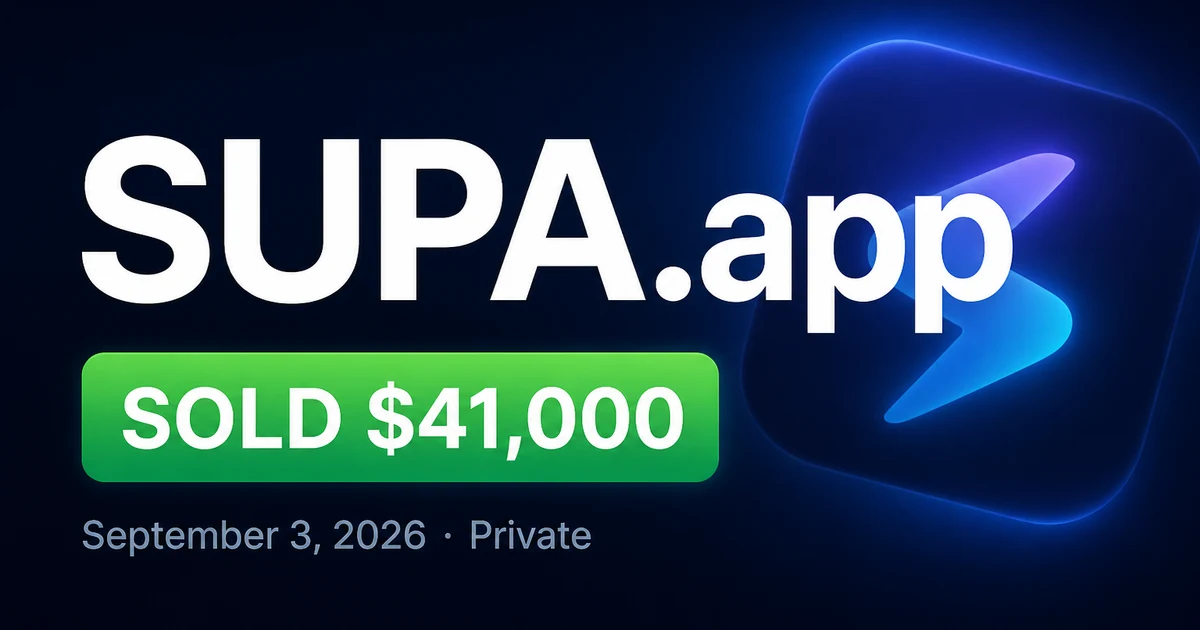
I almost shrugged at SUPA.app because short .app brandables show up in my feed constantly. Then the private-sale number stuck. $41,000 on 3 September 2026 is not retail pocket change. Full disclosure: I still treat private rows with extra skepticism until the facts stabilize. SUPA.app is the software-home signal I wanted this week.
SUPA.app is the 3 September 2026 proof that strong brandable .app names can clear $41K in private deals when the letters feel like a product, not a leftover generator string.
I cross-checked public reporting against NameBio habits, weekly color on DNJournal, and trader talk on NamePros. Prior .app texture: EXE.app at $35K and app domain market value August 2026. Extension choice for founders: app vs .ai vs .com.
What happened with the SUPA.app private sale on 3 September 2026?
SUPA.app closed for $41,000 in a private sale on 3 September 2026. Early notes framed it as a strong short brandable on Google's .app — product energy, speakable punch, software-native TLD. Private channels mean fewer public buyer details. That is normal. It also means you diligence harder, not softer.
I've closed and watched private .app deals. The good ones still pass the phone test. SUPA does.
| Sale | Price | Date | Venue | Lane |
|---|---|---|---|---|
| SUPA.app | $41,000 | 3 Sep 2026 | Private | Short brandable .app |
| EXE.app | $35,000 | Aug 2026 | TopDomains | Dev/product .app |
| Plateful.com (same day) | $87,500 | 3 Sep 2026 | Snagged | Dictionary .com |
| Weak invented .app | Low retail | Any week | Varies | Not comparable |
When I log supa app, I tag it brandable-software — not dictionary .com cosplay.
Why did SUPA.app clear $41K?
Because the string feels like a product name you can put on a home screen. Short. Punchy. Easy to say. .app already signals software. The stem does not fight the TLD. I've killed more .app asks for ugly invented stacks than for price. Ugly stacks stay ugly at any BIN.
My take? Low-to-mid five figures is rational for elite short .app when inbound is real. It is fantasy for random leftovers.
How does SUPA.app compare to EXE.app?
EXE.app printed around $35,000 in August on a marketplace lane. SUPA cleared a bit higher in private. Same neighborhood. Different exact stories. Read the EXE.app sale note before you pretend one row sets every floor.
Honestly, neighborhood comps beat single-row religion every week of the year.
Should investors reprice all short .app after SUPA?
Only names that pass a cold phone test and feel product-ready. Hyphen piles, number mashups, and harsh consonant soup do not inherit $41,000. Neither do trademark-risky lookalikes of famous brands.
When someone forwards me supa app as a blank check for their portfolio, I send the phone-test list back. Mood pricing is not a strategy.
What founder products fit a SUPA.app style name?
Developer tools, productivity apps, consumer utilities, fintech-lite products, and any software brand that wants speed in the mouth. The letters suggest "super" energy without locking one vertical. Width helps. Forced vertical jargon hurts.
I've pushed founders toward dictionary .com when they needed enterprise email trust first. .app is a product home. Know which job you are buying.
How should sellers list brandable .app after SUPA?
Price for phone-test quality and software buyers, list where .app founders browse, and keep escrow non-negotiable on private closes.
- Confirm the facts you will cite — SUPA.app, 3 Sep 2026, private, $41,000.
- Lead with product speakability — One pronunciation, no apology.
- Keep comps in .app — EXE-tier peers first; .com dictionary on another slide.
- Price for conversation — Cold fantasy BINs train silence.
- Screen trademarks — Short punchy strings collide often.
Follow Google Search Central after launch — .app HTTPS storytelling still needs real content.
How should startups use .app versus .com and .ai after this print?
Use .app when you are shipping product software and want a modern DNS home without forcing an AI story. Use .com when USA default trust and email matter most this quarter. Use .ai only for AI-native products with clean words. Read USA startup domain choice before ideology wins.
Live software inventory examples help more than vibes — start with Aifolio.app, then browse premium domains. Keep domain tools and the acquisition FAQ open during diligence.
What landing page mistakes kill .app premium asks?
Parking ads on a software TLD, broken SSL irony, empty "make offer" pages, and brand stories that never mention a product. Buyers paying forty-one K expect adult presentation. A parked page says you do not care.
I've lost weeks on names priced right and presented wrong. Presentation is inventory.
What escrow steps apply to private .app deals?
Use known escrow even when the deal feels friendly. Confirm auth-code path. Document WHOIS update. Budget transfer days into launch calendars. Private does not mean handshake-on-Twitter.
I still write the checklist on paper. Boring wins.
How does SUPA.app change app domain pricing conversations?
It raises the credible conversation band for elite short brandables. It does not rewrite every renewal. The companion pricing guide after SUPA exists for that longer math — this sale note is the receipt, not the whole curriculum.
How should end users diligence SUPA-style .app names before buying?
Say the letters once. Confirm private-sale facts you will cite. Screen software trademarks. Budget escrow and transfer days. I've watched startups treat .app like a costume change and skip content. HTTPS storytelling still needs pages.
Also decide whether you need a product home or a trust default. Different jobs. Supa app comps help elite short brandables — they do not replace extension strategy for email-heavy USA enterprise sales.
What does SUPA.app teach about private liquidity versus public comps?
Private deals can clear real money with less theater. They also invite rumor inflation. I've seen prices drift in retellings within a day. Write the facts down. Date. Spelling. Amount. Then negotiate.
Public marketplace comps like EXE still matter for triangulation. One private row is a point. A neighborhood is a map. Supa app pricing talk should use both — never the rumor alone.
What outbound mistakes follow a $41K .app private sale?
Spamming every four-letter .app owner with "like SUPA" is the fastest way to look unserious. I've watched those campaigns die in silence. Specificity is slower and kinder to your reputation.
Good outreach names the private-sale date, the $41,000 figure, and why the target letters share product punch. Then it admits gaps. When I cite supa app, I also list letter patterns I would not buy at any BIN. Honesty filters noise.
Another mistake is treating one private row as a portfolio-wide reprice event. Elite short brandables moved. Junk did not suddenly grow a product story.
How should brokers pitch .app brandables to startup buyers?
Lead with software-native fit and speakability. .app already says product. The stem should not fight that signal. Then show EXE-tier neighborhood comps. Then separate dictionary .com slides so founders do not average unrelated jobs.
I coach brokers to ask whether the team is shipping software this quarter or cosplaying modernity. If email trust is the real blocker, talk .com first. If the product is AI-native, talk .ai with clean words. .app is a lane — not a personality.
Also demand lander hygiene before the ask. Empty make-offer pages kill five-figure paths. Buyers paying forty-one K expect adult presentation. Parking ads on .app look especially ironic.
What renewals should .app holders cut after SUPA?
Cut harsh consonant soup. Cut hyphen piles. Cut trademark-risky lookalikes of famous brands. Keep punchy product-ready strings with real outbound lists. I've renewed generator leftovers because a headline made me greedy. The renewal invoice was the reality check.
SUPA clarified an elite short-.app conversation band near EXE. It did not forgive junk drawers. Write the kill list while the lesson is fresh. Then price survivors for conversation, not theater.
If you need deeper pricing math, use the companion guide after SUPA — this sale note is the receipt. Receipts matter. Curricula matter more when you are repricing a whole book.
I keep EXE and SUPA on one sticky note and junk renewals on another. Mixing those notes is how portfolios get expensive and slow. Supa app belongs on the elite note only when the letters earn it — punch, product energy, and a phone test that does not apologize.
When I revisit supa app, I ask whether the target name shares punch, length discipline, and product energy. If not, the comp is decoration.
What trademark risks hit short punchy .app names?
Lookalike risk against famous "super" brands and crowded software classes. Budget counsel into acquisition cost. A pretty domain with a cease-and-desist is not a launch win.
United States filing strategy matters early if you sell into USA app stores and enterprise pilots. Plan enforcement with the lander, not after App Store screenshots.
September 3 reminded me that .app can print serious private money when the letters feel inevitable. Your job is filters — not collecting every four-letter leftover because a headline was loud.