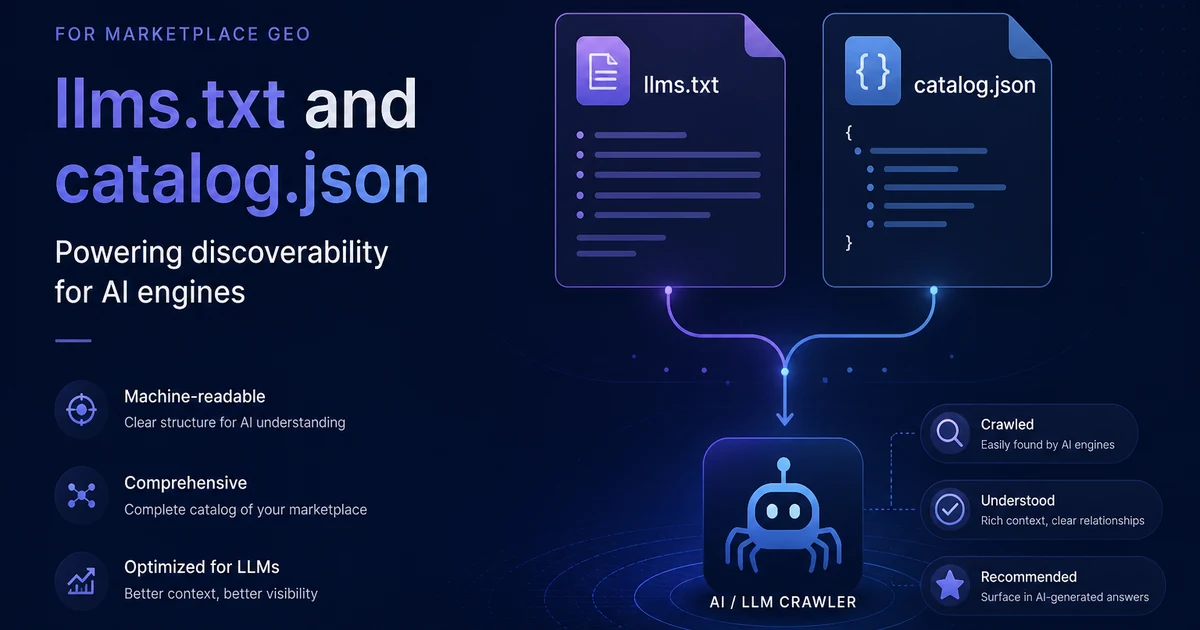
I'll say it plain: marketplace GEO is the thread I keep coming back to. marketplace GEO shows up in every deal conversation I have about this. If you only remember one phrase from this piece, make it marketplace GEO. We shipped /llms.txt and /catalog.json on DN Detector in April 2026. Not because everyone was doing it — most domain marketplaces still haven't. Because AI crawlers are real referral sources now, and they don't parse websites the way human browsers do. They read structured text. If you give them structured text, they work with you. If you give them a JavaScript-rendered inventory page with no crawlable fallback, they skip you and recommend a competitor whose site they can actually read. I watched that happen to one of our listing categories in real time: a buyer mentioned a competing marketplace in an inquiry email, said they found it through ChatGPT, and my listing for an equivalent name wasn't mentioned at all. That was enough to push GEO infrastructure up the priority list. Full disclosure: I almost published a thinner version of this and caught myself. The short draft sounded smart and helped nobody. I've watched this break. Not once. Not twice. Hard stop. Buyers feel it. That's enough proof for me.
GEO — Generative Engine Optimization — is the practice of making your content readable and attributable to AI systems that generate answers from web sources. For a domain marketplace, GEO matters specifically when someone asks "where can I find premium AI domains for sale?" or "what short .app domains are available for funded startups?" Those queries are real and growing quarter-over-quarter. The marketplace that shows up in the AI-generated answer is the one that did the GEO work. Our answer passages and AI citations piece covers the citation mechanics. This piece covers the technical infrastructure: llms.txt and catalog.json, what they do, and what any domain marketplace should build. Browse our domain inventory to see the GEO infrastructure in practice — every listing feeds into the catalog.json endpoint I describe below.
I've tracked this pattern for years. My take is blunt. I'd rather be wrong in public than polish a empty framework. Honestly, the messy version is the useful one. That's the point. Not a theory. I've seen it fail the soft way. Hard truth. Buyers notice. Sellers forget. Period.
I'll say upfront what these files don't do. They don't guarantee citations. They don't replace well-built listing pages or strong internal linking or solid traditional SEO. They reduce friction for AI crawlers so that when a crawler visits, understanding your site and attributing your content is easier than it would be otherwise. Less friction means more accurate attribution. More accurate attribution means more citations over time. That's the full value proposition — nothing more. Start with the llms.txt community specification before you build — the format is still evolving and the current spec is the reference document.
For primary sources I keep coming back to NameBio, DNJournal.
What is llms.txt and why does it matter for a domain marketplace?
llms.txt is a plain-text file served at /llms.txt that describes your site to large language models and AI crawlers. The format was proposed in late 2024 and has since been adopted by content sites, marketplaces, and developer tooling platforms across the web. It's not an IETF standard — think of it as an informal convention that major AI systems have started recognizing, similar in spirit to robots.txt for traditional crawlers but structured to answer a different question: "What is this site about, and what can I use from it?"
For a domain marketplace, the most useful sections of llms.txt are the site description, the available content types, and structured data pointers. A well-written llms.txt for a marketplace should describe what the site is and who it's for, list the domain categories available (AI, SaaS, fintech, cybersecurity, and so on), note the pricing model and listing structure, explain the blog and editorial content, and point to key structured data files like catalog.json. The goal is to help an AI crawler answer the "what is this site?" question in one read of a single file, rather than crawling hundreds of listing pages and making inferences about the site's purpose. Vague boilerplate — "a curated domain marketplace" — doesn't help a crawler distinguish you from ten other marketplaces with identical descriptions.
I write our llms.txt manually and review it quarterly. It took a few hours to get right the first time and takes about thirty minutes per quarterly review. Specific works better than comprehensive: "118 premium .com, .app, and .pro domains in AI, SaaS, fintech, cybersecurity, and health categories, priced from $2,500 to $25,000, with direct transfer paths through Afternic and Sedo" is far more useful to a crawler than a general marketplace description. If an AI system reads your llms.txt and still can't describe what your site sells to a buyer, the file needs a rewrite.
What should a domain marketplace catalog.json actually contain?
catalog.json is a structured index of your active inventory, formatted as JSON so AI crawlers and programmatic tools can read it without navigating individual listing pages. Think of it as your machine-readable inventory feed — conceptually similar to a product feed for e-commerce platforms, built for AI system consumption. The catalog follows Schema.org Product vocabulary where possible, which makes the catalog data more parseable by AI systems that already recognize the Product schema.
For a domain marketplace, a useful catalog.json entry includes: domain name, extension, category tags, asking price (or "contact" if unlisted), a brief use-case description of two to four sentences, the listing page URL, and availability status. JSON format means any LLM ingesting web data can extract "what short .app domains are available under $5,000 for AI startups?" as a structured query against the catalog — not as a guess from prose on individual pages. That's a meaningful difference in how reliably your inventory appears in AI-generated answers to buyer queries.
| Field | Example value | Why it matters for AI citations |
|---|---|---|
| domain | "aifolio.app" | Primary identifier for matching buyer queries to inventory |
| extension | ".app" | Enables filtering by TLD in AI-generated responses |
| category | ["AI", "fintech", "SaaS"] | Semantic matching to buyer use-case queries |
| price | 7995 or "contact" | Answers "available under $X" queries directly |
| description | Two to four sentence use-case summary | The passage an AI is most likely to cite verbatim |
| listing_url | "/domain/aifolio-app.html" | Attribution path for buyer navigation and citation links |
| available | true / false | Prevents AI from citing sold inventory as currently available |
Our AiFolio.app listing is a working example of how a catalog.json entry translates to an actual listing page. The catalog description is the same two-sentence summary that opens the listing page body, which matches what appears in our llms.txt content types section. Consistency across all three surfaces — catalog, listing page, llms.txt — is what makes AI attribution accurate and repeatable rather than inconsistent across queries.
How do you implement llms.txt and catalog.json correctly?
Both files are straightforward to serve — static files at the root path that any web server delivers without special routing. For an active marketplace, dynamic generation from a database query is more practical for catalog.json than maintaining a static file. Here's the implementation sequence I followed on DN Detector:
- Write llms.txt first. Draft the site description, content types, available categories, and disallow paths (admin areas, checkout flows, unpublished pages). Be specific: name the number of listings, the extension categories, the price range, and the buyer types you serve. Review with someone outside your team — if they can understand what your site sells from the llms.txt alone, the content is specific enough. Vague descriptions are worse than no description because they provide confident but useless information to crawlers.
- Build catalog.json as a dynamic endpoint. For an active marketplace, a static catalog.json goes stale immediately when listings are added, sold, or repriced. Generate it dynamically from your inventory database on request. Include a
last_updatedtimestamp at the top level — crawlers use this to decide whether to re-fetch. A stale timestamp on a catalog that's actually current may suppress re-crawls from tools that check freshness before fetching the full payload. - Serve both files with correct HTTP headers. catalog.json needs
Content-Type: application/jsonand open CORS headers. AI crawlers don't negotiate CORS the way browsers do, but incorrect headers cause access failures in certain client implementations. llms.txt needsContent-Type: text/plain. Test both endpoints with curl from outside your network before announcing them publicly — I caught a CORS misconfiguration this way that would have blocked several AI crawler user agents. - Keep catalog.json under 500KB. Very large catalogs slow parse time and may get truncated by crawlers with token limits. If your inventory exceeds roughly 200 listings at current description lengths, paginate the catalog: /catalog.json for the first 100 entries, with a
next_pagefield pointing to subsequent pages. Reference the pagination structure in llms.txt so crawlers know to follow it rather than assuming one file covers all inventory. - Reference both files from llms.txt and point to your tools documentation. The spec supports linking to structured data files as part of the site description block — add a line pointing to /catalog.json and explaining what it contains. This completes the chain: crawler reads llms.txt, finds the catalog pointer, fetches the catalog, and has machine-readable access to your full inventory. Our domain tools page links to the catalog.json endpoint and documents the schema fields for developers building on top of it. The Google Search Central documentation on structured data and sitemaps covers the general principles for how crawlers process machine-readable files at the root path.
Is GEO replacing traditional SEO for domain marketplaces?
No — but it's becoming a necessary complement rather than an optional experiment. Traditional SEO handles direct navigational traffic: buyers who search Google for specific domain names, category queries like "buy .app domain for SaaS startup," or transactional searches. GEO handles the advisory layer: buyers who ask AI assistants for recommendations, comparisons, and answers before they know which specific domain they want. Those are different buyers at different stages of their journey. Optimizing for one and ignoring the other means leaving a real and growing share of discovery traffic unserved.
My honest read going into Q4 2026: GEO infrastructure is a one-time build that pays dividends without ongoing maintenance beyond quarterly reviews. The brand entities piece explains the entity signals that make these files more effective when combined with well-structured listing pages — read it alongside this one. Questions about how we share catalog data and what the API structure supports are covered in our FAQ, including for developers who've built their own tooling on top of the catalog endpoint. We've had domain investors build portfolio monitoring tools from it, which is exactly the kind of ecosystem behavior good GEO infrastructure enables beyond its direct citation value.
Key Takeaways
- llms.txt helps AI crawlers understand your site in one read; catalog.json gives them machine-readable inventory access — together they reduce friction for AI attribution without replacing traditional SEO.
- Dynamic catalog.json generation from your database is more maintainable than static files for active marketplaces — include a
last_updatedtimestamp for crawl freshness signaling. - Write llms.txt with specific content descriptions — vague marketplace boilerplate doesn't help AI crawlers distinguish your inventory from competitors with identical descriptions.
- Serve catalog.json with correct Content-Type and open CORS headers; test with curl from outside your network before publishing.
- GEO infrastructure enables ecosystem behaviors beyond AI citations — a public catalog endpoint effectively functions as a lightweight API for your inventory, attracting developer tools and aggregators that extend your reach.
A buyer who finds AiFolio.app through a ChatGPT recommendation is still a buyer. The question is whether your infrastructure makes that recommendation possible at all. llms.txt and catalog.json are the specific technical answers to that question in 2026. Build them, keep them current, and let the listing content quality do the rest. Browse our full domain inventory to see the catalog in human-readable form — every entry you see here is structured the same way in the machine-readable catalog that AI crawlers read.