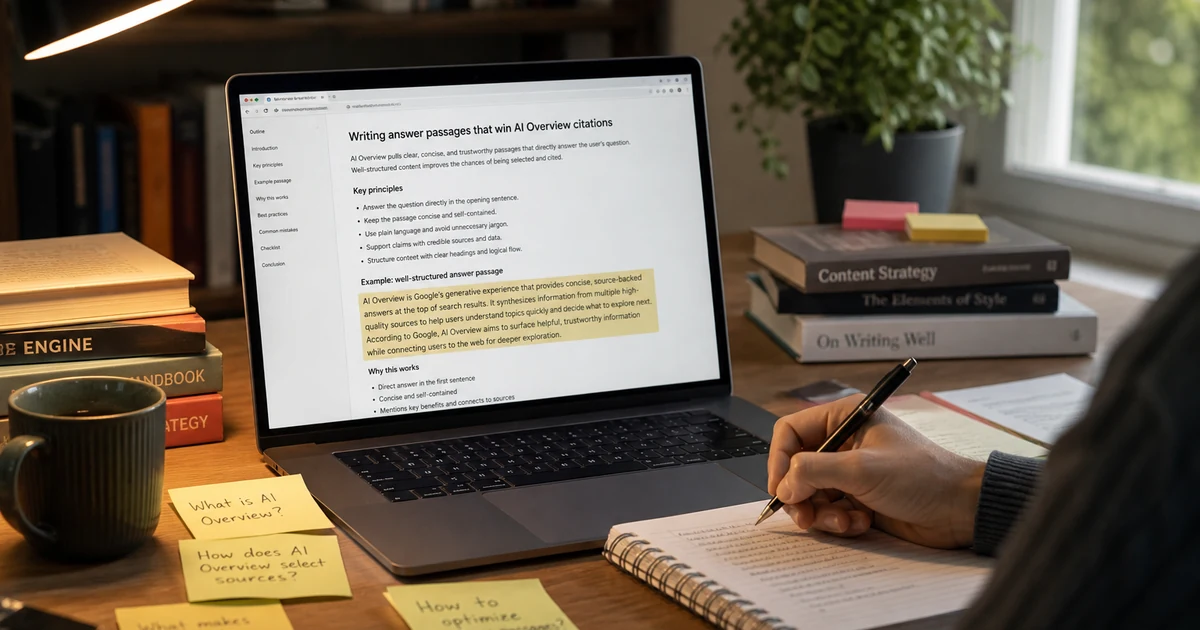
I used to write long, winding sections and hope Google figured out what I meant. Then I started watching which of my paragraphs got quoted inside AI Overviews — and the pattern was so obvious I felt a little dumb for missing it.
The pages earning AI Overview citations weren't the longest. They were the ones with tight, self-contained answer passages — roughly 130 to 170 words — that fully resolved a single question without making the reader (or the model) hunt for context.
So let me show you how I structure those passages now, why the length matters, and how to make a block genuinely quotable instead of just present.
This isn't theory I read in a thread. It's what I changed across dozens of pages after staring at citation patterns for weeks, and the lift in both AI mentions and plain old snippet wins was hard to argue with.
What makes a passage citation-eligible?
An answer passage is a chunk of content that stands on its own. If you lifted it out of the page and pasted it into a chat window, it would still make complete sense — no "as mentioned above," no dangling pronouns, no missing setup.
Google has said for years that its systems can rank individual passages, not just whole pages — that's the same idea behind featured snippets. AI Overviews take that further, stitching together short, authoritative segments from multiple sources.
The sweet spot I keep landing on is 130 to 170 words. Shorter than that and you're often too thin to be authoritative. Longer and you dilute the core answer with hedging and tangents the model has to wade through.
Write every key section as if it might be the only thing about your page a reader ever sees. Because increasingly, it is.
That mindset alone changed my writing more than any tool. Each section earns its place by answering something completely.
How do you structure a 130-170 word answer passage?
I use a simple three-move template, and it's boringly reliable. First, a direct answer in the opening sentence — no throat-clearing, no "there are many factors." Say the thing.
Second, two or three sentences of support: the reasoning, a specific number, or a concrete example that proves you know what you're talking about. This is where first-hand experience separates you from the summarizer bots.
Third, one sentence of nuance or a caveat, so the passage reads like a genuine expert wrote it rather than a definition generator. Models seem to favor content that acknowledges edge cases.
The anatomy, in order
- Direct claim — answer the exact question in the first line.
- Evidence — a stat, example, or step that supports it.
- Nuance — a caveat or condition that shows real expertise.
- Self-contained language — no references that only make sense with surrounding text.
Put a clear, question-style heading right above it. The heading is the query; the passage is the answer. That pairing is what both classic snippets and AI systems are hunting for, and I lean on it in every piece across more SEO breakdowns.
What common mistakes kill citation eligibility?
The biggest one is burying the answer. If your passage opens with three sentences of context before it gets to the point, a model may grab the context and miss the payoff — or skip you entirely for a competitor who leads with the answer.
The second is context-dependence. Phrases like "as we saw earlier" or "this approach" without a noun make a passage unliftable. Every block should survive being read cold.
Third is over-optimization. Stuffing the same keyword five times reads like spam to people and adds nothing for machines. Write for a smart human skimming fast — that's the same reader profile a language model approximates.
And fourth: no evidence. A confident claim with zero support is easy to ignore. One specific figure, date, or example makes a passage dramatically more quotable, because it gives the AI something concrete to attribute to you.
There's a fifth mistake I fell into myself: writing passages that answer the question I wish people asked instead of the one they actually type. Match the real query. If people search "how long should an answer passage be," your heading and first line should mirror that phrasing, not some cleverer version of it.
Pull those phrasings straight from your Search Console query report and from the follow-up questions AI tools suggest. The exact words your audience uses are sitting right there in the data, and matching them is the cheapest citation edge you'll ever get.
Does this help regular rankings too?
Yes, and that's the beauty of it. Everything that makes a passage citation-eligible also makes it snippet-eligible and more useful to human readers. You're not trading classic SEO for AI SEO — you're doing one thing that serves both.
Google's own recent guidance to website owners keeps circling back to the same idea: quality, clarity, and helpfulness win. Well-structured passages are just clarity made operational.
If you run a content site or a marketplace, this compounds. Every product or category description written as a clean answer passage becomes a candidate for citation. Our AI listings, for example, use tight, self-contained blurbs — browse the AI domains and you'll see the format in action.
How do you test whether a passage is working?
Writing a good passage is step one. Knowing whether it earns citations is step two, and most people skip it entirely, then wonder why nothing changes.
My crude but effective test: copy the passage into a plain document, strip the surrounding page, and ask whether a stranger could answer the heading's question from that block alone. If they can, a model probably can too. If they need context, you've got work to do.
Then I watch the data over the following weeks. In Search Console, I look for the passage's target query gaining impressions, and I periodically ask a few AI tools the question directly to see who they cite. It's not scientific, but patterns emerge fast.
- The isolation test — does the block answer its heading with zero outside context?
- The impression check — is the target query trending up after the rewrite?
- The spot-check — do AI answers to that question start naming your page?
- The revisit — if nothing moves in a month, tighten the opening line and add a concrete number.
Nine times out of ten, when a passage isn't landing, the fix is the same: the answer wasn't in the first sentence, or there was no evidence to anchor it. Lead with the claim, back it with a fact, and most of the problem solves itself.
Try it on one page this week: pick your best-ranking article, rewrite the top three sections as clean answer passages, and watch the impressions. It's the highest-impact edit I know.
If you're building something worth citing, a sharp brand name helps the attribution stick — take a look at browse our premium listings or the acquisition FAQ when you're ready.
— DN Detector editorial