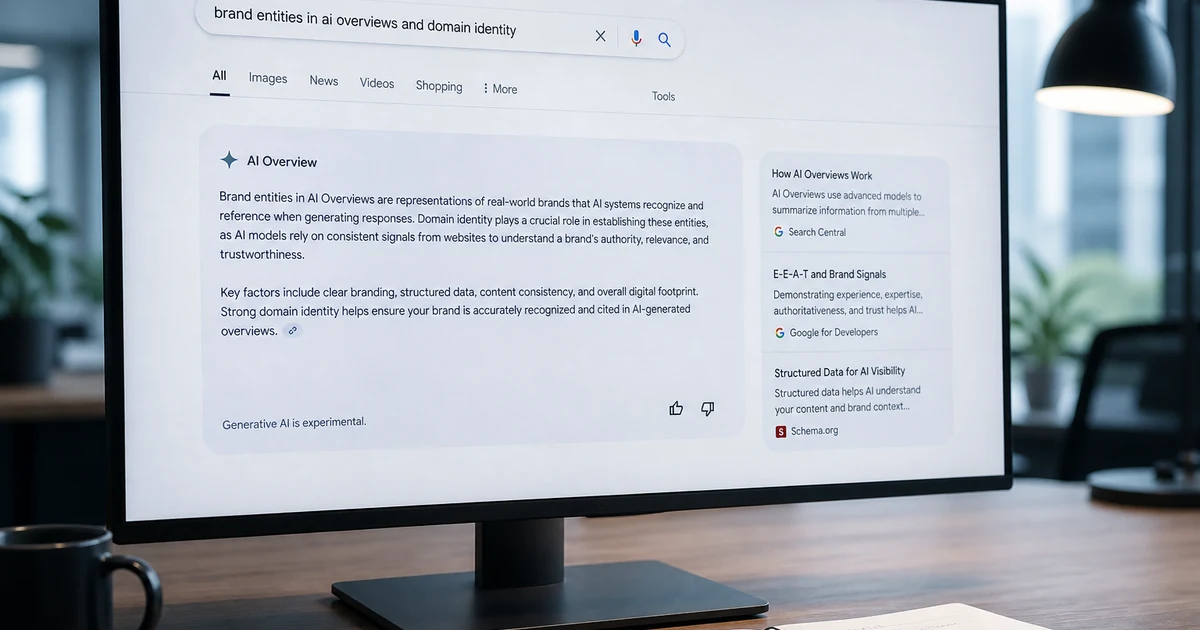
Google's AI Overviews don't just summarize pages anymore — they summarize entities. And your domain is one of the strongest entity anchors Google has when it decides who "you" are on the SERP.
I noticed the shift when a client's brand started appearing in AI Overviews with the wrong parent company attached. Same product. Wrong domain association. We fixed structured data, aligned the domain with the legal entity, and within six weeks the Overview cited the correct site. The content barely changed. The identity graph did.
If you sell domains or build on them, this matters twice: your marketplace entity and the brands you help launch. Here's how brand entities work in AI search — and why a name like BitBrain.app is more than a URL.
How Do AI Overviews Build Brand Entities?
Google's systems knit signals — domain, Knowledge Panel, Wikipedia mentions, schema markup, consistent NAP data, social profiles — into an entity record. When AI Overviews answer a query, they prefer sources tied to a coherent entity over anonymous pages.
That's different from classic keyword SEO. You can rank for a term without being the entity Google names in a summary. Entity SEO is about becoming the default answer when someone asks who or what, not just ranking for how.
Google Search Central documentation on structured data is the technical floor. Organization schema, sameAs links, and explicit domain declarations help machines map your site to your brand. Skip that work and Overviews may cite a competitor with cleaner entity signals — even if your content is better.
Schema.org Organization markup isn't optional garnish for funded startups anymore. It's how you tell AI systems "this domain is the canonical home of this brand."
Keywords get you in the room. Entities get you named in the answer.
I've audited dozens of domain marketplace sites. The ones losing Overview citations share a failure mode: inconsistent naming between domain, title tags, and footer legal text. The ones winning align all three — boring, effective, repeatable.
Why Does Your Domain Matter More Than Your Logo?
Because models read text first and pixels second.
Your domain is the persistent string across email, press, investors, and integrations. Logos change every rebrand. Domains — when chosen well — stay stable for years. AI systems weight that stability when resolving "BitBrain" to a specific product versus a generic phrase.
Short, unique compounds help. BitBrain.app is defensible as a brand entity. smartbrainai.com is a keyword pile agents and humans confuse with a category. When you browse our AI domain hub, notice how many listed names are coined compounds — they're built for entity separation.
Press coverage accelerates entity formation. Bloomberg and Wired links with consistent domain spelling teach models faster than ten blog posts on a hyphenated alternate. Founders who buy the right domain before PR outreach pay once; founders who fix entity confusion pay forever.
Read our Gemini AI Overviews guide and brand entity SEO piece for parallel tactics — the through-line is identity consistency, not tricking algorithms.
The Knowledge Panel gap I see constantly
Startups launch on a great product domain but register their LLC under a different string. Google sees two entities. AI Overviews split citations. Users trust neither.
Fix: make the domain the public brand, align legal name where possible, and wire sameAs schema to verified profiles. It's unglamorous work that moves Overview share more than another 2,000-word blog post.
What This Means for Domain Buyers and Marketplaces
If you're acquiring a launch name, run an entity checklist before you close.
- Uniqueness: Google the string. If it's a common phrase, entity separation will be expensive.
- Spelling stability: No creative letters — press and models will fragment you.
- Extension credibility: .app and .com reinforce product legitimacy in entity graphs.
- Handle alignment: Match domain, Twitter/X, LinkedIn, and GitHub where possible.
- Schema readiness: Plan Organization markup on day one, not month six.
Marketplace operators: your own entity matters too. Category hubs, consistent author bylines, and inventory pages that don't duplicate titles across hundreds of listings protect your site from looking like a template farm to entity classifiers.
Check the acquisition FAQ for how we present listings — clean titles aren't just UX; they're entity hygiene.
Can a Premium Domain Fix a Weak Entity Strategy?
No — but a weak domain can sabotage a strong one.
Buying BitBrain.app doesn't auto-create a Knowledge Panel. You still need citations, schema, and consistent mentions. What a premium name buys you is head start on uniqueness and memorability — the raw materials entities need.
I've seen teams try to entity-build on generic keyword domains and spend $40,000 on PR to overcome ambiguity. A coined .app would have cut that bill in half. The domain isn't the whole strategy. It's the foundation you don't want to pour twice.
Expect AI Overviews to get more entity-dependent, not less. As summaries compress, the system must trust who is speaking. Domains are the cheapest durable trust signal you can own outright.
What I'd do this quarter
Audit your top ten money pages for entity consistency. Pick one flagship domain per product line. Implement Organization schema. Pitch three publications that will spell your domain correctly in the link. Measure Overview citations monthly — not just blue-link rankings.
Boring? Yes. Effective? Also yes.
Marketplace operator checklist
If you sell domains, your site is a YMYL-adjacent business. Entity clarity isn't optional. Use consistent publisher name in articles, link author pages, show physical or registered business contact, and avoid anonymous "team" bylines on money content.
Duplicate title tags across hundreds of listings dilute entity signals. Templating is fine; identical meta descriptions are not. Customize the first sentence per category at minimum.
Measuring entity progress
Track branded search volume monthly. Watch Knowledge Panel appearance for your marketplace brand. Log AI Overview citations in Search Console beta reports where available. Entity SEO is slow; measure quarterly, not daily.
Competitive entity confusion cases
Two startups in the same niche with similar names create entity collision — Google merges or splits citations unpredictably. Before you buy, search the brand string plus "app" and "ai" and read who already owns mindshare.
Trademark clearance complements entity research. USPTO clearance without Google entity clearance is half a job. Do both before wire transfer.
Press releases should use identical boilerplate company description across wires — consistency trains entity graphs faster than one-off interviews with sloppy naming.
If you rebrand, publish a permanent redirect map and update schema sameAs the same week. Dragging rebrand cleanup for months splits your entity and costs Overview citations.
Schema markup minimum viable setup
Organization JSON-LD on homepage: name, url, logo, sameAs array. WebSite schema with SearchAction if you have on-site search. Article schema on blog posts with author Person linked to author page.
Validate in Rich Results Test after deploy. One broken comma shouldn't block launch but fix it within the first week — errors compound in entity graphs.
Listing pages can use Product schema cautiously — only if price and availability are accurate. Stale Product schema is worse than none.
Entity work is unglamorous and compounds. Six months of consistent schema, press, and naming discipline beats a one-week "AI SEO sprint" every time. Start with your domain — it's the string everything else should orbit.
If you're shopping for a launch name, bias toward uniqueness you can own in entity space, not keyword density that merges you with a thousand lookalikes.
Run a quarterly "entity audit" — Google your brand, screenshot Overviews, check Knowledge Panel, verify schema validates. Fifteen minutes per quarter prevents expensive confusion later when PR scales and models already learned the wrong mapping.
How Do You Test Entity Clarity Before Launch?
Search your candidate name in quotes plus "company," "app," and "tool." Read page one for collisions. Run the same queries in ChatGPT and Perplexity — note which entities dominate answers today.
Register socials and a stub site with Organization schema before your big PR push. Entities form faster when multiple signals appear together in a short window.
Ask five people to recall your domain after one spoken pitch. If three spell it wrong, fix the name or fix the spelling — don't launch and hope Google sorts it out.
Press and entity reinforcement
Every press hit should use identical company naming and domain spelling in the boilerplate. Variation trains models to treat you as multiple entities. I send a one-line style guide with every interview request — reporters appreciate it.
Podcast appearances matter too. Transcripts feed retrieval systems. Say your domain clearly once per segment; hosts will clip it.
Sponsor disclosures don't hurt entity trust when honest. Hidden affiliations do when discovered.
Entity SEO is the slow game that compounds. Start with a name worth owning — browse AI listings or read our analysis archive — then build the graph around it deliberately. Your future Overview citations will thank you.
- DN Detector editorial