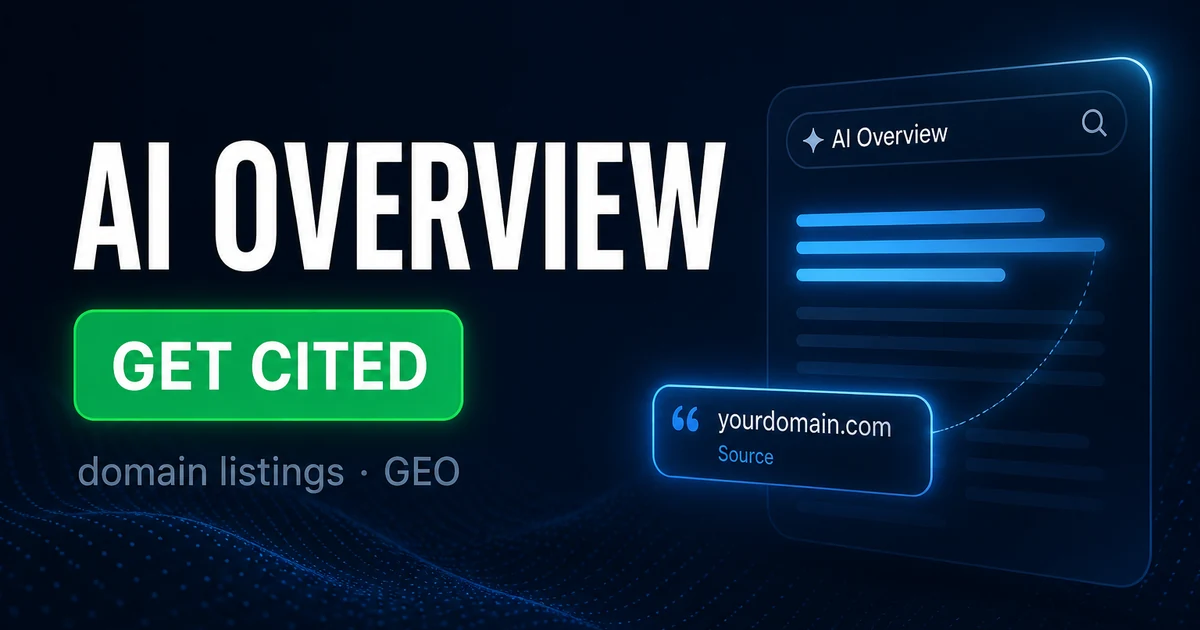
AI Overview citations is what this piece is about — the facts first, then what I'd actually do with them.
A founder messaged me in May 2026: "Google's AI answer said AiFolio.app is for sale and linked your page." He wasn't complaining. He was verifying before he wired an offer. That single AI Overview citation did more trust work than three months of parked-page DNS ever would. I've been reverse-engineering which listing elements earn those citations since — not from theory, from pages that actually show up in GSC's Generative AI report.
Domain listings are weird citation candidates. You're not publishing a 2,000-word guide. You're selling a name. Google still quotes you when the page answers a tight question clearly: Is it available? What's it for? What's the extension? How do I buy? The Google AI optimization guide doesn't carve out an exception for marketplaces. Helpful, crawlable, attributable content wins — including for-sale URLs.
Full disclosure: I thought only editorial blogs could earn AI Overview citations. Inventory pages proved me wrong. The AiFolio.app listing is my control case — FAQ schema, Product markup, named buyer categories, no fluff. When AI impressions tick up there, it's because the page is built to be quoted.
What makes a domain listing citable in AI Overviews?
Google cites pages that resolve a specific question in a self-contained passage. For listings, the questions are transactional and navigational. "Is [domain] for sale?" "What is [domain] good for?" "How much does [domain] cost?" Your opening paragraph and FAQ answers must answer those in plain language — first sentence, no warmup. When a founder wants a shortcut I walk the boring parts first — fee schedules, renewal math, escrow timing, and the ugly middle where nothing feels exciting — because that middle is where most deals die.
Entity clarity matters as much as length. The page should disambiguate the domain from apps, people, or unrelated brands with the same string. I've seen listings lose citations to Crunchbase or LinkedIn because the for-sale page never stated what the name is. Three sentences of use-case copy beat a wall of adjectives every time.
Structured data reduces guesswork for machines. FAQPage JSON-LD mirroring visible FAQ text is the highest-use markup I've deployed on listings in 2026. Product schema with Offers — price or make-offer — gives crawlers a machine-readable availability check. Validate with the Rich Results Test before you celebrate citation wins.
| Listing element | Citation role | Common failure |
|---|---|---|
| Opening paragraph | Names domain, category, availability in 50 words | Marketing fluff before the domain name |
| FAQ block | Quotable Q&A for price and acquisition | Schema that doesn't match visible text |
| Use-case section | Matches "good domain for X" queries | "Great for many businesses" |
| Product schema | Machine-readable price and availability | Missing Offers block |
| Internal links | Entity reinforcement from category hubs | Orphan listing with no inbound links |
How do you optimize a for-sale page for AI Overview citations?
This is the workflow I run on new inventory before I expect any AI visibility.
- Write the citation sentence first. One line you'd want quoted: "[Domain] is a premium .app for sale, ideal for [specific buyer types], listed at [price or make-offer]." Put it in the first paragraph.
- Build four to six FAQ pairs. Availability, price, use case, extension, acquisition path. Keep each answer under 200 words. Mirror them exactly in FAQPage JSON-LD per the FAQPage spec.
- Add Product + Offers schema. Name, description, price, availability. Match the live page — stale schema kills trust when Overviews quote wrong numbers.
- Link from a category hub and one blog post. AI systems weight pages that look like part of a site, not stray landers. Our AI domain category exists partly for this signal.
- Ship fast, crawlable HTML. No JS-only price blocks. Google needs to read what buyers read.
- Track AI impressions in GSC. The Generative AI performance report won't show queries yet, but page-level impression rows confirm citation presence.
The FAQPage schema guide covers markup errors I see weekly. The answer passages piece covers prose rhythm — short declarative sentences machines can lift intact.
Do marketplace listings compete with Afternic or Sedo for citations?
Sometimes — and you want your canonical listing to win. Marketplace syndication is great for transactions. It's terrible as your only entity definition. If Afternic's thin template ranks as the authoritative answer, the Overview quotes their boilerplate, not your use-case story. Your site should be the richest source on the name you control.
Keep prices consistent across surfaces. I've watched AI answers blend two sources and quote the lower outdated price. One source of truth on your domain, syndication second. Our domain tools help me audit schema and index status before I syndicate.
What should you avoid when chasing AI Overview citations?
Don't keyword-stuff "AI domain for sale" fifteen times. Don't add fake FAQ questions you wouldn't answer on a sales call. Don't block AI surfaces with the GSC opt-out toggle on finished listings — that's for draft pages, not inventory you're marketing.
My honest caveat: citations aren't sales. They're introductions. The listing still needs escrow clarity, mobile-friendly layout, and a contact path that works at 11pm. Read our acquisition FAQ from the buyer's side before you rewrite copy — it lists the objections AI summaries skip.
What query types trigger AI Overview citations for domain listings?
I've bucketed them into four groups from spot checks and buyer emails — not from GSC query exports, which still aren't available for AI in August 2026.
Navigational availability. "Is [name] for sale?" "Can I buy [name]?" These are the highest-intent citations. Your FAQ answer must say yes explicitly with a price or make-offer path.
Use-case recommendations. "Best domain for AI portfolio app" or "short .app for fintech startup." Listings with named buyer categories win here. Generic "premium domain" copy loses to competitors who sound specific.
Extension clarification. "What is [name].app?" Buyers comparing .com versus .app need the listing to state extension and HTTPS expectations plainly. One sentence in the opening paragraph handles it.
Price band research. "How much does a premium .app cost?" Category-level queries may cite a representative listing if your page includes a concrete number and justification. Vague "contact us" pages rarely get quoted.
How do you audit a listing before expecting AI Overview citations?
I run a fifteen-minute checklist on any name we're actively marketing:
- Search the domain plus "for sale" in incognito — note whether an Overview appears and who gets cited.
- Run Rich Results Test — FAQ and Product schema must validate clean.
- Read the first 100 words aloud — if you haven't said the domain, extension, use case, and availability, rewrite.
- Compare price on-page to Afternic/Sedo syndication — mismatches poison citations.
- Confirm the page isn't on AI opt-out in GSC settings.
- Check Generative AI impressions after two weeks — no rows means fix fundamentals before chasing tactics.
Repeat after every material price change. AI systems cache aggressively. Stale citations hurt conversion worse than no citation — buyers arrive angry about a number you already changed.
How long until new listings earn their first AI Overview citation?
My observed range in 2026: three to twenty-one days after indexation, assuming FAQ schema validates and the page isn't opted out of AI surfaces. Faster on names with existing brand search volume. Slower on coined brandables nobody has typed yet. Don't panic at day five. Panic at day thirty if Generative AI impressions are still zero — that's a fundamentals problem.
Accelerators that helped in our tests: internal links from a category hub the same day the listing goes live, a blog mention within the week, and price parity across syndicated marketplaces. None are guarantees. They're the same SEO hygiene that speeds classic indexing — AI citation is a lagging indicator of entity trust, not a separate magic trick.
Should you rewrite listings that never get cited?
Yes — but diagnose first. Check indexation, schema errors, AI opt-out status, and price mismatches before you rewrite prose. If fundamentals are clean and impressions stay zero for thirty days, rewrite the opening paragraph and FAQ answers using the citation sentence formula from earlier in this piece. I've rescued stagnant listings with a single FAQ addition: "How do I buy this domain through escrow?" with a five-sentence answer naming Afternic, Sedo, and direct inquiry.
Compare against a cited competitor listing in the same category — not to copy, but to see which questions they answer that you skipped. Marketplace SEO in 2026 rewards completeness over cleverness. Browse our portfolio for listings that combine editorial depth with transactional clarity — that's the template I clone when a name should be earning AI Overview citations but isn't.
One more thing I'd stress: mobile readability. Half the AI Overview citations I've spot-checked on phones pull from pages that render clean on small screens. Broken tables and hidden prices don't get quoted. They don't convert either.
Citation wins compound. A listing cited once in August is more likely to be cited again in September if the page stays accurate. Treat every FAQ update as reputation maintenance, not a one-time SEO project.
Key Takeaways
- AI Overview citations on domain listings go to pages that answer availability, price, use case, and acquisition in quotable passages.
- FAQPage and Product schema mirroring visible content are the strongest technical signals for for-sale URLs.
- Category hub and blog internal links help listings look like authoritative site entities, not orphan landers.
- Your own listing page should be richer than marketplace syndication templates.
- Track Generative AI impressions by page in GSC to confirm citation presence while query data is still missing.
If you've seen a listing cited in an Overview for a query I didn't mention here, send it — I'm building a swipe file of real examples for Q4 2026.