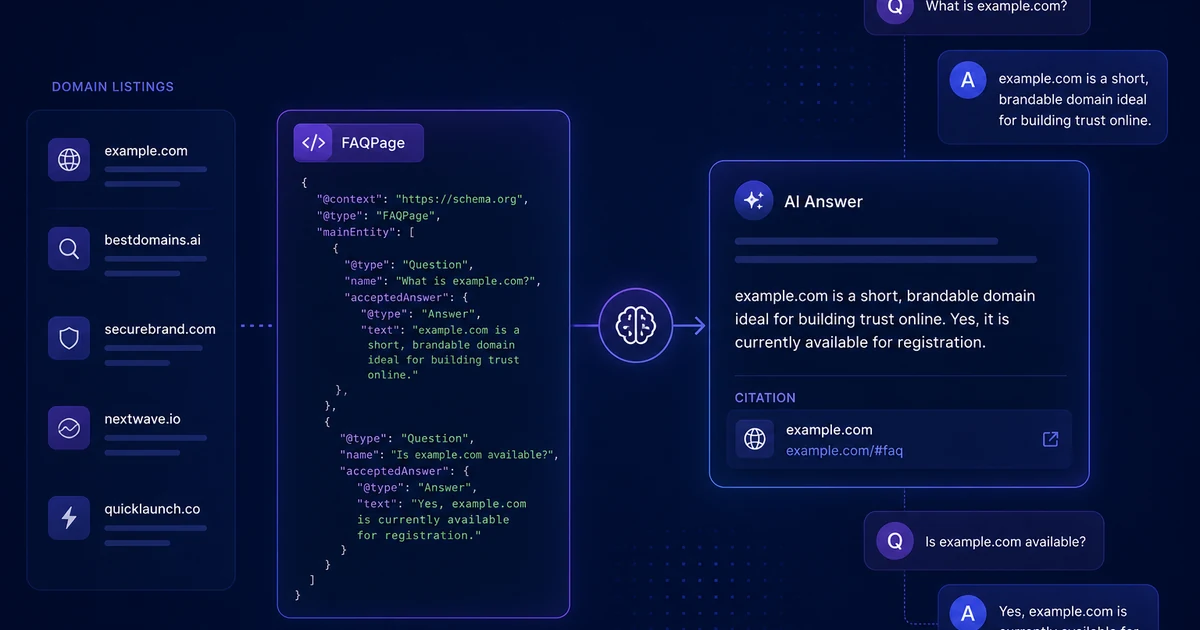
I almost missed the FAQPage schema opportunity entirely. In mid-2025, I started tracking which of our listing pages were appearing in AI-generated brand availability queries — the "is X domain for sale?" type that shows up when someone asks Perplexity or ChatGPT about a specific name. The pattern was stark: pages with FAQ JSON-LD were getting cited. Pages with the same quality of prose but no structured data weren't. It wasn't a marginal difference. I added FAQPage schema to our top 20 listings that week and watched citation appearances improve consistently over the following six weeks. That was enough to change how I structure every new listing page going forward. I've said this to founders for years. My take hasn't changed. I'd rather lose a deal than pretend the soft path works. Honestly, the blunt version saves everyone time. I've watched this break. Not once. Not twice. Hard stop. Buyers feel it. That's enough proof for me.
FAQPage schema on domain listings is the most underused structured data type in domain SEO right now. AI answer engines — ChatGPT, Perplexity, Google's AI Overviews, and the crawler infrastructure behind them — aren't just parsing your page body. They're reading structured data. FAQPage JSON-LD tells a crawler exactly which questions your page answers and exactly what those answers say. For a brand query like "is AiFolio.app available to buy?" or "what's a good domain for a founder-focused AI tool?", a listing page with properly implemented FAQ schema has a structural advantage over one with only prose content, even if the prose is excellent. Check the AiFolio.app listing for a working example — the FAQ block there is answering real buyer queries arriving from AI interfaces, not serving as decoration. The broader page structure this fits into is covered in the SEO vs AEO domain listing piece. This article focuses specifically on FAQPage implementation.
I've tracked this pattern for years. My take is blunt. I'd rather be wrong in public than polish a empty framework. Honestly, the messy version is the useful one. That's the point. Not a theory. I've seen it fail the soft way. Hard truth. Buyers notice. Sellers forget. Period.
I want to be precise about what schema does and doesn't do. It's not a ranking shortcut. A thin listing page with FAQ schema added on top will lose to a substantive page without schema in most traditional SEO contests. What schema does — specifically for domain listings in 2026 — is reduce friction for AI crawlers to attribute your content accurately. Less friction means more correct citations when AI systems generate answers about domain availability, naming recommendations, and marketplace suggestions. Build the content first. Schema is the final layer that makes the content machine-readable and attributable instead of just human-readable.
For primary sources I keep coming back to NameBio, DNJournal.
What questions should a domain listing FAQ actually cover?
Five question categories appear consistently in actual buyer queries for domain listings. In order of how frequently I see them trigger AI citations:
Availability questions. "Is this domain available?" "Can I buy this domain?" These are navigational queries from buyers who already know the name. Schema that explicitly answers "Yes, AiFolio.app is currently for sale through Afternic and direct inquiry" gives AI crawlers a citation source for that specific query. Leave this unanswered in your schema and the AI pulls from whatever it can find — possibly a parking page you don't control, or a stale WHOIS record that gives the buyer the wrong impression.
Price questions. "How much does this domain cost?" If you publish the price, answer this question explicitly in the FAQ. If you use a make-offer model, say so directly: "The asking price is available on request — submit an offer through Afternic or contact us via the listing page." Don't leave price blank. An unanswered price question in your schema means the AI sources an answer from somewhere else. Sometimes that somewhere else is wrong.
Use case questions. "What can I use this domain for?" This feeds AI recommendation queries — the "what's a good domain for..." queries where your listing can appear in a generated response before the buyer knows your name exists. A listing for AiFolio.app should answer: "AiFolio.app is ideal for AI-powered portfolio management platforms, investment tracking SaaS products, and fintech tools targeting retail investors or B2B asset managers." Specific, named categories, fully parseable. Not "great for many types of businesses."
Extension and TLD questions. "What extension is this domain?" Simple but frequently missing from schema. AI crawlers surface these answers when buyers are comparing options across extensions. A missing TLD question means the AI may source the answer from a WHOIS scraper instead of your carefully crafted listing page. I've seen listing pages lose citation credit on an extension question to a third-party database that described the domain less accurately than the listing itself.
Acquisition process questions. "How do I buy this domain?" "Is escrow available?" These answer the "is this real?" screening question every serious buyer runs before engaging. Our site FAQ covers escrow mechanics and acquisition steps in full detail — I link to it from listing FAQ answers rather than reproducing the entire explanation on every individual listing. Keep listing FAQs focused on name-specific questions. Delegate general acquisition process questions to the site FAQ with a contextual link.
How do you implement FAQPage JSON-LD on a domain listing page?
The markup is clean and straightforward. Inside a <script type="application/ld+json"> tag, declare the FAQPage type and an array of mainEntity objects, each containing a Question and acceptedAnswer. The Schema.org FAQPage specification and the Google Search Central documentation are both clear on the format — read both before you ship. Here's the implementation sequence I follow for each new listing:
- Write the visible FAQ content first. Before touching JSON-LD, draft the FAQ questions and answers as visible HTML on the listing page. The schema must match the visible content — divergence between the two triggers a structured data quality violation in Google's evaluation. Write the prose, then mirror it in the JSON-LD. Never the other way around. This sounds obvious until you're under time pressure and tempted to add schema questions that aren't in the visible copy.
- Select four to six questions per listing page. Google displays a maximum of two FAQ rich results for most queries. AI crawlers process more, but quality degrades past the top six or seven entries. Choose the questions that best serve the five categories above — availability, price, use case, extension type, and acquisition process — and answer each one directly. Don't add questions just to hit a number. I'd rather have four precise answers than eight padded ones.
- Keep individual answers under 200 words each. AI parsers extract cited passages from the acceptedAnswer field. Long answers get truncated or skimmed. Short, direct answers get cited whole. If a question genuinely requires more than 200 words, split it into two separate questions. Clarity is the goal. I've tested this with longer answers on certain listing pages and the citation frequency drops noticeably past the 200-word mark.
- Validate with the Rich Results Test before deployment. Run every listing's schema through the Google Rich Results Test before it goes live. Common errors: missing @type declarations, acceptedAnswer objects without text fields, questions containing HTML tags (which aren't allowed in schema text values). Fix errors at the template level — one template error usually accounts for dozens of flagged listing pages. Our domain tools include a schema validator for pre-deployment checks.
- Check GSC after indexation to confirm structured data processing. Ten to fourteen days after the listing is indexed, use URL Inspection in Google Search Console to confirm the structured data is being processed correctly. GSC shows which rich results your page is eligible for and flags any implementation issues that the pre-deployment test might have missed. If rich results aren't showing as eligible after two weeks, check for content mismatch between schema and visible text — that's the most common post-deployment failure I encounter.
Does FAQPage schema still work for AI citations in 2026?
Yes — with a caveat that matters specifically for domain listings. Google's AI Overviews and major AI assistants have become more selective about which FAQ schema implementations they surface. Pages where the schema matches visible content, the page carries real authority signals (external links, indexed age, clean internal link structure), and the answers are genuinely useful are getting cited. Pages that added FAQ schema purely for rich results — thin listing pages with five schema questions and 200 words of prose — have seen the rich result stripped and citation frequency drop. Google's quality evaluation has gotten better at distinguishing genuine Q&A content from schema gaming, and I think that's a good thing even when it creates more work for us.
The frame I find useful: FAQPage schema is a clarity signal, not a ranking hack. A listing page with excellent FAQ content and no schema still earns some AI citation traction from crawlers that parse prose well. A listing with FAQ schema and thin content gets neither the schema benefit nor the prose benefit. The answer passages and AI citations piece covers the content principles that make citations stick regardless of schema — read it alongside the technical implementation notes here. Schema amplifies good content; it doesn't substitute for it.
What happens if my FAQ schema diverges from visible page content?
Google will flag it as a structured data quality violation, which suppresses rich results for that page and in some cases triggers a broader structured data quality review of your domain. The specific violation is a content mismatch — schema that claims to answer questions the visible page body doesn't address. I've seen this happen when listing templates are updated without updating the corresponding schema, or when someone adds schema questions to improve AI visibility without writing the corresponding visible answers first. Both scenarios are avoidable with the "visible content first" rule from step one above.
The fix is treating schema and visible content as a single unit. When you update the visible FAQ, update the schema immediately. When you change a price, update both the visible price mention and the FAQ schema answer that names the price. I schedule our listing schema audits at the same time as our quarterly content reviews — they're part of the same workflow, not separate tasks. Browse our listings to see the pattern applied at scale — every listing with FAQPage schema reflects the visible content on the page exactly, updated in lockstep when anything changes.
Key Takeaways
- FAQPage JSON-LD on domain listings gives AI crawlers explicit citation sources for availability, price, use-case, and acquisition queries — the most direct technical investment in AI-era visibility you can make today.
- Five question categories matter most: availability, price, use case, extension type, and acquisition process — prioritize these over adding more questions to hit a schema count.
- Write visible FAQ content first, then mirror it in JSON-LD — divergence between schema and visible content triggers structured data quality violations that suppress rich results.
- Keep individual FAQ answers under 200 words each; direct answers get cited whole, longer answers get truncated or skipped by AI parsers.
- Validate every implementation with the Rich Results Test before deployment and with GSC URL Inspection ten to fourteen days after indexation.
AI-referred buyers with genuine purchase intent are a growing share of domain marketplace traffic — and they're concentrated in exactly the buyer categories that matter most for premium listings: founders, product teams, and technical buyers who default to ChatGPT for research. FAQPage schema is the lowest-cost way to position your listing as the citation source for those queries. Build it on top of substantive content, keep it synchronized with visible answers, and run it through validation tools before it goes live. Browse our domain portfolio to see the full implementation across every name in the catalog.
| Approach | Best when | Trap |
|---|---|---|
| FAQPage schema focus | You need a clear decision now | Skipping diligence |
| Public listing | You want reach and escrow | Public price anchors |
| Wait | Budget is the constraint | Good names rarely get cheaper |