I'll say it plain: SEO myths is the thread I keep coming back to. SEO myths shows up in every deal conversation I have about this. If you only remember one phrase from this piece, make it SEO myths. In 2026 I still watch names like Aura.com move while founders hesitate. I get this question at least twice a month, sometimes more often when a .ai sale makes the news: "Will a .ai domain hurt my SEO because Google restricts it to Anguilla?" The answer is no. And I've noticed that even people who know the "no" answer often can't explain why it's no — which means they can't explain the important follow-up: what does the generic treatment actually mean for your ranking strategy? The two errors cancel each other out in practice, and founders end up making TLD decisions based on myths in both directions.
Let me give you the primary source first. Google's own geotargeting documentation explicitly lists .ai among the ccTLDs it treats as generic-use — meaning no geographic targeting is applied by default, and no Search Console country setting is required for global indexing. This isn't folklore or an interpretation; it's documented in the same page where Google explains how .io and .co work. I've pulled that page up in client conversations more times than I can count. The documentation hasn't changed in any meaningful way through the 2025–2026 updates to Google's search guidance.
I've tracked this pattern for years. My take is blunt. I'd rather be wrong in public than polish a empty framework. Honestly, the messy version is the useful one. That's the point. Not a theory. I've seen it fail the soft way. Hard truth. Buyers notice. Sellers forget. Period.
Full disclosure: I used to repeat "Google treats .ai as generic" without actually reading what the documentation said beneath the headline. I assumed "generic treatment" meant something like a mild ranking boost — or at least a neutral adjustment relative to a country-code restriction. I checked it properly earlier this year and found out I was carrying a half-true understanding. The myth in one direction I'd already corrected. The myth in the other direction — that "generic = advantaged" — was something I was quietly helping spread. This piece is my attempt to be more careful. Check the Source.ai stem brand breakdown for why TLD choice matters for brand reasons even when it doesn't move SEO levers.
For primary sources I keep coming back to DNJournal.
Does Google treat .ai differently from .com for SEO?
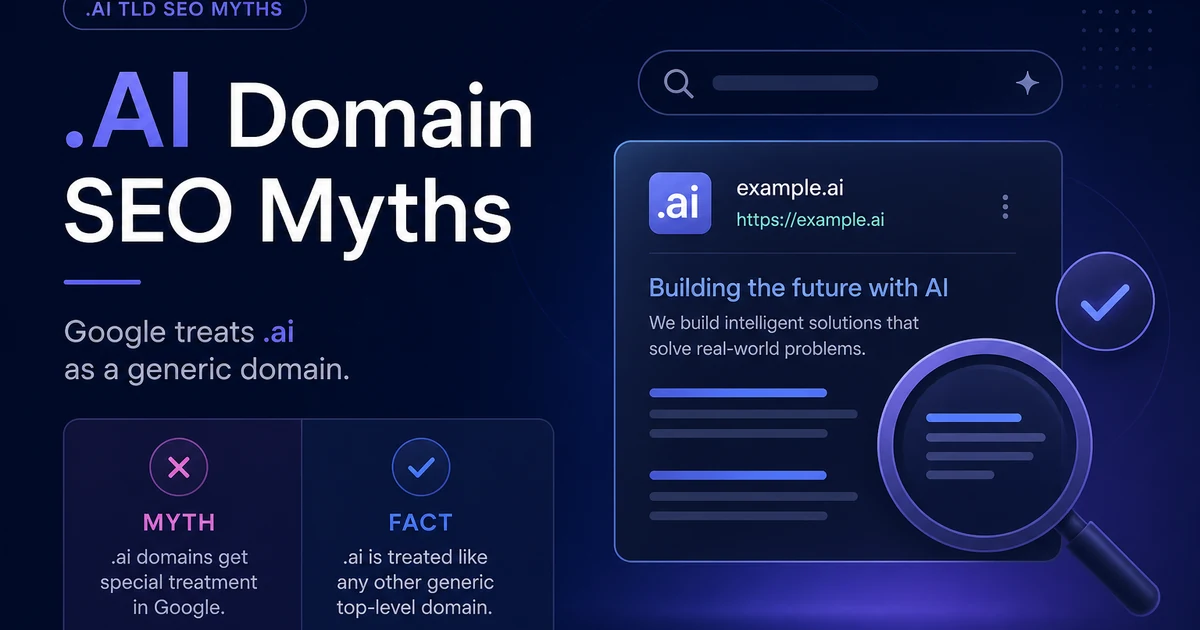
No — and "no" goes both ways. Google's generic treatment of .ai means no geographic penalty and no algorithmic advantage. The extension puts .ai on level ground with .com, .net, and the new gTLDs like .app and .io. Level. Not above. Not below. Your .ai domain ranks based on the same signals that determine ranking for every other domain: content quality and depth, backlink authority, E-E-A-T signals, technical health, and user engagement metrics. The TLD is not a variable in that equation in either direction.
I see the "Google-indexed as generic — SEO-ready!" framing in domain listings regularly and it frustrates me every time. It's technically accurate in the narrow sense that there's no geo-restriction. And it creates a misleading implication that the extension itself confers some SEO property. It doesn't. A weak site on .ai ranks exactly as poorly as a weak site on .com in the same competitive landscape. A strong site on .ai performs comparably to a strong equivalent .com. The extension changes nothing about that comparison.
The practical implication: your TLD choice should be driven by brand clarity, audience trust, and user perception — not by SEO games that don't exist in Google's algorithm. That's not a reason to avoid .ai. It's a reason to choose it (or not) on the right grounds. If your audience is technical, building an AI product, and would find .ai credible as an extension for your domain, that's a legitimate brand argument. It's adjacent to SEO, not the same thing. Indirect effects on engagement and branded search are real — just don't confuse them with an algorithmic ranking advantage.
Will owning .ai hurt your SEO because of the Anguilla connection?
No. And I want to address this specifically because the Anguilla context causes real confusion among founders who haven't looked at how ccTLD classification actually works in practice.
.ai is technically assigned to Anguilla by IANA — that's a geopolitical and administrative fact. Anguilla does benefit from registration revenue, which is why the registry has been receptive to global use. But "assigned to Anguilla" and "restricted to Anguilla for search purposes" are completely different claims, and confusing them costs founders real decisions. Google classifies ccTLDs based on global usage patterns, not official IANA territory assignment. When a ccTLD is primarily used by non-territory registrants and the global use is well-established — as it clearly is for .ai — Google removes the default geographic association.
The same applies to every ccTLD that's become a global brand standard. .io is technically the British Indian Ocean Territory. .co is Colombia. .me is Montenegro. Nobody running a .io SaaS company thinks they're targeting the Indian Ocean for search purposes, and Google doesn't think so either. The pattern is consistent: the registry opens global registrations, global usage establishes the TLD as a generic brand standard, and Google's classifier reflects that reality. .ai followed exactly that path, and the Google Search Central canonical guidance confirms that generic-use ccTLDs don't get default country associations applied.
For founders who want the investment and market angle on .ai versus .io specifically — including the IANA policy discussion that surfaced in 2024 around the British Indian Ocean Territory's future — the .ai vs .io investor choice piece covers both the geopolitical and aftermarket angles together. Worth reading alongside this one if you're deciding between extensions.
What actually affects SEO on a .ai domain?
Same things that affect SEO on every other domain. I'll make this list short because these really aren't .ai-specific — they're domain-specific, and the extension is irrelevant to all of them.
- Prior use history. Was this .ai previously used for spam, thin affiliate content, or a link scheme? Prior manual actions and algorithmic penalties can attach to a domain through ownership changes. WHOIS history and cached page archives tell you a lot quickly. This is the diligence step I see skipped most often on premium AI domain acquisitions.
- Accumulated authority. A newly registered .ai starts with zero authority. A .ai with two-plus years of active use, genuine backlinks, and indexed content carries accumulated equity. If SEO is part of your acquisition thesis, check the backlink profile before making an offer — not after.
- Canonical resolution if you own multiple extensions. If you own both brand.ai and brand.com and redirect one to the other inconsistently, or serve different content on both, you're creating a technical SEO problem that the TLD itself isn't causing. The multi-extension setup requires an explicit canonical strategy. I covered this in detail in the multi-extension redirect guide.
- Content and authority strategy. Your plan for link acquisition, content production, and E-E-A-T signaling matters more than your TLD choice by an order of magnitude. This hasn't changed in Google's quality documentation and I don't expect it to.
So why do some .ai sites rank poorly?
Not the extension. New, thin, or under-resourced sites in competitive niches — the same reasons .com sites rank poorly in identical conditions. I've seen .ai sites on page one for competitive queries. I've seen .com sites buried past page three on adjacent queries where the .ai site ranked. When someone tells me their .ai site doesn't rank and they blame the extension, my first question is about content depth and backlink profile. Those are almost always the answer.
There's one exception worth naming: if your .ai domain was previously used for a geo-targeted Anguilla business, and Google's Search Console has a historical country targeting signal attached, you'd want to clear that explicitly. That scenario is rare — most .ai registrations have no Anguilla connection whatsoever — but if you've purchased an aged domain through the aftermarket, check the Search Console history if the previous owner is willing to transfer it. The buyer FAQ covers the full transfer process including the Search Console handoff that gets overlooked in most acquisitions.
For naming and domain selection, check the AI domain collection for names with strong brand signal and clean history — a name like AIfolio.app is a useful example of how a clean .app stem can sit alongside a .ai without the canonical confusion I described earlier. And if you want to benchmark your options against real aftermarket closes rather than appraisals, NameBio's comparable sales data is the most reliable reference I use — no fabricated numbers, just pattern recognition from documented transactions. Browse the premium domain marketplace with real SEO criteria in mind: domain age, backlink history, category relevance. The TLD alone doesn't move any of those levers.
| Factor | Does it affect .ai domain SEO? | Notes |
|---|---|---|
| Geographic restriction (Anguilla) | No | Google classifies .ai as generic-use — no country targeting applied by default |
| TLD-based ranking boost over .com | No | Generic treatment means level ground, not advantage |
| Prior domain penalty or spam history | Yes | Carries across ownership changes — check WHOIS history and cached pages before buying |
| Accumulated backlink authority | Yes | Same as any domain — aged .ai with real backlinks outranks fresh .ai with none |
| Canonical resolution across extensions | Yes | Uncoordinated multi-extension stacks split authority — not an extension problem, a setup problem |
| Content quality and E-E-A-T signals | Yes | Dominant variable across all TLDs — the extension can't substitute for content depth |
My honest bottom line: the .ai extension in 2026 is a brand signal, not an SEO tool. Pick it because it says something true about what your product is — not because you heard it gets special treatment from Google. It doesn't. And that's fine.