I'll say it plain: multi extension is the thread I keep coming back to. multi extension shows up in every deal conversation I have about this. If you only remember one phrase from this piece, make it multi extension. In 2026 I still watch names like Aura.com move while founders hesitate. A founder I was advising last month owned three versions of her product name: .ai, .app, and .com. She'd registered them at different points in the company's life — .ai when she launched, .app when she added mobile, .com when a competitor nearly registered it first. None of them resolved to the same content. The .ai pointed to the live product. The .app pointed to an old landing page she'd forgotten about. The .com did a half-working redirect to the .ai that broke on HTTPS. Her Google Search Console showed three separate domain properties with different accumulated authority, different indexed pages, and different sets of backlinks. That's not a multi-extension strategy. That's three separate brands competing against each other for the same queries — and losing all three to a focused competitor with one clean domain.
Owning multiple extensions of your brand name is the right move for brand protection. I've believed this for years and I'd make that argument to any founder at any stage. But the value of that ownership is entirely conditional on having an explicit redirect and canonical strategy from day one — not from "someday when we have time." I've watched "someday" become eighteen months of fractured link equity and a full-day technical cleanup that should have been a one-hour setup at launch. I'm genuinely not exaggerating the cleanup time — it took me longer than it should have to untangle the canonical signals on one property, and I do this professionally. The .ai SEO myths piece covers why the TLD itself isn't the SEO variable — the consolidation setup is. This piece is the practical how-to that piece references.
I've tracked this pattern for years. My take is blunt. I'd rather be wrong in public than polish a empty framework. Honestly, the messy version is the useful one. That's the point. Not a theory. I've seen it fail the soft way. Hard truth. Buyers notice. Sellers forget. Period.
Full disclosure: I've done this wrong myself. Not with three extensions simultaneously, but with two — and I left them uncoordinated for long enough that untangling the canonical signals required a month of careful redirects and a fresh sitemap submission. The fix was boring and not complicated. The cost of waiting was real. If you're setting up a domain stack now, or you're the founder sitting on three uncoordinated extensions right now, the next four sections are the sequence I'd walk you through.
For primary sources I keep coming back to NameBio, DNJournal.
Why own .ai, .app, and .com for the same brand?
Three reasons, and I'd rank them in order of importance for how you should prioritize the purchase:
- Brand protection from the start. If you own only .ai and a competitor, a typosquatter, or even a confused customer registers the .com of your brand name, they now have an asset that can capture your traffic, confuse your press, and cost you a UDRP proceeding to recover. UDRP legal fees typically start around $1,500–$3,000 for an uncontested case. The cost of registering the other two extensions — roughly $50–$70/year for .ai, $14/year for .app, $10–$15/year for .com — is a straightforward risk-adjusted calculation. Buy defensive before you have a reason to.
- Different audiences default to different extensions. Technical users and the AI-native audience type .ai. Mobile product users and app-store browsers think .app. Enterprise buyers, investors, and press still default to .com as the expectation for a "real" company. If you own only one, you're creating lookup friction for at least one segment — and lookup friction is a measurable acquisition cost even when it's invisible in your analytics dashboard. I'd estimate I've seen three acquisitions stall because an investor typed the .com of a brand, hit a parked page, and filed the company differently in their mental model before the meeting even started.
- SEO authority consolidation. When redirects are set up correctly, all link equity pointing at your non-canonical extensions accrues in one place. Split your brand across three uncoordinated domains and you fragment authority — Googlebot indexes all three, your backlinks scatter, and you actively compete against yourself for your own brand queries. Consolidate early and you build a single, stronger topical signal faster than any of the three individual properties would have done separately.
Which extension should be your canonical?
My default recommendation: .com if you own it. Universal trust signal, works in every context without explanation — investor pitch, enterprise contract, press mention, email signature. If you've got the .com of your brand name, it's your canonical. No debate needed on the alternatives.
If you don't own the .com and your product is genuinely AI-focused, .ai is an increasingly legitimate canonical. Google's generic treatment means no ranking penalty — I covered this in the SEO myths piece and I'd refer you there for the full documentation. The extension carries credibility with technical audiences in 2026 in a way it didn't in 2019. I'd say that shift happened somewhere around 2023 and it's been consistently accelerating since. Institutional buyers are no longer reflexively skeptical of .ai email addresses and .ai primary domains, and I now see .ai as a reasonable canonical choice for AI infrastructure companies and technical products that have the .ai but don't need the .com to be credible with their primary buyer.
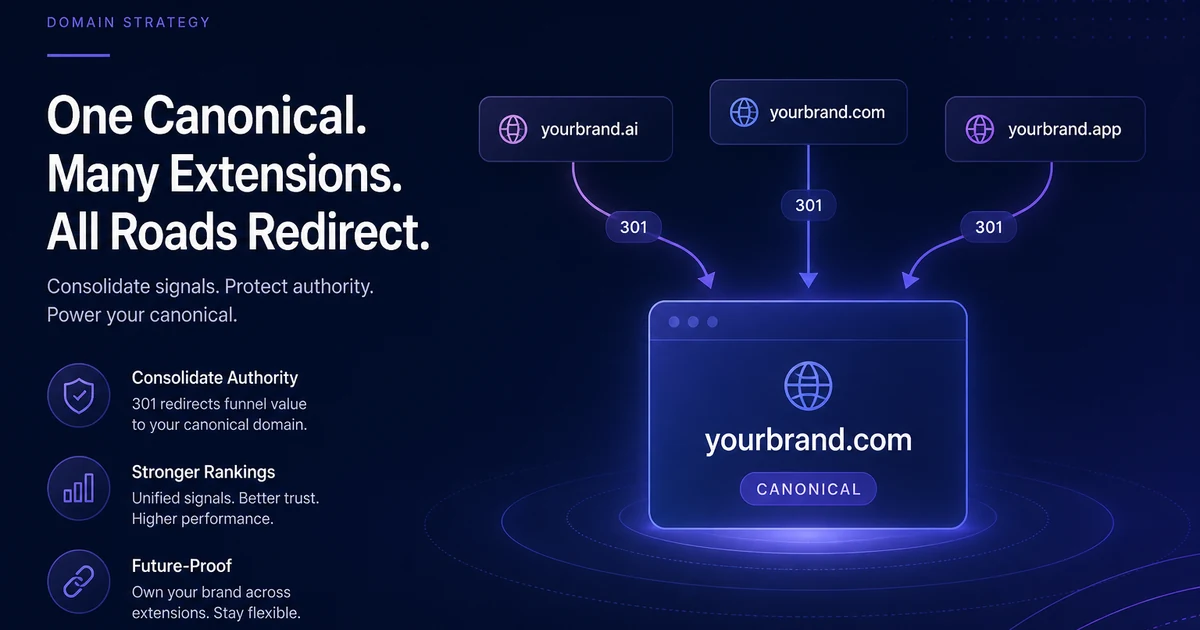
.app works as a canonical for mobile-first products where the extension reinforces the product type — the audience sees ".app" and their mental model matches. I'd use it confidently for consumer and prosumer tools where the primary distribution channel is an app store. Pick exactly one. Make it the canonical. 301-redirect the others to it permanently. Not 302-redirects — temporary redirects don't pass link equity and signal to Googlebot that you haven't decided yet. You've decided. Commit.
How do you set up the redirect stack correctly?
The technical setup is sequential, not parallel. Do these in order:
- Choose your canonical and announce it internally. Before touching DNS, update your deck, LinkedIn company page, App Store listing, API documentation, and any public materials to use one domain. Mixed signals across your own materials create Googlebot confusion that's slow to clean up.
- Point all non-canonical domains at canonical via 301 redirects. Using Cloudflare redirect rules (what I'd recommend for most startups — it's two steps in the dashboard, about ten minutes per domain, and the redirect runs at the edge before your origin server sees the request): create a Redirect Rule matching all traffic on the non-canonical hostname, forward to the canonical root with 301 status. Do this for every non-canonical extension you own.
- Set canonical link tags in your HTML head on all pages. Even after the redirect is live, add
<link rel="canonical" href="https://yourdomain.com/page-path/" />to every page on your canonical. This confirms the preferred URL explicitly and protects you during any transition period when Googlebot may still have cached pages from the old non-canonical versions. - Verify all three domains in Google Search Console. Confirm the canonical property shows correct coverage. Check the URL Inspection tool on a few key pages to confirm Googlebot is reading your canonical signal correctly. If the non-canonical domains still have their own Search Console properties, you don't need to delete them — but they shouldn't be showing active indexing after your redirects are live.
- Submit a clean sitemap on your canonical domain only. Submitting sitemaps from non-canonical domains sends conflicting signals that can slow Googlebot's consolidation of your authority. One sitemap. One domain. Submit it from the canonical Search Console property.
Use domain tools to verify your redirect chains are resolving cleanly and not creating loops. A redirect chain (A→B→C instead of A→C directly) loses equity at each hop and is harder to debug. Clean direct redirects are always better. Check the buyer FAQ for the full transfer and technical setup process if you've just acquired a new extension and need to fold it into an existing stack.
What mistakes fragment brand equity across extensions?
The ones I see most often, roughly in order of how expensive they are to clean up. I've personally made two of these mistakes, so my sympathy on the cleanup is genuine:
- Building active SEO content on two extensions simultaneously. One .ai site with a blog and three months of backlinks, plus a separate .com site with different landing pages. Googlebot indexes both. Link equity splits. You're competing against yourself for your own brand queries — and splitting signal makes you rank worse on both than you would have on either alone.
- Using different extensions at different funnel stages. Marketing runs campaigns to .ai, the product is hosted on .app, the blog lives on .com. Press pickups scatter links across all three at random. Consolidate before your first major press mention. Not after.
- Registering the .com years after building authority on .ai — then either not redirecting (running two live sites) or redirecting .com to .ai without a migration plan (which feels backwards to new users who type .com and get silently redirected). If you add the .com late, decide immediately whether it becomes canonical (requiring a full domain migration with proper 301s from .ai to .com, plus updated Search Console) or stays a redirect pointing to .ai. Both are defensible. The half-measure — redirecting .com to .ai on HTTPS but not HTTP, or only redirecting the root and not subpaths — creates the exact technical mess I described in the opening.
- Email extension not matching canonical. Sending investor emails from a @brand.ai address while your canonical is brand.com, or vice versa, signals ambiguity about which domain is the actual company domain. I know it sounds minor. Investors notice. Enterprise procurement teams notice. Make your email match your canonical from day one.
Should I buy all three extensions on day one?
If you've validated the name and made any public commitment to it — announced it in a blog post, shared it on social, put it on a pitch deck — yes, buy all three immediately. My recommendation is stronger than that: buy them the day you decide internally, before any announcement. The window between "we chose the name" and "someone registers the other extensions" is shorter than founders consistently expect, especially for clean AI-related stems where registrant monitoring tools are common and actively used. I've seen founders lose the .com of their brand name within 72 hours of a public launch announcement. That cleanup cost them $3,800 on a name that would have been $12 to register the day before the announcement. It still happens.
The math is trivially simple: .ai renewal at roughly $50–$70/year, .app at around $14, .com at $10–$15. Under $100/year total. Budget it before traction, not after a competitor forces your hand. And if you're still in name validation mode and only want one for now, register the canonical you'll actually use and set a calendar reminder for the moment you make any external commitment. That reminder has a non-zero chance of being the best five dollars you spend this year.
Browse the premium domain marketplace for names available cleanly across the extensions that matter for your product. A name like AIfolio.app shows how a well-chosen extension anchors the canonical while the stem carries the brand weight as the product scales — the .app extension reinforces the product type and the "AI-folio" structure gives you a natural .ai and .com to register defensively. That's the stack setup in a single purchase decision.
| Scenario | Recommended canonical | How to handle the others |
|---|---|---|
| You own .com + .ai + .app | .com | 301-redirect .ai and .app to .com; set canonical tags; submit one sitemap |
| You own .ai + .app, no .com | .ai (for AI products) or .app (for app-first products) | 301-redirect the non-canonical to canonical; register .com as soon as name is validated |
| You own only .ai | .ai | Register .com and .app immediately; set up 301 redirects from day one |
| You own .com from old project, relaunching as AI product | .com (keep the equity) | Register .ai for brand signal; redirect .ai to .com with 301; don't build content on both |
The boring truth about multi-extension domain stacks is that the correct setup takes one afternoon and the incorrect setup costs you months of authority confusion and at least one afternoon of cleanup anyway. I think about it as the domain equivalent of setting up proper git branching on day one: annoying to do when you're moving fast, deeply painful to untangle retroactively. Do it once, do it right, and then stop thinking about domain infrastructure and go build the actual product.