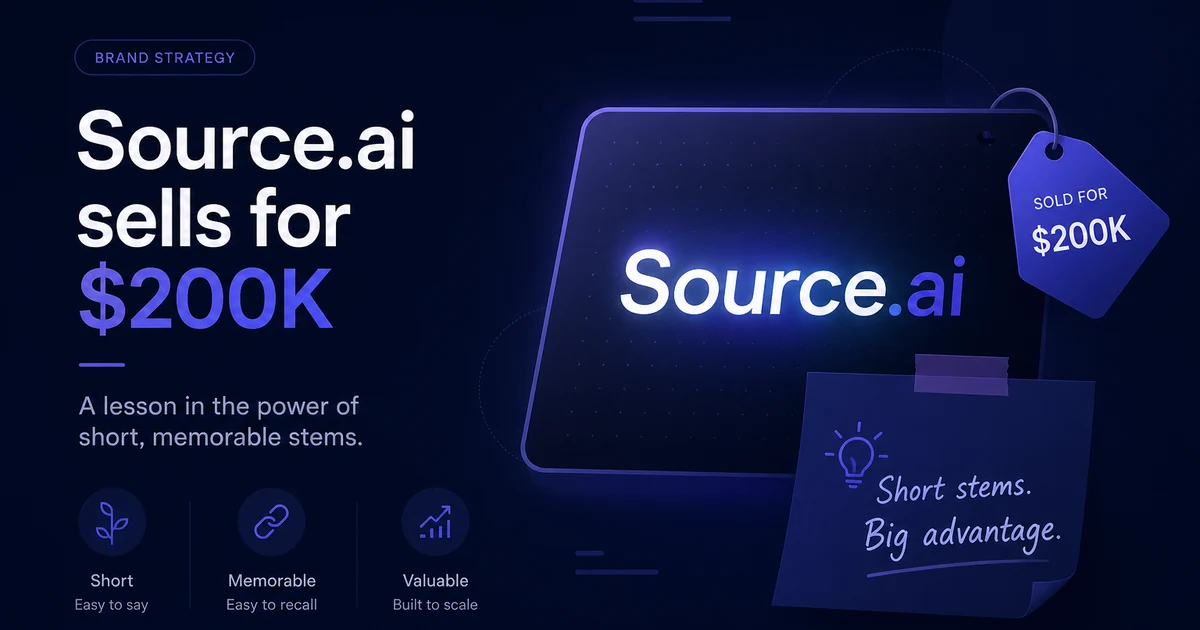
I'll say it plain: stem brand is the thread I keep coming back to. stem brand shows up in every deal conversation I have about this. If you only remember one phrase from this piece, make it stem brand. I almost scrolled past it. The DNJournal weekly chart for July 29, 2026 listed Source.ai at $200,000 — brokered through fruits.co and OpusDNS. I skimmed it, moved on, then came back ten minutes later because something nagged at me. The price seemed high for a single-word .ai with no visible brand history behind it. Then I actually spent time with the word "Source" and realized I'd been looking at it wrong.
My instinct on first read was somewhere in the $40k–$70k range. I've watched .ai sales closely for most of 2026 and the noise level is high — compounds with "AI" bolted on, category-descriptor names, two-word phrases that read like a SaaS feature list. Source.ai is none of that. It's eleven characters total. One word. A real dictionary entry. And whoever bought it paid $200,000 for a reason that has nothing to do with .ai market mania.
I've tracked this pattern for years. My take is blunt. I'd rather be wrong in public than polish a empty framework. Honestly, the messy version is the useful one. That's the point. Not a theory. I've seen it fail the soft way. Hard truth. Buyers notice. Sellers forget. Period.
Full disclosure: I got this wrong on first pass. What changed my read was thinking about what "Source" actually means across a decade of software history — not what it means in AI right now. That distinction is the whole lesson from this sale. And I think it applies directly to every founder still picking an AI brand name in the second half of 2026. The midyear 2026 sales review flagged this pattern across multiple closings — dictionary anchors clearing higher multiples than AI compounds, consistently. Source.ai is the single most visible proof point.
For primary sources I keep coming back to Google's Search docs.
What did buyers actually pay for at $200,000?
Three things, and none of them are "enthusiasm for AI domains as an asset class."
- Semantic width. "Source" means something durable across every tech context that exists. Source code. Open source. Source of truth. Data source. Source material in supply chains. Sourcing in procurement. A buyer building an AI data pipeline, an open-source developer tool, or an AI-assisted procurement platform all have a legitimate claim on this name. None of them need to explain it. I've noticed this semantic reach is what distinguishes an anchor word from a label — "Source" works equally well for a company pivoting from data to agents to infrastructure. The name doesn't require updating when the product does.
- Zero modifier dependency. You don't say "Source AI Platform" or "Source ML Suite." The name stands without scaffolding. I think this is the most underrated quality in domain valuations — people focus on TLD, length, pronunciation, and skip the simpler question: can the name carry the company on its own, or does it always need a category noun to be legible? "Source" passes. "DataSourceAI" fails it from the first use. That difference compounds over years of brand-building.
- Phonetic cleanliness. One syllable. Unambiguous spelling. Works on a podcast, a whiteboard, a cold email, a conference badge. Nobody asks "how do you spell that?" Nobody mangles it in a verbal recommendation. For word-of-mouth acquisition — still the highest-converting channel in B2B software — I'd argue that cleanliness is a real competitive advantage that shows up in attribution data, not just aesthetics.
Compare this to a typical weak AI compound: a category descriptor plus a generic function word. "DataAI.app." "IntelliAI.io." "NexusML.com." These describe features. They don't hold positions. And when the feature gets commoditized — in AI, features commoditize inside eighteen months — the name becomes a liability. Source.ai ages in the opposite direction. The broader the AI category grows, the more valuable a word that anchors why the AI matters becomes.
What makes a word a "stem brand" versus a compound name?
My read on the stem brand concept: it's simpler than most naming discussions make it sound. A stem is a standalone word — verb, noun, or adjective — that implies a benefit or action without requiring a second word to complete the thought. "Source" is a stem. "DataSource" is a compound. "Scout" is a stem. "AIScout" is a compound. The distinction isn't length. It's whether the word can carry the full brand signal on its own, without a modifier propping it up.
Stems have a specific property that compounds don't: they survive category shifts. If you name your company "SourceAI" and AI becomes a commodity descriptor — which it will — you've got "Source" left, which is fine, but you've also got the awkward suffix doing nothing. If your domain is Source.ai, the extension handles the category signal and the stem handles the brand signal. They're doing separate jobs cleanly. That's a structural advantage, not a fashion preference.
What I look for in a stem-quality word: it's in a major English dictionary as a standalone entry; it implies an action, benefit, or position in a tech context without needing a modifier; it's under eight characters; it has no silent letters or multi-consonant clusters that vary by accent; and it carries meaning that isn't tied to a specific feature that could be built into any platform next year. "Source" hits all five. So do "Scout," "Arc," "Flow," "Build," "Shift," and a handful of others. That list is short. Genuinely short. Most of the clean ones are already registered, sold, or held at prices that reflect this scarcity.
The weak AI compound pattern is the opposite: category descriptor plus "AI" or "AI" plus a generic function word. These describe what the product does at a moment in time. That's useful for marketing copy. It's fatal for brand longevity. I've watched founders defend compound names by saying "but it's really descriptive." That's the exact problem. Descriptive is temporary. Position is durable.
Which AI domains follow the Source.ai template?
The pattern I'd screen for: a single English dictionary word — verb, noun, or adjective — that implies an action or benefit in a tech context, paired with .ai. Under nine characters total including the extension. No hyphens. No invented spellings. No "AI" already in the stem, which creates redundancy with the extension. And critically: the word carries meaning across multiple possible use cases, not a single narrow category.
Some examples of the pattern working correctly:
- Verbs on .ai: Build.ai, Scout.ai, Shift.ai, Pull.ai — the verb implies what the AI enables without locking the company to one product definition.
- Nouns on .ai: Source.ai (sold, $200k), Arc.ai, Flow.ai, Loom.ai — strong semantic anchors that define a position rather than describing a feature set.
- Adjectives on .ai: Clear.ai, Sharp.ai — rarer but effective when the adjective carries a genuine benefit signal for a technical audience.
What breaks the pattern: adding "AI" to the stem before the .ai extension (the extension already handles that signal — AiSource.ai is redundant and wastes characters); using a category descriptor instead of a position word (PipelineAI.com is a spec, not a brand); anything that requires a pronunciation guide before first use; names over ten characters where hyphenation becomes likely. The Source.ai template is strict precisely because the naming environment rewards strictness — there's no partial credit in brand building.
For names that meet these criteria at a founder-accessible price, the AI domain collection here is curated on stem quality rather than bulk TLD coverage. Browse with the Source.ai template as your filter: would this name work at the top of a pitch deck without a subtitle attached? If you're not sure, the answer is probably no. A name like AIfolio.app shows the tier just below the pure dictionary stem — a coined hybrid that carries clear audience signal without requiring a modifier, available at a price that reflects its position below the single-word benchmark.
What does this sale mean for founders naming right now?
The $200k price is an instruction, not just a data point. It says: the market is now pricing stem quality as a separate variable from TLD quality. That gap is widening. When a dictionary-anchor .ai name sells for $200k and an AI-compound .com sells for $8k in the same week, the lesson isn't "buy .ai domains." The lesson is "own the best word in your category, whatever the extension."
My honest take: most AI company names I see pitched in 2026 describe what the product does rather than what position it holds. That was a defensible approach in 2021 when the category was still novel. It's a weak approach now. Everyone in the space is using the same vocabulary — "intelligence," "nexus," "neural," "flux," "stream" — and the naming is becoming ambient noise. The founders who bought clean stems two years ago are sitting on ownership that their competitors can't replicate by registering a different compound. I'd make a different decision today than I would have in 2021 on this, and I think most people who paid attention to the Source.ai sale are in the same position.
If you're still naming your AI product, the Source.ai sale tells you something useful: the market already knows the difference between a stem and a compound. Use domain tools and NameBio comparable sales data to understand what stem-quality names in your category have actually cleared — not appraisals, not wishful comps. Real closes. That's how you build a realistic offer range before entering negotiation. And check the premium domain marketplace for names with strong stem quality across TLDs before you commit to a compound that you'll want to replace in three years.
| Name type | Example | Brand durability | Typical aftermarket range |
|---|---|---|---|
| Single-word dictionary stem + .ai | Source.ai | High — position survives pivots and AI-hype cycles | $50k–$250k+ |
| Coined hybrid (clear structure, audience signal) | AIfolio.app | Medium-high — category-clear, not pivot-proof | $5k–$30k |
| Category-descriptor compound + AI suffix | DataPipelineAI.com | Low — feature-spec name, ages with the feature | $500–$5k |
| Invented word, unusual spelling | Klyveai.com | Low — trademark uniqueness at cost of recall | Reg fee–$2k |
One last thing I keep turning over: nobody in 2019 would have guessed "Source" would sell on a .ai extension for $200k. The word has been in dictionaries for centuries. What changed isn't the word — it's the scarcity of clean stems available for a category that suddenly needed millions of new brand names at once. That scarcity doesn't reverse. Good names don't get cheaper as the category matures.