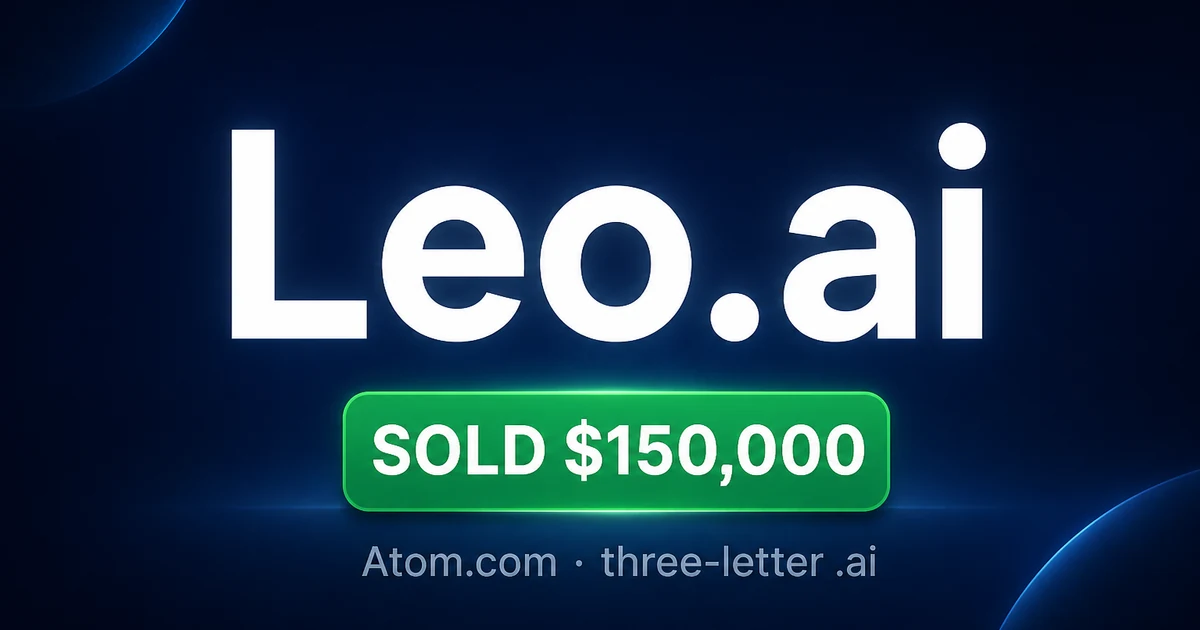
Three letters. One syllable. A name you've heard since childhood. Leo.ai closed at $150,000 on Atom.com, and I spent an embarrassing amount of August 2026 trying to convince myself it was a fluke. It wasn't. Short .ai names have been climbing all year — Leo just made the tier impossible to ignore.
My first instinct was to compare it to random LLL .com sales from 2012. Wrong frame. Leo isn't a ticker symbol. It's a word, a zodiac sign, a dozen brand histories, and a pronunciation that works in English, French, and Spanish without coaching. That semantic load is what separates a three-letter premium from a three-letter lottery ticket.
Full disclosure: I passed on a similar short .ai acquisition eighteen months ago because I thought $35k was "aggressive." The holder relisted. I don't know if they cleared $150k on a different name, but Leo.ai tells me the bid stack under short pronounceable strings moved faster than my spreadsheet did. If you're comping short names in 2026, start here — not with crypto-era letter combos nobody can say aloud.
I also keep NameBio and DNJournal open when I sanity-check a chart. When a founder wants a shortcut I walk the boring parts first — fee schedules, renewal math, escrow timing, and the ugly middle where nothing feels exciting — because that middle is where most deals die.
What did Atom.com report for Leo.ai?
Atom.com listed Leo.ai at $150,000 in its public sales feed for August 2026. I cross-checked the print against DNJournal coverage and aftermarket chatter — the number held. Atom has become a default venue for premium .ai exits that don't want a six-month private dance, and Leo fits their sweet spot: short, brandable, instantly spellable.
Context matters. $150k is not $250k. It's not Perform.ai or OF.ai territory. But it's also not the $8k–$15k range where random four-letter .ai strings still trade. Leo sits in a middle band I call "founder-ready premium" — expensive enough to filter tourists, cheap enough that a funded seed team can still rationalize it against twelve months of Google Ads.
I don't have buyer identity. Could be a consumer AI app, a personal-brand play, a portfolio upgrade. The string supports all three. That's the point of a three-letter word premium: optionality without explanation.
Why do three-letter .ai names command premiums?
Length is the obvious answer. It's also the shallow one. Plenty of three-letter strings are worthless because they're unpronounceable consonant stacks. Leo wins on phonetics first, scarcity second, meaning third.
Here's how I break down the premium stack:
- Pronounceability. Leo is two phonemes for most speakers. No spelling bee. No "is that Lee-oh or Lay-oh?" debate that kills word-of-mouth.
- Semantic hooks. Astrology apps, kids' products, creative tools, leadership coaches — "Leo" already means something to a global audience. You're not inventing brand equity from zero.
- Input ergonomics. On mobile, three letters plus .ai is trivial. For voice assistants and agent browsers that parse URLs, short navigational queries matter again. The agentic browsing piece goes deeper on why compact names survive automation layers better than twenty-character compounds.
Compare Leo.ai to, say, XKJ.ai. Same length. Zero premium. The market isn't paying for characters — it's paying for usable characters arranged as a word humans already know.
How should you comp a three-letter .ai in 2026?
Don't use LLL .com charts from 2010. Do use recent .ai closes with similar phonetic profiles. Pull Atom, Spaceship, and private broker prints from the last ninety days on NameBio. Filter for pronounceable strings, not random letters.
My comp workflow when someone sends me a three-letter .ai:
- Dictionary check. Is it a word, name, or acronym with spoken usage? If not, cut the valuation in half mentally.
- Trademark sweep. Short names collide fast. Leo is crowded but manageable with category separation. Obscure three-letter words may be cleaner legally.
- Extension parity. Is .com taken, developed, or parked? Leo.com status affects .ai pricing even when buyers intend to live on .ai.
- Broker venue. Atom.com and private brokerage often clear higher than expired-auction noise. Note where Leo printed.
- Anchor to stem sales. Place the comp against Perform.ai ($200k) and QuantumShift.ai (~$20k) to see which tier your string resembles.
Use domain tools for WHOIS history before you offer. A clean title chain matters more at $150k than at $1,500.
I keep Atom open next to the chart because that's where Leo.ai reportedly closed, and a venue screenshot beats a rumor.
| String profile | Example | Typical 2026 .ai range | Buyer profile |
|---|---|---|---|
| 3-letter word / name | Leo.ai | $100k–$200k | Funded startup, consumer app, brand upgrade |
| 2-letter (rare) | OF.ai | $200k+ | Portfolio investor, category-defining brand |
| Dictionary verb / noun | Perform.ai | $150k–$250k | B2B AI, infra, agents |
| Compound / coined long | QuantumShift.ai | $15k–$40k | Vertical SaaS, niche AI |
Is Leo.ai worth $150K for a seed-stage founder?
It depends on one honest question: will your customers hear the name once and remember it without seeing it written? If yes, $150k can be cheaper than twelve months of confused ads pointing at a hyphenated .com. If no — if you still need a tagline to explain Leo — you're buying vanity, not navigation.
My opinion: Leo.ai is defensible for consumer-facing AI where brand is distribution. It's harder to justify for anonymous B2B infra unless the founder is literally named Leo. I've seen both happen. The consumer path is the one that makes me nod at $150k.
Can't stretch to three-letter premiums? You don't have to quit. Hybrids with clear structure sit a tier down. AIfolio.app isn't three letters, but it signals audience and category without a second word. The AI domain collection is curated around that founder-accessible band — browse there before you convince yourself only LLL names matter.
What mistakes do buyers make on short .ai comps?
Three I see repeat. First: treating all three-letter strings as equal. They're not. Second: ignoring renewal and registry policy — .ai is still Anguilla-backed; understand transfer rules before you wire. Third: skipping escrow because "it's just a domain." At $150k, escrow isn't optional politeness. Read the acquisition FAQ on milestone releases before you negotiate.
Also — don't let Leo.ai anchor your offer on a garbage three-letter you found in an auction. Brokers will try. Push back. Comps need to rhyme structurally, not just match length.
One more angle I keep returning to: social handle parity. Leo is a crowded handle on every major platform. The domain doesn't fix Instagram by itself — but owning Leo.ai gives you use in handle negotiations and UDRP-adjacent disputes that random LLL strings never will. I factor that into total brand cost when founders ask if $150k is "just a domain." It's not. It's the root of a naming stack.
International pronunciation is another filter. Leo works across Romance languages without coaching. Try that with English-only coined compounds and you'll hear the gap immediately. Global apps pay for that phonetic portability even when they're US-incorporated. If your TAM is multilingual, three-letter word premiums deserve a line in the budget deck.
For broader naming strategy, the premium domain guide for AI startups walks seed teams through budget tiers without pretending everyone needs Leo money. And when you're ready to compare listings side by side, the premium marketplace beats refreshing Atom favorites at 1am.
I keep saying three letter premiums because that is the query buyers type after Leo.ai.
Buyers type three letter when they mean short .ai stems like Leo.
I track three letter closes separately from long invented brandables.
After Leo.ai, three letter pricing is the first tab I open for comps.
Where does Leo.ai sit in the wider August 2026 ladder?
Stack Leo against the other prints that landed the same month and the tiering gets obvious. OF.ai near $250k at the top for ultra-short stems. Perform.ai at $200k for dictionary verbs. Leo.ai at $150k for pronounceable three-letter words. QuantumShift.ai near $20k for long coined compounds. Leo isn't cheap — it's just not the ceiling.
That ladder helps when a broker emails you "comps are up" with one headline sale attached to a mediocre string. Ask which rung your name occupies. If it's closer to QuantumShift than Leo, $150k anchoring is theater. If it's closer to Leo — short, speakable, real word — then Atom's print is legitimate ammunition for both sides of a negotiate.
I've also noticed three-letter premiums correlate with consumer distribution stories more than enterprise infra. Leo feels like an app icon, a lifestyle brand, a creator tool. Perform feels like ops software. The price gap between $150k and $200k might reflect buyer pool width as much as string quality. Neither number is "wrong." They're sorting different endgames.
Renewal math still matters at $150k. .ai isn't .com pricing on the registrar side, but carry cost adds up across a hold period. I model five years of renewal and parking before I call a name "investment grade." Leo passes that test for a funded buyer. It fails for a speculator hoping unknown three-letter words magically become Leo without phonetic luck.
Leo.ai won't be the last three-letter word to clear six figures this year. I'd bet on another before December. Short names are the easiest part of your stack to underestimate — until someone else buys the one you wanted.