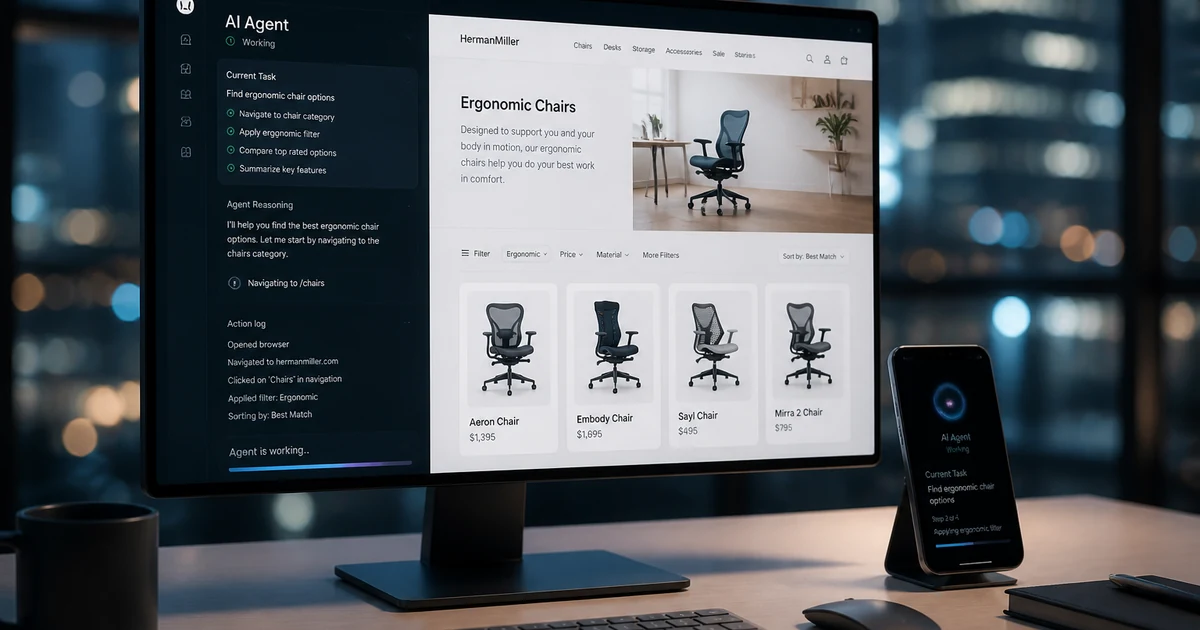
An AI agent booked my dinner reservation last week. I never touched the restaurant's website — the agent did, read the page, filled the form, and confirmed. That tiny moment told me more about domains than any conference talk this year.
We spent two decades optimizing sites for humans and search bots. Now a third reader has arrived: the autonomous agent that browses, clicks, and buys on our behalf. And it has opinions about your domain, like it or not.
What Does Agentic Browsing Actually Change?
Agentic browsing means software that navigates the web with goals, not just keywords. Tools like OpenAI's Operator and Anthropic's computer-use models don't scroll for fun — they parse structure, resolve names, and make decisions in seconds.
Here's the part that matters for anyone holding a portfolio. Agents resolve intent to a destination. When a user says "find me a scheduling tool," the agent has to map that fuzzy request onto a real, trustworthy address. A muddy domain adds friction at exactly the moment friction gets punished.
I've watched agents hesitate on names full of hyphens and numbers. Not because the model is dumb — because ambiguity forces extra verification steps. Every extra step is a chance to bounce to a competitor. Clarity is now a performance feature.
And there's a trust layer underneath. Agents increasingly weigh signals like brand consistency, HTTPS, and whether the domain matches the entity it claims to represent. A clean name on a credible extension reads as lower risk. That's not marketing fluff — it's how these systems triage the open web. You can see the direction of travel in Anthropic's computer use docs, where reliable page parsing is treated as a first-class concern.
There's a second-order effect people miss. When an agent completes a task successfully on your site, that's a signal it remembers. Future runs favor destinations that resolved cleanly last time. A confusing name or a broken parse doesn't just cost one visit — it quietly deprioritizes you for the next thousand.
So I've started thinking about domains the way I think about API endpoints. Stable, predictable, and unambiguous. The names that thrive are the ones an agent can hit a hundred times without ever getting confused about who it's talking to.
Why Do Clear Domains Beat Clever Ones for Agents?
Humans forgive cleverness. We enjoy a pun. Agents don't have that patience, and neither do the users who delegate to them.
Think about how a name travels now. Someone dictates it to a voice assistant. An agent transcribes it. A model has to disambiguate it against a thousand near-identical strings. "Kwik" spelled the cute way loses to "quick" spelled the obvious way every single time in that pipeline.
My rule has tightened over the last year. If I can't say a domain once and have someone type it correctly, it's a liability in an agent-first world. That's why I keep gravitating toward names like AgentPlus.app — one concept, one spelling, zero explanation required. You can see what I mean on the AgentPlus.app listing.
The best domain in an agentic era is one a machine never has to second-guess.
Structure matters beyond the name too. Agents love predictable paths, sane titles, and metadata that says what a page is. If you want a deeper checklist on machine-readable pages, Google's own guidance in Search Central still maps neatly onto what agents reward.
The Extension Question Gets Sharper
People ask me constantly whether extension still matters when an agent is doing the clicking. My honest answer: it matters more, not less.
An agent reading getmytool.xyz versus mytool.app is doing a quiet credibility calculation. The .app extension is HTTPS-enforced by design, which removes an entire class of security ambiguity. For AI products specifically, that baked-in trust is worth real money.
I'm not saying .com is dead — it never is. But for product surfaces that agents interact with directly, a purpose-built extension can outperform a weak .com. Browse our AI domain category and you'll notice the pattern: short, literal, HTTPS-native names dominate the shortlist.
There's a nuance worth stating plainly. An agent doesn't "prefer" .app the way a human might have brand feelings about it. It responds to the properties the extension guarantees — enforced encryption, no insecure fallback, a consistent security profile. Those properties reduce the number of checks the agent has to run before it trusts the destination.
Fewer checks means faster completion, and faster completion means the agent is more likely to finish the job on your site rather than abandon it. In a world where a user delegated the whole task and never sees your homepage, that quiet efficiency is the entire game.
What This Means For Buyers Right Now
Let me get practical, because theory doesn't close deals. Here's how I'd adjust a buying strategy for the agentic era.
- Favor literal over lyrical — a name that describes the thing beats a name that requires a story.
- Kill ambiguity — drop hyphens, numbers, and creative spellings that break voice and transcription.
- Match extension to function — .app and .ai signal product and category; use them where agents transact.
- Test the say-and-type — read the name aloud to someone and watch them type it. If they hesitate, walk away.
- Check machine legibility — before you commit, run a name through the analyzer to gut-check length, clarity, and brandability.
One data point I keep returning to: in my own tracking, single-word and clean compound names close faster and hold value better than gimmicky spellings by a wide margin. That gap has only widened as agents entered the flow.
Are Weird, Made-Up Names Doomed Now?
No — but the bar moved. A coined name like a well-known ride-share brand still works because massive spend taught every human and model what it means. You probably don't have that budget.
Without nine figures of marketing, an invented word starts life as noise to an agent. It has no semantic anchor, so it leans entirely on your ability to build recognition. That's a slow, expensive climb. A semantically clear name skips that climb almost entirely.
So my take is blunt. If you're pre-Series A, buy meaning, not mystery. Save the abstract branding for when you can afford to teach the whole internet — humans and agents alike — what your invented word stands for.
We're early in this shift, and most portfolios haven't repriced for it yet. That's exactly why I'm paying attention now — the names that read cleanly to both people and machines are quietly becoming the scarce ones. Have a look at our current curated inventory and see which ones would survive an agent's first glance, then dig into our other market insights if you want the longer view.
- DN Detector editorial