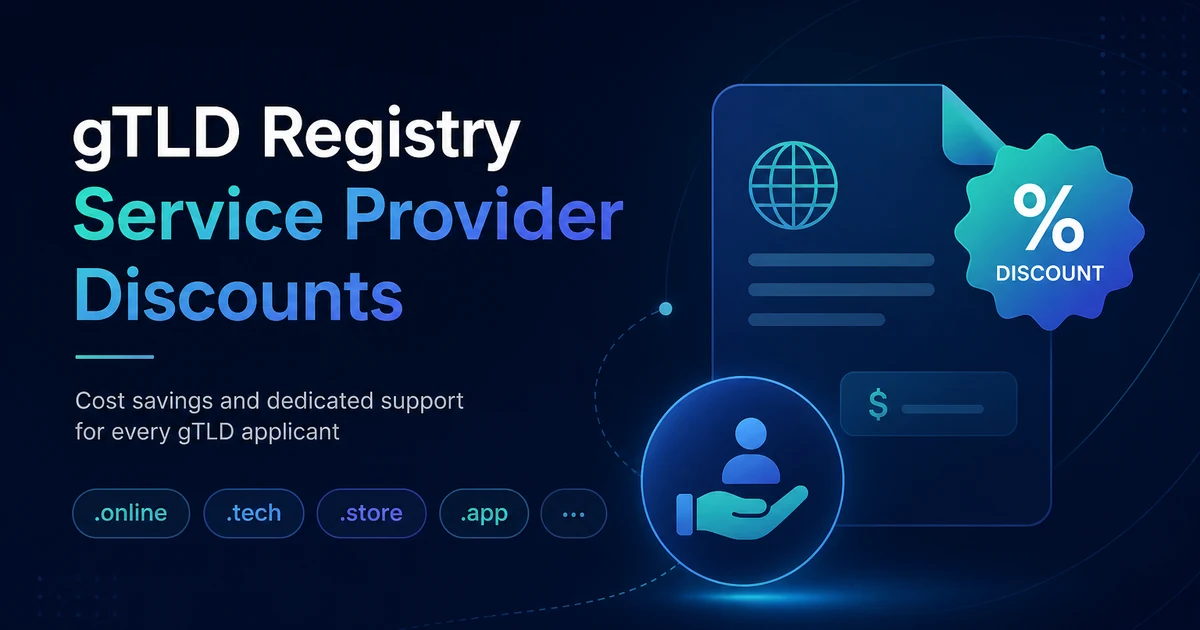
July 2026, buried in a week of application-window coverage: ICANN confirmed that more than ten Registry Service Providers had offered discounted services specifically for gTLD Applicant Support Program recipients. I almost scrolled past it. Took me a few minutes to realize what it meant for the composition of the 2026 applicant pool — and why aftermarket investors who are paying attention should care more than they probably do.
The ICANN Applicant Support Program covers applicants from underserved communities and economies who couldn't otherwise absorb the $185,000 application fee. RSP discounts stack on top. They reduce the ongoing registry infrastructure costs for approved recipients. Together, these programs mean the 2026 gTLD round has a wider and more diverse applicant base than any previous round. Full disclosure: I initially dismissed this as a feel-good policy footnote. It's not. The composition of who applied affects what strings appear on Reveal Day, and that affects how aftermarket positioning plays out through 2027 and beyond.
I've tracked this pattern for years. My take is blunt. I'd rather be wrong in public than polish a empty framework. Honestly, the messy version is the useful one. That's the point. Not a theory. I've seen it fail the soft way. Hard truth. Buyers notice. Sellers forget. Period.
Our Reveal Day investor playbook covers the full timeline mechanics. Also worth reading before diving in: the 2026 new gTLD window investor guide for the broader application context. This piece zooms specifically into what RSP discount program participation signals about the 2026 applicant pool and what that means for secondary market positioning — a question most domain investors haven't asked yet.
For primary sources I keep coming back to Google's Search docs.
Who actually qualifies for gTLD Applicant Support Program assistance?
ICANN's criteria focus on applicants from developing economies, community organizations, and regional entities that meet specific thresholds for financial need and community purpose. Not speculation. Not a backdoor. ICANN runs a verification process, and approved recipients go through structured evaluation before any fee reductions apply. The program was designed to give legitimate operators from underserved markets access to a round they'd otherwise be priced out of entirely.
RSP discounts extend that support into the technical infrastructure layer. Registry Service Providers handle DNS management, ICANN compliance reporting, WHOIS data, and abuse handling — the full operational back-end of running a TLD. Big cost. Ongoing. For new gTLD operators, these aren't startup costs — they're expenses that continue for the life of the registry. Without RSP discount support, Applicant Support fee assistance alone doesn't solve the long-term economics. With it, strings that were previously unviable for community operators become genuine applications.
The practical implication: strings that were too expensive to pursue for legitimate community or regional operators are now viable in the 2026 round. Think geographic identifiers, indigenous language strings, regional industry hubs, community-purpose TLDs. Different category entirely from commercial applications. These aren't necessarily high-value aftermarket plays on their own. But they fill out the applied-for strings list in ways that exceed typical industry forecasts — which means the Reveal Day list will likely surprise most market observers in both volume and geographic distribution. I've watched investors assume the 2026 round would look like a scaled-up version of 2012. The RSP discount data suggests otherwise. We're looking at a round with meaningful geographic and community string representation alongside the commercial applications, and those two categories behave very differently in aftermarket terms.
What do RSP discounts signal about which registries will actually launch?
This is the question most investors aren't asking yet. It's the one with the biggest aftermarket implications, and it requires understanding what RSP backing actually means for a registry's long-term viability.
The 2012 round saw a meaningful number of gTLD operators struggle with sustaining registry operations long-term. Some strings launched, built registrant bases, and then faced operational challenges — technical failures, financial difficulties, or regulatory problems. Real failure. I've seen what that does to .com investor confidence in adjacent categories. Not fun for anyone. Troubled registry situations create bad associations that spill over beyond the specific string, and the 2026 round will repeat that pattern for any operator without credible infrastructure backing.
RSP discounts reduce that failure risk for Applicant Support recipients. A community operator backed by a discount arrangement from a well-resourced RSP has a viable path to sustainable registry operation that many 2012-round equivalents simply didn't have. More strings that launch and stay operational is genuinely good for the namespace and for investor confidence in the round's overall seriousness. The signal for investors: which RSPs offered Applicant Support discounts tells you which operators have credible backing. That's actionable intelligence before Reveal Day, not just background noise.
I'm building a list of RSP-backed Applicant Support applications before November. That evaluation speed matters. When strings are public, I'll be able to assess specific applications faster than most market participants — because I know which RSPs have capacity, long-term commitment, and the operational history to back their discount offers credibly. The first 48 hours after Reveal Day are where first-mover positioning happens or doesn't. The AiFolio.app listing in our portfolio sits in the AI category where RSP-backed community or geographic strings could create indirect category effects. The logic applies across several verticals. Browse the full domain inventory to see which categories we're tracking as Reveal Day positioning plays.
| RSP support level | What it signals | Registry viability risk | Investor action |
|---|---|---|---|
| Full RSP discount for ASP recipient | Credible technical backing, viable long-term infrastructure | Low — competent operator with resources | Map .com adjacencies for this string early |
| No RSP partnership disclosed | Operator managing infrastructure independently | Higher — depends on operator's own technical capacity | Lower priority for defensive .com positioning |
| Well-funded commercial applicant with RSP partnership | Maximum commitment, likely to compete aggressively in contention | Very low — well-resourced on both sides | First priority for Reveal Day adjacency mapping |
| Community string, ASP + RSP discount, narrow registrant base | Viable operation, limited commercial scale | Low operationally, low commercial impact | Monitor geographic .com adjacencies only |
Does the wider applicant pool actually affect premium .com demand?
Indirectly, yes. Not directly. Not through a simple cause-and-effect chain, but through two mechanisms that are real even if they're not always predictable or proportional.
First: a larger, more diverse Reveal Day list means more surprises — strings you expected that didn't appear, and strings you didn't expect that generated multiple applications. Surprises in either direction trigger reactive buying. Brands that see an adjacent string in contention sometimes accelerate .com acquisitions they'd been delaying for budget cycles. That acceleration moves real prices on specific names, and it can be fast. The reaction time on a well-positioned .com when a brand's competitive threat suddenly becomes visible on a gTLD list is measured in days, not weeks.
Second: the overall seriousness signal of a diverse, well-backed applicant pool changes how corporate naming teams treat new gTLD strategy. When CFOs and general counsels see that legitimate community operators and geographic registries participated alongside commercial applicants, the round looks more credible as a long-term namespace shift. That credibility changes defensive buying calculus at large companies who've been watching from the sidelines. It's not a direct trigger. It's part of the context that makes 2026 gTLD activity a more serious consideration for corporate naming budgets than 2012 was. For historical data on how gTLD rounds have previously affected .com market activity, NameBio's historical data filtered by category and year is more reliable than most industry commentary I've read.
I won't overstate the effect. A community-focused geographic gTLD application doesn't directly move the price of a .com in the same category — the connection runs through brand awareness and defensive buying psychology. Real but not always rational. Treat RSP discount expansion as one data point in a larger picture. Scale your positioning to what confirmed strings show in November, not what you're speculating about today.
What should aftermarket investors actually do with this information?
Three things, in order of priority.
Track which RSPs announced discount participation before Reveal Day. ICANN makes this information available through program communications and press releases. Speed is the point. When strings go public in November, you'll map applicants to RSP relationships faster than most competitors — which means faster evaluation of which contention sets are serious and which are undercapitalized community efforts that won't drive material .com pressure.
Review your geographic and community-adjacent .com names. If you're holding premium .com names in categories likely to see community or geographic string applications, your positioning case strengthens slightly. Don't over-rotate. Don't reprice based on speculation before strings are confirmed. That's how you end up holding inventory at an ask nobody pays when the actual strings don't match your thesis. I've made that mistake. Don't make it in 2026 just because the RSP discount data looks interesting.
Build your monitoring workflow now. Our domain tools page has resources for tracking gTLD policy events and setting up monitoring for new string activity. Investors who can act on Reveal Day data within 24 hours capture the first-mover window. Investors who spend the first week reading the announcement text don't. Check our FAQ on gTLD acquisition mechanics — it covers what happens after strings begin entering pre-registration and launch phases, which is a longer and less linear process than most investors expect. DNJournal is where I'd set alerts for application-window coverage and RSP announcements through October.
Key Takeaways
- 10+ RSPs offering Applicant Support discounts signals a wider, more diverse 2026 applicant pool — Reveal Day will likely exceed typical industry forecasts for geographic and community strings.
- RSP participation in the discount program is a proxy for registry operational viability — Applicant Support recipients backed by credible RSPs are more likely to sustain long-term operations than 2012-era equivalents without infrastructure backing.
- Map RSP-to-applicant relationships before Reveal Day to evaluate specific applications faster when the strings list goes public — speed in the first 48 hours matters.
- The wider applicant pool creates indirect, not direct, .com pricing pressure — stay proportional and position only on confirmed strings, not pre-Reveal Day guesswork.
- Build your monitoring workflow now. Preparation before November is the whole competitive advantage. First-mover windows on Reveal Day are measured in hours, not weeks.
RSP discount announcements in July sound like policy footnotes. By November, when Reveal Day arrives and the applied-for strings list is public, every piece of context about who applied and how they're backed becomes actionable intelligence. Start building it now, before everyone else is looking at the same list.