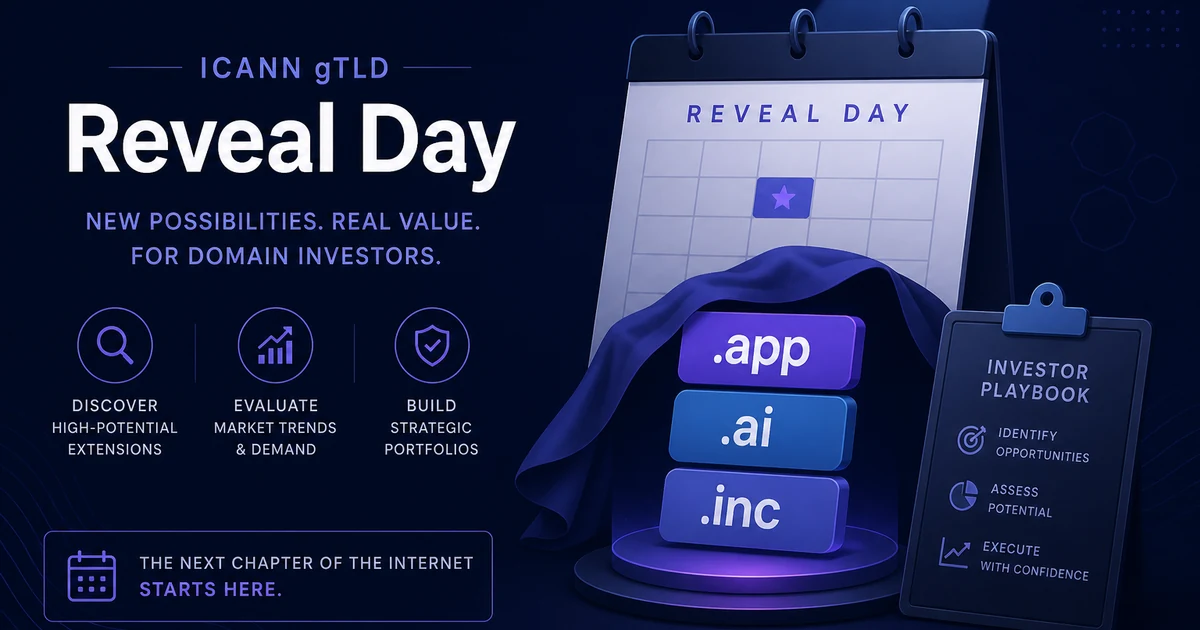
The August 12 deadline passed. If you didn't file an application for the 2026 gTLD round, you're in the majority — and you're not out of the game. ICANN Reveal Day, projected for November 2026, is when the complete applied-for strings list goes public. Every new gTLD someone paid $185,000 to pursue becomes visible to the market simultaneously. That's the real starting gun for aftermarket investors who aren't applicants at all.
I've been watching gTLD rounds since 2012. This one has a different character. More applicants who understand secondary market dynamics, more capital behind the serious applications, and more category diversity than any previous round. That changes how ICANN Reveal Day lands. It's not just a press release moment. It's a trigger for a specific set of portfolio moves that experienced investors start preparing now — not in November, when the window is already closing.
I've tracked this pattern for years. My take is blunt. I'd rather be wrong in public than polish a empty framework. Honestly, the messy version is the useful one. That's the point. Not a theory. I've seen it fail the soft way. Hard truth. Buyers notice. Sellers forget. Period.
Full disclosure: I got the 2012 round wrong. I watched the applied-for strings list go public in June 2012 and assumed the relevant .com adjacency pressure would materialize slowly over years. Some of it did. Some of it moved fast — within weeks of specific contention set announcements — and I wasn't positioned for the fast-moving part. I'm writing the playbook I wish I'd had then. Our coverage of the final application weeks has the timeline context. Also worth reading: the 2026 new gTLD window investor guide for the application economics background. This piece is specifically about what aftermarket investors do from Reveal Day through late 2027.
For primary sources I keep coming back to Google's Search docs.
What actually happens on ICANN Reveal Day?
ICANN publishes the complete list of applied-for gTLD strings in a single release. Every application becomes visible at the same moment — no staggered disclosure. Names applied for by multiple parties create contention sets that head into auctions or private resolution. Single applicants face a defined evaluation and objection window before registry delegation. The whole process then unspools over roughly three to four years, with some strings not reaching live registration until 2029 or 2030.
ICANN Reveal Day itself lasts about 24 hours in terms of market opportunity. After that, the sophisticated actors have mapped the relevant strings, identified contention sets, and started making calls. The window to act on information before it's widely priced into asking prices is genuinely short. I've seen investors get very different outcomes depending on whether they read the list on day one or three weeks later when forum analysis was already saturated. For the official timeline and current status of the new gTLD process, the ICANN new gTLD program page is the primary source — I check it monthly during active application windows and more frequently as Reveal Day approaches.
What are the four moves aftermarket investors make after Reveal Day?
In rough order of priority. These overlap depending on what the strings list actually shows, so think of them as a framework, not a sequence.
Map .com adjacencies immediately. The moment strings are public, pull comps on any .com names in your portfolio that sit adjacent to applied-for strings. Don't wait for forum analysis. The first 48 hours produce the cleanest signal: you can see which strings attracted multiple applicants — contention sets forming — which categories the serious capital is targeting, and which strings will face brand objections. The .com adjacency thesis only works if you're positioned before the defensive buying starts. Not after.
Watch brand defensive purchases in contention categories. When a well-funded brand discovers that a competitor or aggregator applied for a string adjacent to their trademark, the legal response is often an objection filing. The simultaneous brand response is frequently buying the .com equivalent. Fast. Days, not weeks. I've watched this play out after specific contention announcements — the window for premium pricing in these scenarios is measured in weeks, not months. If you're holding a clean .com in a high-contention category, you need to know the strings before the buying starts, not after.
Position for the applicant hedge scenario. Companies that lose contention auctions don't dissolve — they find alternatives. A well-funded team that spent $185,000 on a gTLD application and then lost has budget and motivation to acquire a premium .com in the same category. That buyer is rare but highly motivated. They know exactly what they need, they've already allocated resources for the naming problem, and they want to move without running a transparent bidding process. Watching contention auction results on NameBio and cross-referencing .com closes in adjacent categories in the 60–90 days following major auctions reveals this pattern clearly.
Clean up your monitoring workflow before November. The investors who capture Reveal Day use are the ones with systems already running — alerts for key strings, comps refreshed, WHOIS history verified on the relevant names. Investors who spend the first week of Reveal Day reading the announcement instead of acting on it miss the primary window. Our domain tools page has resources for setting up gTLD policy event monitoring. This kind of preparation is boring. It's also the whole game.
Which .com names benefit most from new gTLD contention?
Not a uniform answer. The ones that move predictably share characteristics.
Generic single-word .coms in categories where multiple applicants compete for the same string. If five companies apply for .finance and two are major financial institutions, every party in that contention set evaluates .com alternatives as contingency planning. Sellers holding clean, short .com names in the finance category get inbound interest that wouldn't exist without the contention announcement. The pressure is real — it comes from funded teams running parallel naming strategies while their gTLD application works through the process.
Short compound names where component words are themselves applied-for strings. Less common than single-word adjacencies, but real. A two-word .com whose components appear as separate gTLD applications sits at a useful intersection for brand teams thinking about long-term naming architecture.
Industry verticals with clear commercial intent and well-funded applicants: fintech, legal tech, health infrastructure, AI tooling. These categories consistently attract applicants with acquisition budgets. Generic brandables in unrelated categories? Almost no pressure. Long-tail keyword .coms that require a logical leap to connect to a contested string? Forget it. The connection has to be immediate for a legal team to approve an emergency .com purchase under time pressure.
The AiFolio.app listing illustrates the principle — a short, focused name in the AI category where contention in adjacent spaces creates meaningful context for buyers thinking about naming coherence. The logic applies across categories. Browse our full domain inventory to see which categories we've been flagging as likely Reveal Day positioning plays since the application window opened.
| Contention scenario | .com demand effect | Timing after Reveal Day | Who benefits |
|---|---|---|---|
| High-applicant-count commercial string (5+ applicants) | Strong — multiple brands hedging simultaneously | Days to 2 weeks | Exact-match and adjacent .com holders |
| Brand trademark directly contested by competitor | Immediate — legal teams move fast | Days after announcement | .com holders with coherent brand adjacency |
| Losing applicant post-auction pivot | Targeted — one motivated, well-funded buyer | 60–90 days post-auction | Sellers who track applicant participants |
| Community or geographic string, low applicant count | Minimal — narrow use case, small buyer pool | Unpredictable | Almost no meaningful .com driver |
How long does the contention process actually take?
Longer than you want. Some strings resolve fast through private applicant agreements — parties negotiate outside the formal auction process when economics make sense. Most contested strings don't. The 2026 round will carry contention processes into 2029 and 2030 for the most-contested strings. Legal objections add time. ICANN's evaluation processes run on their own clock, and they don't care about your portfolio renewal calendar.
This matters for aftermarket investors because the pressure on .com alternatives isn't constant across the entire resolution process. It spikes at predictable moments — ICANN Reveal Day, objection deadline windows, contention auction announcements — and often relaxes between those events. Holding a .com because you expect pressure "from the gTLD round" without knowing the specific schedule means you might carry renewal cost for two years waiting for a window that opens for three months in 2028. Know the calendar.
DNJournal covers relevant ICANN milestone announcements in plain language as they happen — set alerts, don't rely on retrospective forum posts to tell you what moved six weeks ago. Our acquisition FAQ has a plain-language breakdown of contention auction mechanics without the policy-speak, useful if you're new to how these processes work mechanically. And our tools page is where I'd start for building the monitoring setup that makes Reveal Day preparation systematic rather than ad-hoc.
Key Takeaways
- ICANN Reveal Day, approximately November 2026, is when aftermarket investors need to be positioned — map .com adjacencies the moment strings are public, before the market prices in the obvious plays.
- Brand defensive buying and losing-applicant hedging are the two highest-quality use scenarios for .com holders — both are time-limited and require knowing the strings list early.
- Single-word .coms in high-contention commercial categories (fintech, health, AI tooling) benefit most from new gTLD contention; long-tail keyword .coms in the same categories benefit almost nothing.
- The contention process runs years — know the milestone calendar or you'll carry renewal costs through windows that aren't actually open.
- Preparation before November — monitoring workflow, refreshed comps, clear positioning — is what separates investors who capture the windows from those who read about them afterward.
August 19 was the applicant deadline. Everything that happens next is the aftermarket investor's game. ICANN Reveal Day is roughly three months out as I write this. That's enough time to map your holdings, refresh comps on the relevant categories, and build your response plan for the specific windows that open — and close — quickly after November. Don't wait for the press coverage to build your playbook.