I'll say it plain: lease to own is the thread I keep coming back to. lease to own shows up in every deal conversation I have about this. If you only remember one phrase from this piece, make it lease to own. I got a call in June from a founder who'd been "just about to close" a domain lease-to-own deal for four months. The seller had moved the payment terms twice, the escrow arrangement had never been confirmed in writing, and the founder was still pitching on a .io domain that didn't match the deck she'd sent to twenty investors. I asked her one question: "Is any of this signed?" Pause. No. Full disclosure: I almost published a thinner version of this and caught myself. The short draft sounded smart and helped nobody.
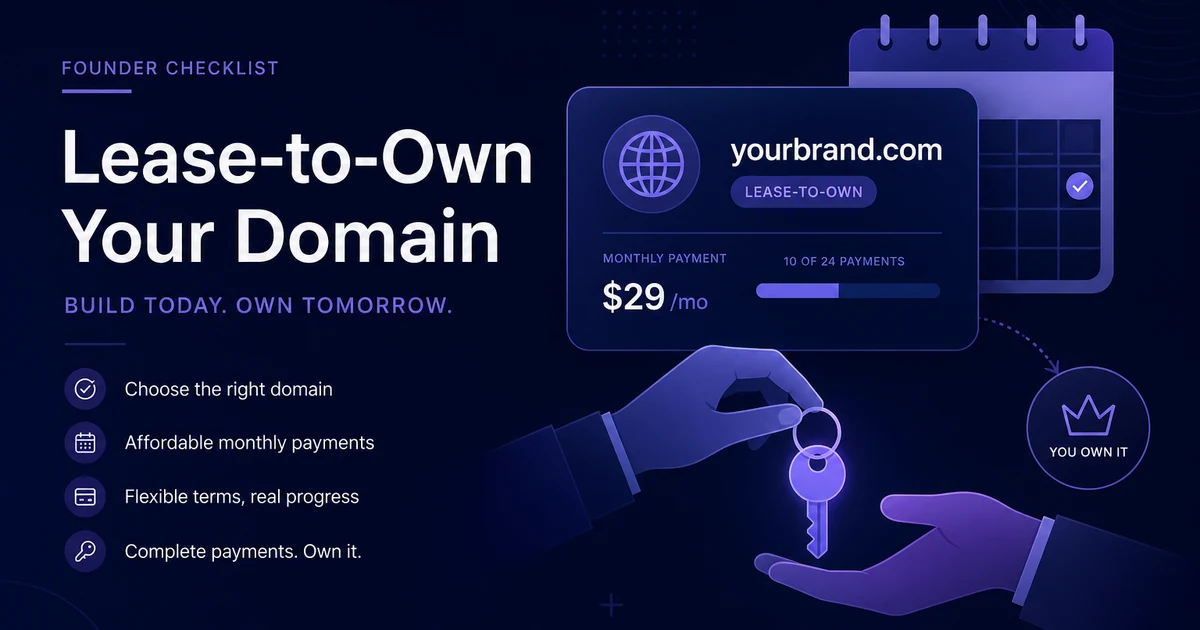
The lease-to-own domain market is bigger in 2026 than it's ever been. Sellers love LTO because it widens the buyer pool — a $40,000 domain becomes accessible to a founder who can commit $800 per month. Buyers love it because they can use the name before they own it. What both sides skip is the contract. This checklist is for founders on the buyer side who don't want to be in month four of an informal arrangement while the seller renegotiates from a position of strength.
I've tracked this pattern for years. My take is blunt. I'd rather be wrong in public than polish a empty framework. Honestly, the messy version is the useful one. That's the point. Not a theory. I've seen it fail the soft way. Hard truth. Buyers notice. Sellers forget. Period.
Before the checklist: if you haven't read the LTO market surge article, the context on why seller interest is exploding in 2026 is useful background. For the installment-deal and BNPL side of the market, the domain BNPL piece covers the overlap and the risks specific to deferred payment structures. This article is narrower: what a domain LTO buyer needs before signing anything.
For primary sources I keep coming back to DNJournal, Google's Search docs.
What should actually be in a lease-to-own domain agreement?
A proper lease-to-own domain deal is a contract, not an email thread. I've seen founders treat the conversation as the agreement and regret it badly. Here's what the document needs to cover — this is not an exhaustive legal checklist, but these are the terms that come back to haunt buyers who skip them.
- Total purchase price and payment schedule — The exact dollar amount you'll pay to own the domain, when each payment is due, and the payment method. Vague language like "approximately $X over the course of the arrangement" is not a contract. Numbers and dates, in the document.
- Escrow arrangement — Who holds the domain during the lease period, and what triggers transfer to your name? Escrow.com's domain name escrow service handles LTO structuring for exactly this — the domain stays in escrow, the seller can't re-list it, and each payment releases incrementally. If the seller resists a third-party escrow arrangement, that's your first serious red flag. Walk away or get a lawyer's opinion before proceeding.
- Default terms — both directions — What happens if you miss a payment? What if the seller dies, sells their holding company, or gets served with a UDRP while you're in mid-lease? Default clauses protect both sides. Read them for what happens to you, not just what you owe. A clause that voids your partial payments on late payment is common and brutal.
- Balloon payment disclosure — Some LTO deals have a balloon — a lump sum due at the end of the payment period to complete the purchase. I've seen founders build monthly cashflow models without realizing a $15,000 balloon was sitting at month 24. Ask explicitly. Get the answer in writing.
- DNS control during the lease period — Can you point the domain to your servers from day one? Or do you get DNS control only on full purchase? The answer varies by deal. Confirm it in writing before you build product infrastructure around the domain's nameservers.
- Registrar lock and transfer restrictions — The domain should be registrar-locked during the lease to prevent unauthorized transfer. Confirm the seller has enabled this and get documentation. This is not paranoia. Unlocked domains get transferred in error more than you'd think.
- Trademark representations — The seller should warrant that the domain is free of known UDRP proceedings or legal encumbrances as of signing. Not a guarantee of future challenges — but a representation of known issues at the time of the deal. Missing this clause is how buyers inherit someone else's dispute.
Is a domain LTO deal actually better than waiting to buy outright?
Sometimes. But "better" depends on what you're comparing it to — and the answer shifts depending on the domain's price, the seller's flexibility, and your cash position going into the next six months.
My honest take: if the domain is priced at $8,000 or less, find a way to buy it outright. The LTO overhead — contract, escrow setup, payment tracking, risk of seller default or UDRP — is meaningful. The mental load of living in an unresolved negotiation while you're trying to build a company is not nothing. Under $10,000, LTO is usually a last resort, not a strategy.
Above $25,000, the math changes. A domain priced at $40,000 that you can pay $800 per month toward — with full DNS control on day one — is a real alternative to running on a placeholder domain while you save up. You get the name now. The risk is what happens in month 14 if your runway changes. Check NameBio's comparable sales data before committing to any LTO price. You want to know if you're paying fair market rate or a lease premium above it. Our domain tools page has comp-check workflows that front this kind of research.
| Factor | LTO makes sense | Buy outright or wait |
|---|---|---|
| Domain price | $25,000 and above | Under $10,000 |
| Cash position | Tight, but monthly payment is manageable for 18+ months | Can absorb a lump sum this quarter |
| DNS control | Available on day one, confirmed in contract | Seller refuses immediate DNS access |
| Escrow | Seller accepts verified third-party escrow | Seller insists on direct payment only |
| Brand urgency | Fundraising or product launch in 90 days | Can run on a placeholder for 12 more months |
What are the biggest mistakes founders make in LTO deals?
Three, in order of how badly they tend to end.
The first: building on the domain before the contract is signed. I talked to one founder who had spent six weeks redirecting traffic, reconfiguring email, and updating his pitch deck to use a domain still under informal negotiation. When the seller came back with revised terms at week seven, the founder had no use — walking away would cost more than accepting the new terms. Don't build anything on a domain you don't own and don't have a signed agreement to own. Not one redirect. Not one email address.
The second: skipping comparable price research. A domain's LTO price is a negotiation, not a fixed market number. If you don't know what the domain would sell for outright — or what comparable names have sold for — you can't negotiate the monthly with any confidence. Pull the comps on NameBio before the first offer. Our buyer FAQ covers the research workflow for pre-purchase domain valuation if you're new to this process.
The third: no fallback plan if the deal collapses mid-lease. Your company email is on the domain. Your product URL is on the domain. Your pitch deck says that domain name. If the seller defaults — or if a UDRP filing encumbers the domain at month 18 — what's your fallback? I always tell founders to register a backup domain in their own name before going deep into any LTO arrangement. Not to use it publicly. Just to own it, so you're not starting from nothing if the deal unwinds.
How do you vet the seller before signing?
Quickly: WHOIS history, registrar account age, and a reference from another buyer if you can get one. Not every seller is a professional domain investor — sometimes it's a startup that pivoted and is monetizing an asset. That's fine. What you want to know is whether there are other claimants to the domain, whether it has a UDRP history, and whether the registrar supports escrow lock during LTO. For a read on current UDRP filing trends affecting the names you might be considering, Domain Name Wire tracks dispute filings in real time and is worth bookmarking before any acquisition.
If you're looking at names in our premium domain marketplace, the LTO question is simpler because sellers are verified and the names are pre-checked. Aifolio.app is one name in the portfolio that would suit an AI platform needing a clean identity on day one — no four-month negotiation, no informal arrangement, no UDRP uncertainty.
My close on this: the domain lease-to-own market is growing because it solves a real problem — great names at prices small teams can absorb over time. The founders who do LTO deals well treat them like real contracts from the first email, not handshakes they'll formalize later. The ones who treat them like informal arrangements usually get a lesson in how use works the hard way, somewhere around month three when the seller recalculates.