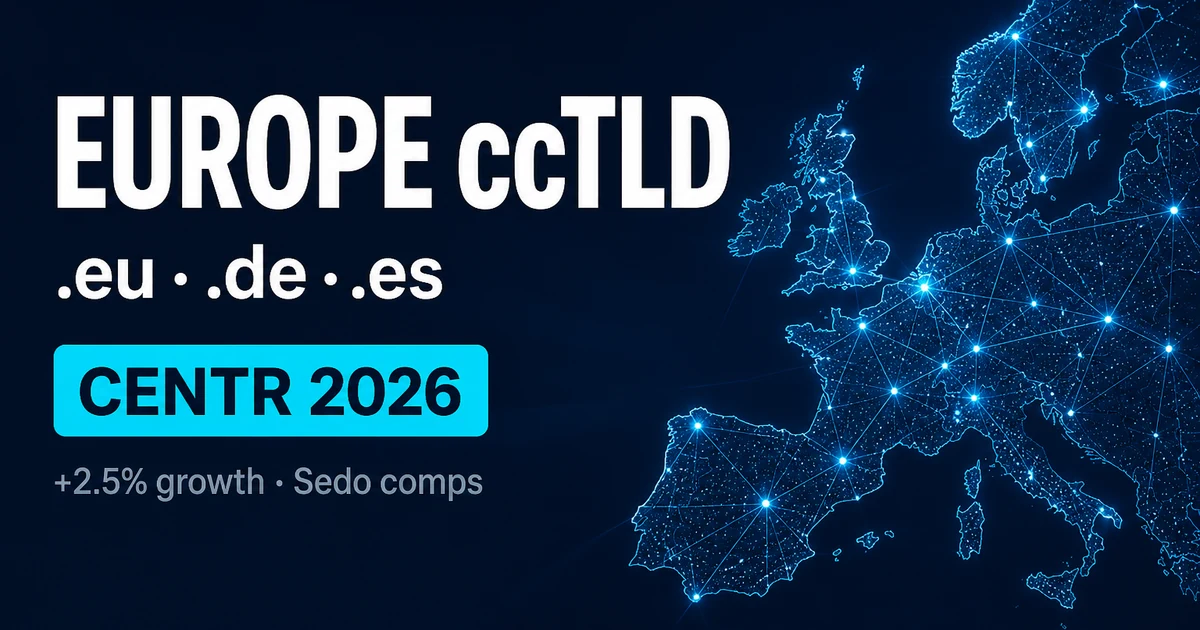
I almost wrote off European country codes in 2023 because my feed was all .ai screenshots from the United States. Full disclosure: that was lazy geography. Europe ccTLD growth came back quietly — CENTR's April 2026 read put European ccTLD median growth near +2.5%, the strongest stretch since early 2022. Boring charts. Real money.
This 2026 domain investing guide explains how to build a Europe ccTLD strategy around CENTR growth, .eu trust, Sedo liquidity, and recent comps from .es, .de, .fr, and Europe-facing .com sales.
Start with the UK premium print in Leta.com at £100K ≈ $135K if you care about Europe-facing .com comps. For Gulf contrast when portfolios go multi-region, read our Gulf domain extensions guide. I keep USA software examples on Aifolio.app when founders ask what a clean product home looks like beside European ccTLDs. Practical hubs: premium domains, domain tools, acquisition FAQ.
Primary sources I trust for this beat: CENTR for European registry statistics, NameBio for aftermarket rows, and DNJournal for weekly sales context. NamePros threads help with mood — not ledger truth.
Quick answer: should investors prioritize Europe ccTLD names in 2026?
Yes if you can specialize by country language and Sedo distribution — Europe ccTLD liquidity is real again at +2.5% median growth, but random foreign keywords without local speakability still die on renewals.
| Asset | Approx print | Market | Venue / notes | Investor read |
|---|---|---|---|---|
| Oro.es | €40,000 ≈ $46.4K | Spain | European aftermarket | Short dictionary .es |
| Rechnungen.de | €44,500 ≈ $52K | Germany | Category German keyword | .de commercial intent |
| MercatoLive.fr | €45,000 ≈ $51.3K | France | Compound .fr | Local commerce story |
| Leta.com | £100,000 ≈ $135K | UK / Europe .com | DNJournal YTD | Premium dictionary .com |
| Syncore.com | €91,500 | Europe .com | Euro-denominated | Brandable .com liquidity |
| .eu zone | ~3.8M regs | Pan-EU | GDPR trust narrative | Continental flag |
My take? Europe is not "one market." Germany's invoice keyword and Spain's gold word are different sports that share a continent.
Method 1: How to build a Europe ccTLD watchlist — step by step
This is the primary method I use when investors ask how to enter European country codes without becoming a renewal museum.
- Pick one language and one country first — German .de or French .fr beats "all of Europe" fantasy. Speakability is local.
- Read CENTR growth notes for that zone — Macro +2.5% median is a green light for the region, not a blank check for junk.
- Filter for dictionary or exact commercial keywords locals actually search — Rechnungen.de energy, not awkward English calques.
- Check Sedo and major EU registrar aftermarkets for live comps — Liquidity lives where European buyers already shop.
- Model EUR pricing and FX explicitly — Oro.es at €40K is not the same spreadsheet cell as a USD GoDaddy print in the United States.
- Verify eligibility and local presence rules per ccTLD — Some Europe extensions are open; others still want EU presence. Read registry docs.
- List where European end users browse — Sedo distribution matters more than a US-only BIN page for many .de/.fr names.
- Cap portfolio share until you close two sales — Europe ccTLD specialization rewards patience; overbuying kills cash.
Honestly, step one saves more money than any "AI pricing tool." I've ignored my own advice and paid for it in renewals.
Method 2: Use .eu when the buyer story is pan-European
.eu near 3.8 million registrations is not hype math — it is a mature continental namespace. GDPR-era trust still shows up in procurement conversations when a brand wants "Europe" without picking Germany over France on day one.
How to decide .eu vs country code
- Ask if the product ships EU-wide on day one — Pan-EU SaaS can justify .eu.
- Ask if local SEO and trust need a country flag — German SMB buyers still love .de.
- Check trademark and eligibility — .eu has its own rules; follow them.
- Price against country-code comps carefully — Do not average .eu with .de keyword sales blindly.
I like .eu as a corporate EU layer beside a national lander — not as a replacement for every local campaign.
Method 3: Harvest European .com comps without confusing them with ccTLDs
Leta.com at £100,000 ≈ $135K and Syncore.com at €91,500 prove Europe still pays for premium .com when the word works. Those are not .de comps. They are Europe-facing .com liquidity — useful for UK and continental buyers who want global email trust.
When I model a Europe book, I keep three ledgers: country-code keywords, .eu continental brands, and Europe-sold .com. Mixing them into one "Europe average" is how people overpay.
Cross-check rows on NameBio and weekly color on DNJournal. For USA contrast the same season, Joiner.com and numeric GoDaddy prints live in a different buyer psychology — still useful for global .com floors, not for Rechnungen.de.
Why did European ccTLD median growth strengthen into April 2026?
Because local trust never left — only investor attention did. After early-2022 softness, registries and SMBs kept registering country codes while social feeds chased gTLD drama. CENTR's +2.5% median is the chart version of that quiet habit.
My take? Growth does not mean every dropped .it is a gem. It means end-user registration demand stabilized enough that quality inventory has a path.
I also watch renewal rates and delete/drop chatter when I can get it. Fresh registrations without renewals are a sugar high. Europe ccTLD strength in 2026 looks more like steady SMB habit than a speculative spike — which is exactly why quality commercial keywords still clear mid five figures in euros.
How do Oro.es, Rechnungen.de, and MercatoLive.fr teach different lessons?
Oro.es is short dictionary Spanish — gold as a word, portable as a brand object. Rechnungen.de is unapologetic German commercial intent. MercatoLive.fr is a compound French commerce story — longer, still local, still paid.
I've used all three when coaching sellers who only wanted "Europe brandables" in English. Local search language beats English inventiveness on country codes. Price discipline follows: do not ask Oro money for a clumsy English calque on .es, or Rechnungen money for a fuzzy synonym nobody searches.
How should sellers use Sedo for Europe ccTLD liquidity?
List clean dictionary and commercial keywords where European brokers and end users already search. Price in EUR when the buyer pool is continental. Answer inquiries in the buyer's language when you can — or use a broker who can. Ghosting German buyers in broken English is a self-own.
I've sold European names faster on Sedo-visible distribution than on a lonely US landing page with no EU payment comfort. Distribution is not superstition. It is where the checkbooks are.
What traps hit USA investors buying Europe ccTLD names?
Assuming English keywords win in France. Ignoring umlauts and accents. Treating .eu as automatically "more premium" than .de. Forgetting local presence rules. Pasting Afternic USA .ai comps onto Spanish .es landers.
Also: underestimating renewal load when you "diversify" across twelve countries overnight. Diversification without language skill is a subscription to pain.
How do Europe strategies connect to Gulf and USA naming?
Multi-region brands often keep .com for global home, add Europe ccTLDs for local trust, and later add Gulf layers for UAE or Saudi entry. Different policies. Different speakability tests. Our Gulf guide covers .ae/.sa/.bh; USA founders still need the .com/.app/.ai choice for Silicon Valley narrative.
Google indexing across country sites needs adult canonicals — follow Google Search Central guidance so .de and .fr pages do not cannibalize each other. Premium domains and domain tools help when you still need a portable global flagship; escrow habits in the acquisition FAQ still apply on Sedo closes.
Which Europe comps should anchor a 2026 model?
Use Oro.es, Rechnungen.de, and MercatoLive.fr for country-code texture; Leta.com and Syncore.com for Europe-facing .com; .eu registration scale for continental trust narrative. Five anchors beat one viral screenshot.
Forum noise on NamePros will argue every number. Keep the ledger boring.
Can GDPR trust still sell a .eu in 2026?
Yes in procurement theater — carefully. European buyers still like a continental flag when data residency and privacy narratives matter. .eu near 3.8 million registrations gives institutional familiarity. It will not fix a weak product, and it will not outrank a sharp .de keyword for German SMB search intent.
I've recommended .eu as a secondary corporate layer beside national landers more often than as a lone hero URL. That boring hybrid keeps Europe ccTLD strategy honest.
What would I buy if I had €25K for Europe ccTLD inventory?
One excellent German or French commercial keyword with Sedo distribution, not five mediocre "Europe brandables." Hold cash for renewals. Learn the language enough to pitch. Track CENTR updates quarterly so macro stories stay honest.
If the keyword is already taken at retail, I wait or buy aftermarket with escrow — I do not "diversify" into twelve weaker countries to feel busy. Busy portfolios are how Europe ccTLD dreams become renewal museums.
My close: europe ccTLD strategy in 2026 is specialization plus Sedo-visible liquidity plus FX discipline. Respect the +2.5% growth signal. Respect local mouths more. And never average Spain, Germany, and a UK .com into one fantasy multiple.