I've been watching premium .com sales through the entire 2026 gTLD application window and the pattern isn't subtle. When strings attract multiple applicants — when gTLD contention sets form — something specific happens to .com pricing in adjacent categories. It doesn't wait for the auction to resolve. It starts moving on Reveal Day, when the market learns which strings are contested, and builds through the objection windows and eventual launch dates that stretch years forward. I've said this to founders for years. My take hasn't changed. I'd rather lose a deal than pretend the soft path works. Honestly, the blunt version saves everyone time.
Most domain investors treat gTLD contention sets as background noise. Two or more applicants apply for the same string, ICANN runs an auction, one party wins. Simplified version. The investor-relevant version is more interesting and less tidy. The effects on premium .com pricing in adjacent categories are real, predictable in their timing even when unpredictable in magnitude, and worth building a positioning thesis around — if you understand the three mechanisms and the windows in which they operate.
I've tracked this pattern for years. My take is blunt. I'd rather be wrong in public than polish a empty framework. Honestly, the messy version is the useful one. That's the point. Not a theory. I've seen it fail the soft way. Hard truth. Buyers notice. Sellers forget. Period.
Full disclosure: I got this wrong in 2012. I watched gTLD contention sets form after the first round's Reveal Day and assumed the .com pressure would build slowly over the multi-year resolution process. Some of it did. The best windows — the fast defensive buying windows — I missed. Closed before I was ready. Our Reveal Day investor playbook covers the broader timeline. This piece is specifically about how gTLD contention sets create .com pricing pressure and how to position for it. For the official ICANN contention resolution process and current 2026 status, the ICANN new gTLD program page is the primary source worth bookmarking now.
For primary sources I keep coming back to Google's Search docs.
How do gTLD contention sets move .com prices?
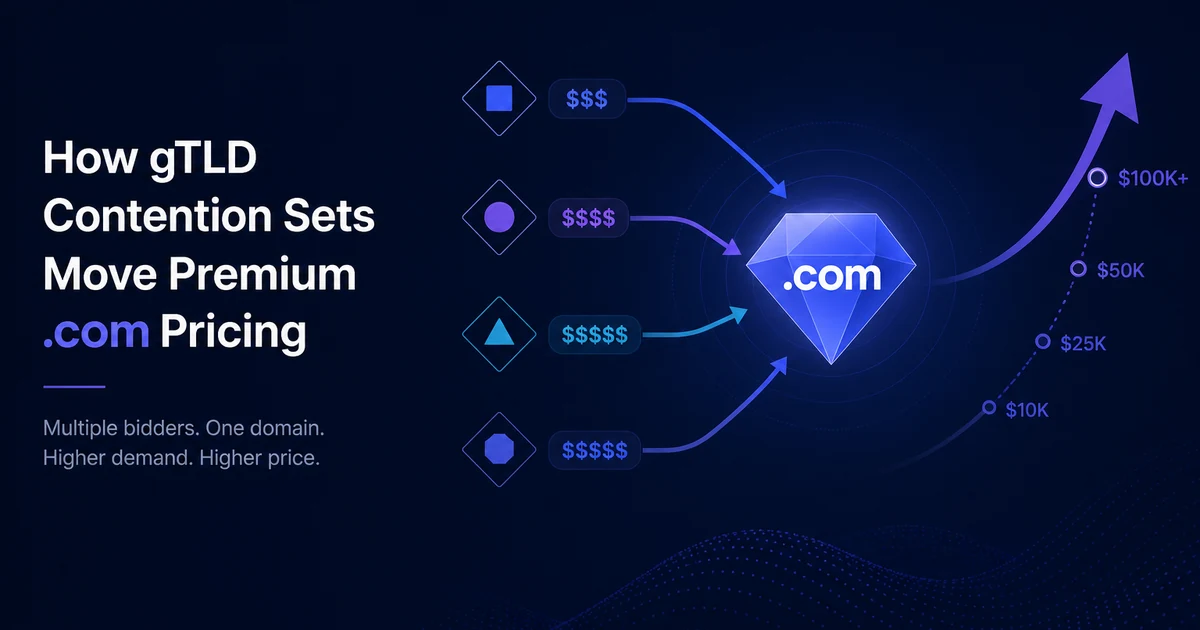
Three mechanisms. They operate on different timelines and have different implications for which names you want to hold.
Defensive brand buying. When a brand discovers that a competitor, aggregator, or unrelated party has applied for a string containing their trademark or industry descriptor, the legal team files an objection. The simultaneous brand response is often buying the .com equivalent — both to establish position and to signal market control. Fast move. This is reactive, frequently urgent, and pushes prices above what the domain would have fetched before the contention announcement. I've watched this play out in real portfolios, and the useful window is days, not weeks. Sellers who know the strings are in contention before Reveal Day are positioned. Sellers who learn about it from forum posts a week later aren't.
Losing applicant hedging. Companies that lose contention auctions don't dissolve — they pivot. A team that spent $185,000 filing a gTLD application and then lost has capital and motivation to acquire a premium .com in the same category. Motivated buyer. Real budget. They know exactly what they need, they've already allocated resources for the naming problem, and they want to move without a transparent bidding process that exposes their strategy. Private outreach by sellers holding the right name at the right moment catches these buyers. Public listings often don't — these buyers aren't browsing Afternic. They're calling brokers or contacting sellers directly. Watching contention auction results and cross-referencing .com closes in the 60–90 days following reveals this pattern consistently.
Speculative positioning by investors. The third mechanism is the messiest. Investors anticipate contention in specific categories and buy .com adjacencies ahead of Reveal Day, expecting to sell to defensive buyers or losing applicants after strings go public. Sometimes it works. Sometimes it doesn't. It also produces a lot of inventory held at inflated reservation prices that never sells because the anticipated pressure never materialized in that specific category. I've seen investors tie up capital for 18 months waiting for a buyer who solved their naming problem another way. Don't over-rotate on speculative .com positioning based on gTLD guesswork. Data after Reveal Day is worth more than predictions before it.
Which contention scenarios produce the most .com pricing pressure?
The cases where premium .com demand moves most predictably share a few specific characteristics.
High applicant count in a string with commercial resonance. If five companies apply for .finance and two are major financial institutions, every party in that contention set evaluates .com alternatives as contingency planning. Real buyers. Real budgets. Sellers holding clean, short .com names in the finance category get inbound interest that wouldn't exist otherwise. The pressure comes from funded teams running parallel naming strategies while their gTLD application works through the process — motivated on a timeline they don't control.
Strings with obvious consumer brand value. .shop, .buy, .hotel, .cars — strings where winning the gTLD means controlling registration of an important commercial keyword for an entire industry. High stakes. Wide buyer pool. The strategic value is immediately legible to everyone involved. Contention at this level generates the most observable secondary market activity. These are the scenarios where a two-week window produces multiple serious conversations, not one tentative inquiry.
Strings where the applicant's business plan requires .com coherence regardless of the auction result. A company applying for .brand who doesn't own brand.com has a naming problem to solve whether they win or lose. Smart .com holders in this category pick up the phone proactively. Reactive selling — waiting for the buyer to find you — still works, but proactive outreach to the right applicant beats it on price and timeline when you know who the applicants are before they've resolved their problem another way.
The AiFolio.app listing illustrates the positioning principle — a short, focused AI-category name where adjacent gTLD contention creates context for buyers thinking about naming coherence across their infrastructure. Browse our full domain inventory to see which categories we're watching closely ahead of Reveal Day.
| Contention type | .com demand effect | Window length | Best .com profile to hold |
|---|---|---|---|
| High-count commercial string, 5+ applicants | Strong — multiple brands hedging simultaneously | 2–4 weeks after Reveal Day | Exact-match or close-adjacent single-word .com |
| Brand trademark directly contested by competitor | Immediate — legal teams move in days | 1–2 weeks after contention announcement | .com with clear brand adjacency to the applicant |
| Losing applicant post-auction pivot | Targeted — one motivated, well-funded buyer | 60–90 days after auction result | .com matching losing applicant's exact category |
| Community or geographic string, low applicant count | Minimal — narrow use case, indirect effects only | Unpredictable, often zero | Not a reliable .com demand driver |
Are premium .com prices actually rising because of 2026 gTLD activity?
Mixed picture, honestly. The categories adjacent to high-contention strings — fintech, legal tech, health infrastructure, AI tooling — are showing price resistance in 2026. Sellers holding firm. Asks that would have been negotiable 18 months ago aren't moving now. Whether that resistance converts to actual closed sales at elevated prices depends on which specific strings go to contested auctions and how much capital is involved.
The 2012 round produced real aftermarket pressure in some categories and almost nothing in others. The 2026 round is larger, has a more sophisticated applicant base, and includes the RSP discount program that widens the applicant pool meaningfully. My expectation: more observable .com pricing pressure in tech, finance, and health than in geographic or community strings. Expectation is not data. Every gTLD round has surprised observers in different categories than predicted.
NameBio filtered by category and date range is the right tool for tracking this empirically — after Reveal Day, not before. Category guessing without confirmed strings is speculation. Acting on confirmed data after November is positioning. DNJournal covers major .com sales with enough deal context to distinguish contention-driven closes from standard market activity — use both sources together and compare the timing of .com closes in specific categories to contention auction announcements. The correlation is visible when you're looking for it with the right data.
What should investors actually hold ahead of Reveal Day?
Short, clean, unencumbered .com names in categories with obvious commercial gTLD interest: fintech, infrastructure, health, legal tech, AI tooling. Not every name benefits. Most won't. The category is where likely pressure concentrates and where qualified buyers have budget to move quickly after Reveal Day. The filtering condition is real commercial utility, not just category membership.
What to deprioritize or shed: long-tail .coms that require a buyer to make a logical leap to connect them to a contested gTLD. Names with trademark risk you haven't verified. Names in categories where ICANN historically has seen few applicants and minimal brand interest — parts of the 2026 strings list will be predictably quiet, and the .coms adjacent to quiet strings benefit from nothing.
One thing I keep coming back to: the investors who do best in the post-Reveal Day windows aren't necessarily the ones who predicted the right strings. They're the ones who had their monitoring workflow ready, their comps refreshed, and their name descriptions clear enough to send to a buyer's general counsel in one email on short notice. The preparation happens now. Our domain tools page has the monitoring setup worth building out before November. Our FAQ covers contention auction mechanics in plain language for anyone who needs to understand the process before explaining it to a potential buyer. And the premium domain negotiation playbook covers the seller-side tactics that apply when you have legitimate use from external contention pressure and need to manage a motivated, time-pressed buyer conversation correctly.
Key Takeaways
- gTLD contention sets trigger three distinct .com pricing mechanisms — defensive brand buying (days), losing applicant hedging (60–90 days post-auction), and speculative positioning — each with different windows and risk profiles.
- The highest-quality .com pricing pressure comes from high-applicant-count commercial strings and situations where the applicant needs .com coherence regardless of their auction result.
- Premium .com demand in fintech, health, and AI tooling categories is showing price resistance in 2026 — whether it converts to elevated closed sales depends on which specific strings reach contention.
- Use NameBio after Reveal Day, not before. Acting on confirmed strings is positioning; acting on category guesses before November is speculation that ties up capital you might need later.
- Preparation before November — monitoring workflow, refreshed comps, clear buyer-facing descriptions — is what separates investors who capture the windows from those who read about them afterward.
Contention sets are where the gTLD story gets genuinely interesting for .com investors. The auction winner gets the string. The losers get a budget and a problem to solve. That's the opportunity. Whether it materializes depends on which strings the November list reveals — and on whether you've done the preparation work to act on day one rather than day fifteen.