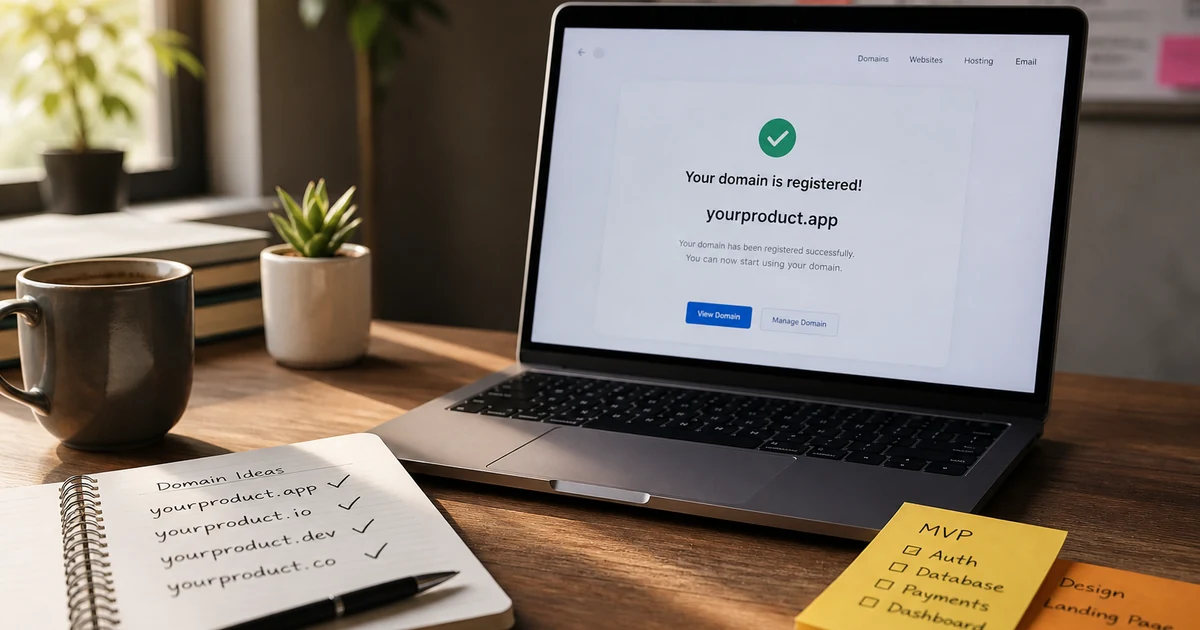
The question I hear most from technical founders: "Do I grab the .app now, or wait until I know this thing works?"
It's a fair worry. Buying too early feels like paying for a name you might abandon. Buying too late feels like handing your dream domain to whoever moves faster. Both regrets are real, and I've watched founders live through each.
My short answer: buy the .app earlier than your instincts tell you to — but buy the right tier of name for the stage you're in. Let me explain the difference, because that nuance is where most people go wrong.
Why buy a .app before the MVP even exists?
Because a good name is a depreciating opportunity, not an appreciating cost. The name you want today is available today. It may not be next quarter.
There's also a practical reason unique to .app: it's on the HSTS preload list, meaning every .app site is required to serve over HTTPS. As Google Registry explains, that security-by-default is baked into the extension. For a product touching user data, that's a genuine feature, not a formality.
And there's a founder-psychology angle I won't pretend isn't real. When you own the name, the thing feels real. You put it on your GitHub, your landing page, your investor updates. That momentum is worth more than the registration fee.
And there's a coordination benefit early teams overlook. The instant you have a real domain, everyone is pointing at the same thing — the same email domain, the same repo name, the same workspace URL. Ambiguity about what you're even called is a surprisingly common source of early drag. Owning the name kills that ambiguity on day one for a rounding-error cost.
Domains are cheap to hold and expensive to chase. Owning early is almost always the cheaper mistake.
So when should you actually wait?
Waiting makes sense in one specific situation: when the name you want costs real money and your idea is still a moving target.
If you're pre-product and genuinely unsure whether you're building a scheduling tool or a CRM, don't drop $8,000 on a premium brandable tied to one of those directions. Your positioning could flip after ten customer calls, and then that expensive name is dead weight.
In that fog-of-early-stage phase, do this instead:
- Register a cheap, disposable working name to ship your MVP fast.
- Keep a shortlist of the premium names you'd want once positioning is locked.
- Set a trigger — first paying customers, or a specific revenue mark — that tells you it's time to upgrade.
The mistake isn't waiting. The mistake is waiting on a cheap, available name that someone else can grab for the price of a coffee. Those, you buy immediately.
And be honest about what "still deciding" really means. Half the founders who say they're waiting for clarity are actually just avoiding the decision. If you've shipped, talked to users, and the name still fits — that's not fog, that's confirmation. Stop stalling and lock it before someone reads your public roadmap and beats you to it.
What's the difference between a placeholder and your real domain?
This is the distinction that saves founders money and heartburn. Not all domains carry the same risk of loss.
A placeholder is a name you're fine losing — a temporary label while you validate. Spend almost nothing. Ship. Learn.
Your real domain is the one you'll put on business cards, in the app store, and in a Series A deck. That one, you want locked before it becomes a bidding war. A clean, descriptive brandable like AutoFlows.app is exactly the kind of name that reads like a finished product — the sort worth securing before a competitor with the same idea does. Browse our SaaS domains to see how these premium-but-reasonable names look side by side.
The founders who get burned are the ones who treat their real domain like a placeholder — dragging their feet until traction arrives, only to find the name gone or repriced 5x.
I've seen the repriced version happen more than once. A founder validates on a scrappy name, gets a bit of press, and the premium domain they'd eyed suddenly has a broker attached and a number to match — because the owner watched them succeed. Traction is public. If the world can see you're winning, so can the person sitting on the name you want.
Does buying early actually help with fundraising and traction?
It helps more than it should, which is exactly why it's worth doing. Investors and early users read polish as a proxy for competence.
When a founder shows up with a coherent name on a proper domain, a clean landing page, and matching handles, they look further along than someone on a free subdomain. That perceived momentum is often the difference in a crowded seed market. Plenty of stories in the Y Combinator library come back to the same theme — small signals of seriousness compound early.
For traction specifically, a memorable, spellable .app reduces friction the instant you start doing word-of-mouth, demos, or podcasts. Every time someone repeats your name to a friend, a clean domain is the difference between them finding you and finding a 404.
Here's a cost I see founders discover too late: launching, getting a wave of attention, and then migrating to the "real" domain right as momentum peaks. Now you're juggling redirects, broken backlinks, and confused users during the exact window you most wanted to look buttoned-up. Buying the real name before that wave hits means you ride it on one clean domain instead of patching plumbing mid-surge.
What this means for your timeline
Here's the framework, boiled down. If the name you want is cheap and available, buy it today — full stop; the downside is a few dollars, the upside is peace of mind. If it's a premium name and your positioning is still fuzzy, ship on a placeholder and set a clear trigger to upgrade. And the second your idea firms up, secure the real domain before traction makes it a target.
Run any premium candidate through our domain valuation tool first so you know whether the asking price is fair or founder-tax. And check our other market insights for how naming trends are shifting this year.
My prediction for the rest of 2026: as AI lowers the cost of building, more founders will chase the same obvious names at the same time. The gap between "available today" and "gone next month" is going to keep shrinking. Buying the right name a little early will look smarter every quarter.
If you're at the "should I buy it yet" crossroads, spend ten minutes in our premium listings and see whether your dream name — or a better one — is still sitting there. That single check answers the timing question faster than any framework.
— DN Detector editorial