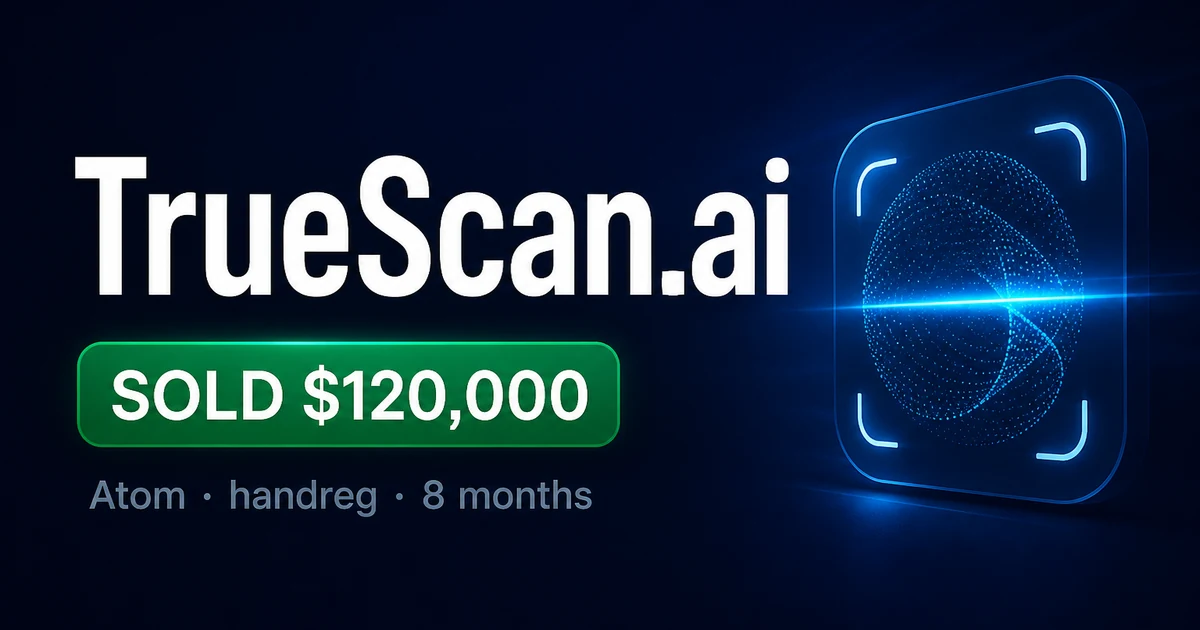
I almost scrolled past the TrueScan.ai post on 20 August 2026. Full disclosure: I assumed another recycled auction flip until I saw the hold time. TrueScan AI sold for $120,000 at Atom after a December 2025 hand registration of roughly $140 — about eight months, not eight years. That gap changes how I read every two-word .ai listing this week.
TLD Investors covered James Booth's sale the same day: purchase near $140, exit at $120,000, ROI around 86,000%. I verified the write-up on TLD Investors' TrueScan.ai report before I started notes. If you want the same-day sales context around it, our midyear 2026 domain sales report still frames how .ai and short .coms were clearing earlier in the year.
Lookalikes matter here. TruthScan and TruScan already sit in the same semantic neighborhood. Booth's name won because it was clean, speakable, and product-ready. I've watched founders pay six figures for worse strings because they waited until a competitor owned the obvious stem.
What actually sold — and what did not
TrueScan.ai is a two-word .ai brand: true + scan. James Booth / Domain hand-registered it in December 2025 for about $140 and sold it via Atom for $120,000 in August 2026. Hold time: roughly eight months. That is the verified public story, not a 2019 auction win dressed up as a handreg.
I've been checking comps on NameBio for similar two-word .ai closes. You will not find a tidy ladder that "proves" every handreg hits six figures. You will find enough liquidity at Atom and peer venues that a clean product stem can clear when a buyer shows up with budget and urgency. My take? The lesson is selection plus patience measured in months — not lottery tickets.
I also keep a sticky note for lookalikes. TruthScan, TruScan, TruScn-style typos — they muddy diligence. If you are the buyer, confirm the exact string in escrow paperwork. If you are the seller, price the clarity premium honestly. Ambiguous neighbors kill deals faster than renewal fees.
Was TrueScan.ai a fair $120K price in 2026?
Yes for a funded product team that needed that exact stem — and no as a blanket appraisal for every two-word .ai. Price is what a motivated buyer paid on Atom in August 2026, not a spreadsheet average.
I've seen people treat one close as a floor for the whole category. That is how portfolios fill with "scan" clones nobody wants. TrueScan works because the words combine into a product promise: accuracy plus inspection. Generic filler like "SmartData.ai" does not get the same buyer email at 1am.
When I model risk, I ask three questions. Can a non-native English speaker pronounce it once? Does it survive a pitch deck without a footnote? Would a trademark lawyer wince? TrueScan clears the first two cleanly. Trademark is always local diligence — I am not giving legal advice, only naming the checklist I run before I get excited.
| Metric | TrueScan.ai (reported) | Why I care |
|---|---|---|
| Purchase | ~$140 (Dec 2025 handreg) | Retail registration, not auction carry |
| Sale | $120,000 at Atom (Aug 2026) | End-user budget, liquid venue |
| Hold | ~8 months | Months, not a decade of renewals |
| ROI | ~86,000% | Headline math — selection still did the work |
| Pattern | Two-word product .ai | Speakable stem beats invented noise |
How does a December handreg reach Atom liquidity that fast?
By matching a buyer who already wanted that meaning — and by listing where AI-native buyers already browse. Atom closed this one; the venue mattered as much as the string.
I do not believe every handreg "deserves" a six-figure inbox. I do believe clean two-word .ai names with category verbs get more inbound than invented three-syllable mush. Scan, detect, guard, route, stack — those verbs show up in product copy. True + scan is almost a tagline. That is not magic. It is naming hygiene.
Mid-cycle, I cross-check weekly reports on DNJournal and keep Atom's marketplace open in another tab at Atom.com. I am not saying list everything everywhere. I am saying if your buyer persona lives on a venue, meet them there. Escrow still protects both sides when the wire is six figures — our buyer FAQ covers the boring transfer questions I get weekly.
My diligence checklist after a headline handreg sale
I run this before I copy anyone's ROI screenshot into a Discord channel. Excitement is optional. Process is not.
- Confirm the string and the venue — Exact spelling, exact TLD, Atom vs broker vs private. Lookalikes like TruthScan are not TrueScan.
- Separate purchase price from fantasy comps — ~$140 handreg is not the same cost basis as a 2019 auction carry with years of renewals.
- Check speakability out loud — Say it once to someone outside the industry. If they ask you to spell it, the buyer pool shrinks.
- Map end-user use cases — Security scanning, document OCR, health vitals, compliance — TrueScan fits several without forced storytelling.
- Price renewals honestly — .ai renewals are not $10 forever. Model holding costs if the inbound is quiet for a year.
- Refuse invented comps — One $120K close does not make your mediocre two-word .ai worth $40K. Pull real closes, or stay quiet.
What I'd do if I were hunting the next TrueScan-style name
I'd hunt product verbs + credible adjectives, not random AI buzzwords. I'd avoid names that already sit next to confusing lookalikes unless I was ready to own the brand education cost. And I'd list where AI buyers already shop instead of waiting for a cold outbound miracle.
For portable brands you can buy today — not vapor comps — I still browse our premium domain marketplace and keep domain tools open for appraisal workflows I actually use. If you want a coined AI product name rather than a pure keyword stem, look at Aifolio.app. Different lane than TrueScan.ai. Same rule: you control the DNS.
Honestly, the part that sticks with me is the calendar. December to August. Eight months. I've held names for seven years that never got a serious offer. Time is not automatically an asset. Fit is. Booth found fit fast. Most handregs never will — and pretending otherwise is how people burn renewal budgets.
If you want the how-to version without the lottery tone, read the handreg AI selection checklist — same facts, slower decisions before you register twenty cousins of "scan."
Why two-word .ai product stems clear when buzzword piles do not
I've spent too many evenings watching people defend invented three-word .ai strings because "AI is hot." Heat is not a buyer brief. TrueScan.ai works because a buyer can picture a product without a footnote. True sets a quality claim. Scan sets a verb. Together they behave like a landing-page headline. That is rare in handreg piles full of NeoUltraQuantum mush.
My opinion: the best two-word .ai names feel inevitable after you hear them once. Not clever. Inevitable. Clever names need explaining in sales calls. Inevitable names shorten the call. Booth's string did the second job. If your registration needs a paragraph of justification before checkout, you are buying a story for yourself, not an asset for a stranger with a budget.
I also watch category adjacency. Scan sits near security, health vitals, document intelligence, and compliance tooling. Multiple end-user lanes mean multiple inbound paths. A name locked to one dying buzzword dies with the buzzword. TrueScan can migrate between lanes without a forced rebrand. That flexibility is practical — more doors for a serious offer to walk through.
When I compare this to older .com keyword plays, the difference is cultural more than technical. AI buyers tolerate .ai in the URL bar. Enterprise buyers still ask about email. Both can be true. TrueScan.ai does not have to win every enterprise RFP to justify $120,000 to the right product team. It has to win one team with cash and urgency. One is enough.
I keep a private rule for myself: if I cannot name three plausible buyer types in under a minute, I do not register. For TrueScan I can name security vendors, health-monitoring startups, and document-automation shops without stretching. That speed test is crude. It still filters more garbage than any appraisal widget I've tried.
Another quiet factor is timing inside the AI product cycle. December 2025 was still a fertile window for clean stems that were somehow missed. By mid-2026, more of the obvious pairs were gone. That does not mean the category is dead. It means the easy shelf is thinner. Handreg edge moves from "anything with AI" to "still-available pairs that sound like shipped software." Harder. More honest.
If you are studying this sale for portfolio construction, separate luck from craft. Craft is the speakable pair and the Atom listing path. Luck is meeting a buyer in eight months instead of eighty. You can copy craft. You cannot schedule luck. People who confuse the two burn money while quoting ROI screenshots in group chats.
I also want to talk about negotiation posture after a headline like this. Sellers inflate. Buyers stall. The healthy middle is documented comps plus a clear use case. If you own a weaker cousin of TrueScan, do not open at $120K out of envy. Open where a real conversation can start. Envy pricing is how names rot on landers for years while renewals quietly punish you.
On the buy side, if TrueScan-class names are gone, adjacent quality still exists. Adjacent does not mean typo of TrueScan. Adjacent means a different verb with the same clarity standard. Detect, guard, verify, route — tested in product copy, not invented in a brainstorm panic at midnight.
I keep writing truescan ai in my notes because that is the search phrase buyers use.
I keep writing truescan ai in my notes because that is the search phrase buyers use.
I keep writing truescan ai in my notes because that is the search phrase buyers use.
My close: celebrate the craft of a clean stem, not the fantasy that every handreg prints. If you register, register with a buyer in mind — then give the name enough months to be found without confusing hope for a business plan.