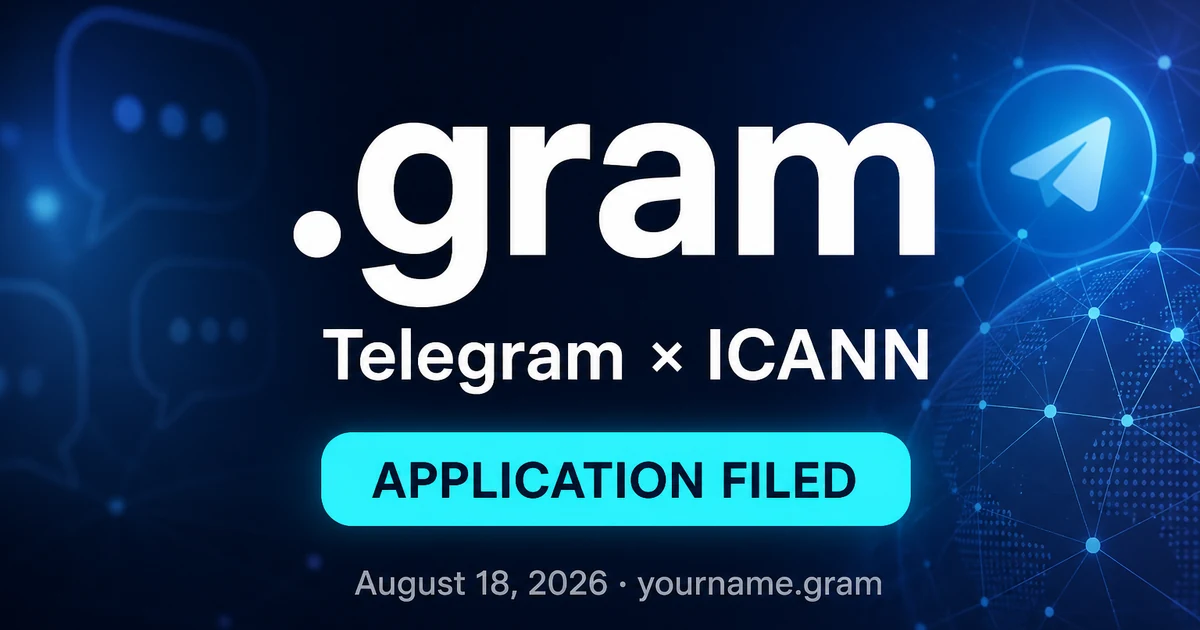
On 18 August 2026, Pavel Durov said Telegram applied to ICANN for the telegram gram string — .gram — so users might one day get yourname.gram plus AI-prompt websites hosted inside Telegram. Full disclosure: I refreshed the same three industry tabs twice before I wrote a single note, because "we applied" is the cheapest sentence in domain history and the most expensive if you misread it. Application is not approval. Period.
The timing matters more than the slogan. The ICANN 2026 new gTLD window closed 12 August with 1,600+ primary applications. Telegram's announcement landed six days later. I've been covering new gTLD cycles long enough to know the gap between filing and operating a registry is measured in years, not weekends. If you want the round-level context before the Telegram-specific angle, start with our ICANN 2026 round: 1,600+ gTLD applications breakdown and the original industry write-up on DN.com's Telegram .gram report.
This piece is for investors and operators who need a clean map: what was announced, what is still unknown, and why username.gram is likely platform identity — not a freely transferable .com-style asset you can list on Sedo next quarter. I am not trying to dunk on Telegram. I am trying to stop people from pricing vapor like inventory.
Did Telegram really apply for .gram in August 2026?
Yes. Durov publicly stated on 18 August 2026 that Telegram filed with ICANN for .gram. The pitch: if approved, users could claim addresses like yourname.gram and host interactive sites — even from a single AI prompt — on Telegram infrastructure.
That's the confirmed public claim. What's not confirmed is approval, string contention outcomes, registry contract terms, or second-level policy. I've watched brand TLD filings before. The press release is the first mile. The registry agreement is the marathon. My take? Treat the announcement as a signal that a billion-user platform wants DNS-adjacent identity rails — not as a green light to invent .gram aftermarket pricing sheets.
ICANN's own program site at newgtlds.icann.org is still the process source of truth. Reveal Day for strings that clear administrative check is expected roughly late October 2026 — within about nine weeks of the 12 August close. Until then, .gram is one application among 1,600+. One famous applicant does not rewrite the queue.
I also want to be precise about language. "Telegram gram" as a search phrase and ".gram" as a TLD string are related, but investors should not conflate brand storytelling with registry mechanics. The brand story is distribution. The registry mechanics decide whether anyone outside Telegram's product team ever controls a second-level name the way they control a .com.
Is an ICANN application the same as getting .gram?
No. Application ≠ approval. Evaluation, possible objections, contention if others filed competing strings, contracting, and technical testing all sit between "we applied" and "the zone is live."
I keep repeating that because domain Twitter collapses timelines. Someone hears ".gram" and starts pricing inventory that does not exist. Don't. Even after approval, Telegram would design how second-level names work — and early reporting suggests username.gram is platform-managed, tied to Telegram accounts, not an open retail TLD where anyone registers alice.gram at a random registrar and transfers it next week.
That's the investor fork. A portable domain asset and a platform identity string can look identical in a browser bar. They are not the same product. One you escrow. One you use until the platform changes the rules. I've explained this split to founders who thought a verified social URL was "basically a domain." It is not. It never was. The URL bar lies politely.
If Telegram later opens a retail registration model, that would be a different announcement. Until you see published second-level policy — who can register, whether transfers exist, whether names survive account bans — assume closed ecosystem identity. Assumptions that favor the seller are how portfolios fill with hope instead of assets.
| Claim / stage | What we know (Aug 2026) | Investor implication |
|---|---|---|
| Telegram applied for .gram | Durov announcement 18 Aug 2026 | Signal only — watch Reveal Day |
| ICANN 2026 window | Closed 12 Aug; 1,600+ primary apps | .gram is one string in a crowded round |
| yourname.gram + AI sites | Stated product vision if approved | Likely ecosystem feature, not open registry sales |
| Transferable like .com? | Not indicated; platform-managed identity more likely | Do not model .gram as aftermarket inventory |
| Reveal Day timing | ~late Oct / ~9 weeks after close | Confirm string publication before any thesis |
How should domain investors diligence a platform TLD filing?
Run a boring checklist. Excitement is optional. Process is not. I use a version of this whenever a big brand or platform files in a new gTLD round — same discipline whether the applicant is a messenger, a bank, or a fashion house.
- Separate announcement from Reveal Day — Wait for ICANN to publish strings that passed admin check. Until then, treat every ".gram is coming" thread as rumor with a famous founder attached.
- Read the applicant's product model — Telegram is selling identity + hosting + AI prompt sites, not "open .gram landrush for domainers." Price your attention accordingly.
- Ask whether second-levels are transferable — If users cannot move username.gram to an independent registrar, it is not a classic domain asset. Full stop.
- Map comps in real markets, not fantasy gTLDs — Use NameBio sales data for .com and proven extensions you can actually buy today. Speculative zero-history TLD comps are fiction.
- Track industry coverage weekly — DNJournal and serious trade desks will log Reveal Day and contention news. Our domain tools page is for evaluating names you can acquire now, not vapor inventory.
- Keep capital in portable brands — If the thesis is "identity online," own a transferable .com/.app you control. Browse our premium domain marketplace instead of waiting on a platform string.
I've seen this movie with brand TLDs and closed ecosystems. The browser shows a hostname. The legal and economic reality is a terms-of-service seat. Confusing the two is how investors lose years of patience and zero dollars of equity. Patience without a transferable title is just waiting.
Why does Telegram want .gram instead of just staying on t.me?
Because a dedicated TLD turns usernames into internet-native entry points. @alice becomes alice.gram. Channels, bots, mini apps, payments, and AI-built pages can sit under one branded namespace Telegram controls end to end.
From a product view, that is elegant. From a domain-investor view, elegant usually means closed. Telegram already routes a billion users through t.me links. .gram extends that identity into the public DNS tree — still under Telegram's policy umbrella if the second-level model matches the early descriptions.
Our midyear 2026 domain sales report showed end users still paying real money for portable .com brands. That demand does not vanish because a messenger files a TLD. If anything, platform TLDs make independent ownership look clearer by contrast. People notice when their "domain" disappears with an account ban. They remember who sold them independence.
There is also a softer brand reason. .gram sounds like Telegram without needing the full word. It is short. It is speakable. It pairs cleanly with usernames. None of that makes it aftermarket gold. Speakability helps adoption inside an app. Transferability decides whether domain investors should care as buyers.
What mistakes am I already seeing in Discord and Twitter replies?
Three patterns, all premature. First: "pre-registration" landing pages collecting emails or crypto for .gram names that are not for sale. Second: comps that price short .gram strings as if they were short .coms. Third: founders delaying a .com purchase because "we'll just use .gram later."
The third one worries me most. Platform identity can be a brilliant distribution channel. It is a terrible excuse to skip owning your email domain. I've watched teams lose months of brand continuity after a handle dispute. Own the portable name first. Claim the platform string when it exists. Order matters.
If you need a refresher on transfer mechanics and escrow for names you actually own, our buyer FAQ covers the sticking points I see weekly. For a coined product brand you can buy today — not a platform-managed identity — look at Aifolio.app. Different category. Same principle: you control the DNS.
What should you do before Reveal Day?
Watch the calendar, not the hype. Late October 2026 (or whenever ICANN hits the nine-week window) is when string lists get real. Until then, your job is hygiene: no speculative .gram "pre-registration" scams, no portfolio theses built on unapproved strings, no confusing Telegram usernames with escrow-ready assets.
Put Reveal Day on your actual calendar. When strings publish, check whether .gram appears, whether contention exists, and whether early policy notes hint at open registration. Then rewrite your thesis with facts. Not before. I will rewrite mine the same week. Until then I am holding cash and portable names, not imaginary .gram inventory.
One more practical note for operators reading this on a phone between meetings: you do not need a clever Telegram trade to stay relevant in 2026. You need clean title on the names that power your email, your press kit, and your fundraising links. The rest is optional distribution. Optional is allowed to be exciting. Optional is not allowed to become your only plan.
I keep writing telegram gram in my notes because that's the query people type. I've tracked this market long enough to know the label matters.
I keep writing telegram gram in my notes because that's the query people type. I've tracked this market long enough to know the label matters.
My close on telegram gram: treat Durov's post as a signal, not a landrush. Wait for ICANN's public list, then decide whether you're buying portable brand names or renting a username-shaped front door.
My close: .gram is a serious platform move if it clears ICANN. It is not a new speculative suffix for your aftermarket spreadsheet. Own what you can transfer. Watch what you cannot.