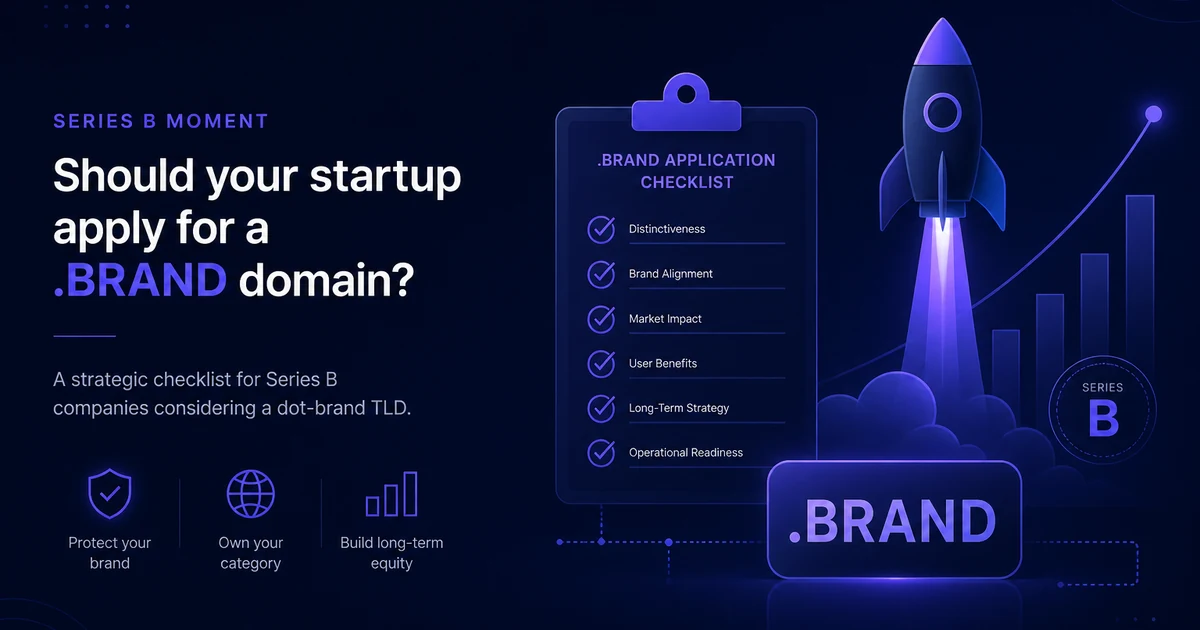
I'll say it plain: dot brand is the thread I keep coming back to. dot brand shows up in every deal conversation I have about this. If you only remember one phrase from this piece, make it dot brand. The August 12 notice landed in my inbox like every ICANN document does — formatted like a tax filing, dense with acronyms, and carrying a $227,000 ask buried in paragraph six. I've been watching dot-brand applications since the first new gTLD round opened in 2012, and the founding teams I respect most had a simple internal rule: if you can't name five concrete things you'll run under .yourcompany that you can't run under .com, don't apply. Most couldn't name them. They applied anyway.
This isn't a case against dot-brand gTLDs. It's a board-level checklist for Series B founders who have three weeks left to decide. The dot-brand application window closes August 12, 2026. The evaluation fee — $227,000, largely non-refundable once ICANN begins processing — is due August 19. If you're past those dates, file this for the next round. If you're reading this in time, let's work through the actual decision.
I've tracked this pattern for years. My take is blunt. I'd rather be wrong in public than polish a empty framework. Honestly, the messy version is the useful one. That's the point. Not a theory. I've seen it fail the soft way. Hard truth. Buyers notice. Sellers forget. Period.
For the investor-side picture — who's circling this round and why domain funds are paying attention — the ICANN August 12 deadline investor guide covers that angle. This piece is narrower: founder decision-making under time pressure, without the brochure tone. I'm going to tell you why I'd probably tell most Series B companies to wait, and then tell you what makes the exceptions obvious.
For primary sources I keep coming back to NameBio, Google's Search docs.
What exactly is a dot-brand gTLD?
A dot-brand is a custom top-level domain where your company owns and operates the entire namespace. Not a registration. An entire TLD. Think .google, .apple, .amazon — every third-level domain under .yourcompany is yours to issue, structure, and revoke. You become the registry for your own brand.
ICANN opened the first new gTLD round in 2012. The 2026 round is the second formal window. The ICANN new gTLD program overview has the official structure — though it assumes fluency in registry operations most startup teams don't have. The short version: you apply, ICANN evaluates, objections get filed, years pass, and — if you clear everything — your TLD gets delegated to the root zone and you can start issuing names under it. Years. Not months.
What most founders miss in that timeline: the 2012 round had strings processing for 3–4 years before delegation. The 2026 round isn't moving faster. If your internal deck says "launch under .yourbrand in Q1 2027," somebody owes the room a corrections slide.
Is a dot-brand gTLD worth it at Series B?
For most Series B companies, no. But the ones that should apply know it before they read a checklist. The decision hinges on use-case clarity, not fee tolerance.
Here's the fee analysis anyway, because your CFO will ask. The $227,000 evaluation fee is not the total cost. Back-end registry operations — which you almost certainly can't run yourself — run $25,000–$60,000 per year through operators like Verisign, Identity Digital, or CentralNic. Add ICANN annual fees, legal defense if objections are filed, and internal IT lift for migration, and the realistic five-year total lands between $500,000 and $900,000. I've seen one company spend $340,000 in the 2012 round, receive delegation, and never launch a single consumer-facing URL under their .brand TLD. The security team used it for internal credentialing. That's a real use case. It's just not a $340,000 one.
| Factor | Apply now | Wait or skip |
|---|---|---|
| Brand permanence | Name is trademarked, not changing in 5 years | Rebrand likely within 3 years |
| Specific use case | Credentialing, enterprise subdomains, internal DNS | Marketing signal only — .com works fine |
| Infrastructure ownership | In-house DNS team or back-end operator contracted | No dedicated infra lead, no operator shortlisted |
| Five-year budget | $700k+ board-approved for the full commitment | Planning around the evaluation fee only |
| Timeline tolerance | 18–36 months to delegation is acceptable | Need domain results this quarter or next |
| Category position | You own the category and intend to defend it long-term | Category still actively contested by multiple players |
What does the application process actually look like?
I want to walk through this concretely, because the ICANN docs read like regulatory filings — accurate and nearly useless without context. Here's the human version of what you're committing to when you apply.
- Trademark verification first — Your company name must be a registered trademark in at least one major jurisdiction. Generic words, geographic names, and single letters face contention or outright rejection. Get a trademark clearance opinion from IP counsel before you spend a dollar on the application prep.
- Select a registry back-end operator — You need a technical operator to run the registry infrastructure. Verisign, Identity Digital, CentralNic, and Neustar all offer back-end services. Get quotes from at least two. Back-end pricing varies significantly and you're locked in for years once contracted.
- Prepare the application bundle — ICANN's application requires technical, financial, and operational documentation across 50+ question sections. This is where the timeline slips. Founders consistently underestimate the document load. Budget 6–12 weeks of preparation with an experienced ICANN consultant — not a domain broker, an ICANN specialist.
- Submit and pay the evaluation fee — $227,000, due August 19. The fee is largely non-refundable once ICANN begins initial evaluation. Partial refunds exist only in narrow early-withdrawal scenarios. Read the refund schedule in the applicant guidebook before wiring.
- Navigate initial evaluation and objections — After submission, ICANN runs initial evaluation over roughly six months. Other applicants or brand owners can file formal objections. Objection defense adds $50,000–$150,000 in legal costs if you're in a contested string category. Budget for it before, not after.
- Delegation and launch — After clearing evaluation and objections, ICANN adds your TLD to the root zone. Delegation typically happens 18–36 months after the application window closes — not 18–36 months from the day you apply.
Full disclosure: I haven't personally submitted a dot-brand application. I've been in the room for two, watched one succeed and one stall at the objection phase. The one that stalled had skipped back-end operator selection — they assumed they'd sort it post-submission. They didn't. DNJournal's applicant coverage is tracking the 2026 round's progress and contention strings worth benchmarking. For an independent view on filing patterns, Domain Name Wire has been running real-time objection updates.
Should your board approve this?
Reframe the question first. The board question isn't "can we afford $227,000?" It's "what are we committing to operationally for the next five years?" That's a different conversation — and a harder one to have honestly.
What I'd put in front of a board: the dot-brand gTLD is a long-term identity infrastructure decision, not a marketing initiative. It belongs in the same category as selecting a primary cloud provider — the switching cost is real, the commitment is multi-year, and "we want to have it" is not a business case. The business case is specific: we will issue product.yourcompany for enterprise clients, we will use internal.yourcompany for authentication, we will run dev.yourcompany for the engineering team. Fill that list with five concrete items. If the list stalls at two vague ones, you have your answer.
The optics of a failed application matter too. I've watched one company apply in 2012, receive delegation in 2015, run three internal URLs under the TLD, and let it lapse quietly in 2019. That story surfaced in their Series D diligence — not as a deal-killer, but as a flag on operational follow-through. Apply when you're ready to commit operationally, not just financially.
Are there faster ways to signal the same brand maturity?
Yes. Most cost under $25,000 and work this year. A clean premium .com under your exact brand name runs $5,000–$20,000 on the aftermarket, sets up in a week, and sends the same permanence signal to investors and enterprise clients as a three-year ICANN application process. It doesn't give you .yourcompany as an owned namespace. It gives you the domain 90% of your stakeholders will actually type and trust.
My honest take on who benefits from this round: the companies I've watched prepare well were tracking the gTLD program since 2023, had their back-end operator shortlisted before the window opened, and are using a checklist like this to confirm, not to discover. If you learned about the August 12 deadline from this article, that's useful data about your current readiness. Not a verdict — just data.
If you're in the "broader domain strategy" phase right now, our SaaS-ready domain names and AI-category names give you the maturity signal this year with no ICANN timeline. The domain tools page walks through comp-check and availability workflows I actually use, and the buyer FAQ covers the acquisition mechanics end to end. For an AI-platform name that works while you wait out the gTLD process, Aifolio.app is worth looking at — a coined three-syllable identity with no category lock-in.
One thing I'd tell founders with August 12 circled on the calendar: if the internal conversation is still "should we apply?" rather than "when do we brief the board?", that's your answer. The companies applying in this round made the decision months ago. You can still make it — but write down what you'll actually do with .yourcompany before you wire the fee. If that list is honest and specific, apply. If it reads like a press release, wait for the next round.