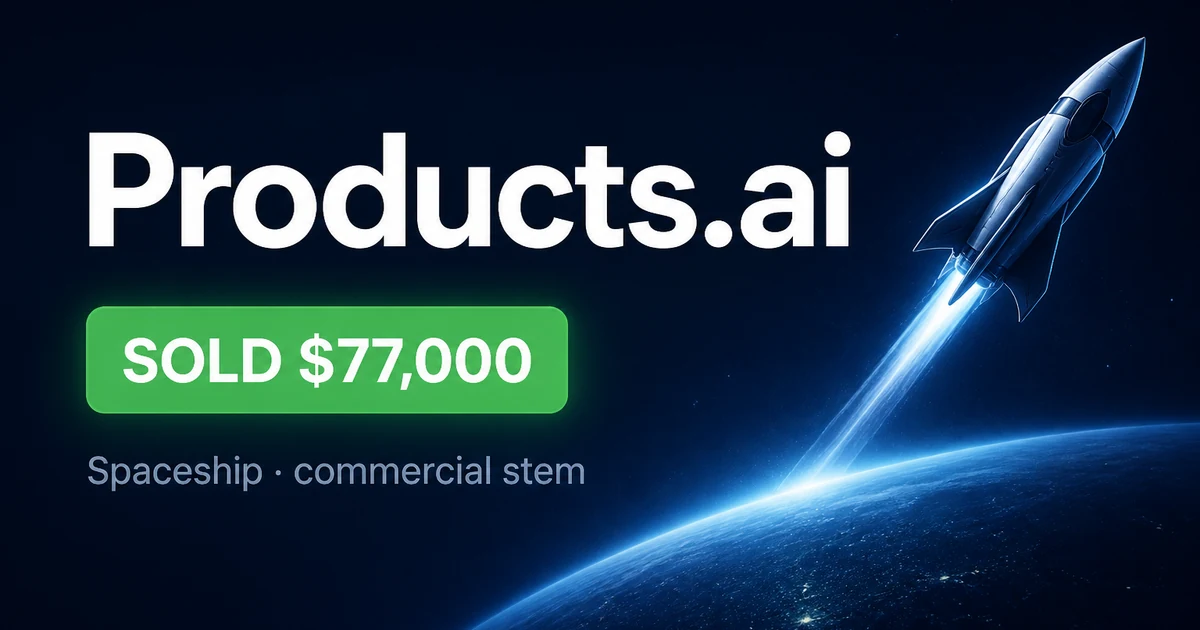
Products.ai closed at $77,000 on Spaceship in 2026, and the products ai angle that stopped me was not another Search Console tutorial. It was the commercial stem. Exact-match. A word shoppers already use. A string people will type as a brand once they hear it once. I opened the DNJournal August sales chart looking for six-figure fireworks and stayed on the $77K line because category search is where AI Overviews actually quote people. The midyear 2026 domain sales breakdown covers the trophy tape; this piece is about a stem that wants to get cited.
Full disclosure: I almost wrote this as a ranking-report walkthrough. I caught myself. We've done the GSC toggles. This sale is a naming and entity problem. Products.ai sold for $77,000 via Spaceship — $6,010 in 2019 if you believe the prior print Domain Name Wire flagged. Same second-level. Different internet. I used to treat commercial stems as 2012 leftovers. That version of me would have passed at $20K. This version is paying attention.
The live site, as reported, is a product-question engine — ask something like "best air fryer under $100" and it compares options. That's not a parked page waiting for a SaaS pivot. That's a category machine sitting on the category word. SEO people chase "best [thing]" with ten thousand affiliate outlines. This buyer (or operator) put the word "products" on .ai and let the URL do part of the introducing. Ugly elegant. I like ugly elegant more than another content calendar.
Why did Products.ai sell for $77,000?
Because "products" is a commercial head noun with branded-search potential, and .ai turns the phrase into a productized entity instead of a catalog URL. Products.ai sold for $77,000 on Spaceship, landing on DNJournal's board through 9 August 2026 around Chronicle.ai at $78,000 and the $75,000 Caveat/Lap pair. High five figures for a plural English word people use when they want to buy things. I don't need a keyword tool to know the stem is commercial. I need a brain.
Exact-match used to mean "rank for the word because the domain is the word." That trick got noisier. What still works: when someone hears "Products AI," they type products.ai or "products ai" and land on you — not on a Wikipedia disambiguation or a big-box retailer. Navigational query. Brand SERP. The domain is the spelling lesson. Period.
The 2019 print at $6,010 is the part I keep circling. If both numbers are real, the stem re-rated by an order of magnitude while AI became the default interface for shopping questions. I won't pretend every commercial .ai will 12x. I will say the 2019 buyer and the 2026 buyer were not paying for the same job. One paid for a speculative label. One paid for a front door to comparison intent.
Can products ai win branded search and AI Overviews at the same time?
Yes — if you treat the domain as an entity home, not as a magic ranking token. Branded search is the easy half: own the string, be consistent, don't let a Twitter handle steal the spelling. AI Overviews are the harder half: Google cites sources that answer category questions cleanly. A site on Products.ai that actually compares products is the kind of source an overview can quote on "best X" and "compare Y" queries. A thin lander with the word "products" in an H1 is not.
This is the opposite of hiding from AI surfaces. You want the citation. You want the overview to say the name. You want the click that still happens when the box isn't enough — and the brand memory when it is. I keep seeing teams pour months into opt-out debates while a competitor sits on the commercial stem and collects the mention. Wrong fight. The fight is: are you the entity associated with the category term, or are you one more URL in a pile of affiliate templates?
My honest line: Products.ai will not rank #1 for "products" against Amazon. That's fine. It can rank first for its own name. It can earn overview citations on mid-tail comparison questions if the pages are genuinely useful. Exact-match in 2026 is an entity wedge plus a memory trick. It is not a 2010 PageRank costume.
| Job the domain can do | How Products.ai helps | How it fails |
|---|---|---|
| Branded / navigational search | People type "products ai" after they hear it | You never say the name out loud the same way twice |
| AI Overview citations | Category answers on a commercial stem | Thin affiliate clones Google already distrusts |
| Category adjacency | "Products" is the shopping noun | You try to rank the naked head term against retailers |
| PR and podcast intros | No spelling footnote | You bury it under a different app name |
| Resale / 2019 vs 2026 | $6,010 → $77,000 if both prints hold | You treat 12x as a promise instead of one path |
How do you audit an exact-match commercial stem before you buy?
Steal this list. I built it so I wouldn't confuse "good SEO story" with "good company name." Products.ai at $77K is the prompt. Your next commercial stem might be cheaper, or it might be a trap with trademark landmines.
- Write the branded query and the category query separately — "products ai" (brand) versus "best running shoes" (category). The domain can help both. It will not automatically win both. If you can't explain the difference in one sentence, you're about to overclaim.
- Search the stem as a listener would — Type the spoken name, the dotted name, and the space phrase. Screenshot the SERP. If a giant already owns the entity, $77K buys a fight, not a shortcut. NameBio's sales history tells you what similar stems cleared; it does not tell you who already occupies the knowledge panel.
- Check whether the live site already answers category questions — Products.ai apparently does. Your target might be a parked page. Parked pages don't get overview citations. Useful comparison pages might. Price the content debt into the offer or you'll buy a URL and still need a newsroom.
- Model citation value, not vanity traffic — One overview mention on a high-intent comparison query can be worth more than a thousand informational sessions. Our domain tools page is where I sanity-check comps before I let a "this will rank" slide into the deck. Comps first. Fanfic second.
- Run clearance on the commercial word in the classes you'll operate — "Products" is descriptive. That's a gift and a problem. Descriptive marks are hard to lock. They're also hard for a competitor to exclusive-own. Get counsel. Then decide if you're building a brand on a word you can't fence.
- Confirm transfer path and walk-away — This one moved on Spaceship. The next one might not. Our buyer FAQ covers escrow timing so the SEO story doesn't outrun the registrar. If the content rebuild costs more than the domain, you're not buying SEO. You're buying a project.
Should SEO teams copy Products.ai — or copy the job?
Copy the job. The job is: pick a commercial stem people already say, put it on an extension your audience trusts, and publish answers that AI systems can quote without blushing. Do not copy the $77,000 number onto an unrelated plural. Do not copy a seven-year-old $6,010 print and call it a floor. One name. One path. Your stem has its own SERP, its own trademarks, its own content gap.
If you're building the comparison layer for a vertical and the exact noun is gone, a coined product name still works — you just spend more on the spelling lesson. The premium domain guide for AI startups is the fit-and-budget pass I'd run before anyone anchors to Products.ai because the word "products" feels like free traffic. It isn't free. It was $77,000 this time. Aifolio.app is the coined alternative I point to when the commercial .ai is the wrong shape for the actual product. Browse the premium domain marketplace if you need a name that can carry a category story without pretending it's 2010 exact-match season.
I'll say the quiet part. Most "SEO domains" I see on Twitter are keyword stuffing with a dash. Products.ai is not that. It's a single plural noun plus the AI extension, aimed at a product that answers product questions. If your site is a blog about productivity tips, this sale is not your permission slip. If your site is a machine that helps people choose things, listen to the stem logic even if you never bid $77K.
One more distinction I wish I'd had in 2019: commercial stem versus keyword dump. Products.ai is one word. GetBestRatedProductsOnline.ai is a dump. Dumps sometimes rank for a season and then look like spam in an overview. One-word stems look like companies. Overviews prefer companies that answer the question without a fifty-link sidebar. If your naming instinct is to pile modifiers to "capture more keywords," sit down. The $77,000 lesson is concentration, not stuffing.
Would I buy Products.ai at $77,000? For an operator already in comparison and willing to keep the content honest — yes, I'd take the meeting. For a content farm looking for a ranking costume — no. The 2026 premium is the entity and the memory, not the old exact-match spell. I wasted years treating commercial stems as unfashionable. Fashion was never the point. Intent was.
My close: I almost turned this into another reporting-UI essay. Products.ai at $77,000 didn't deserve that. It deserved a hard look at commercial stems in an overview world. If you're going to spend like it's 2026, buy a name that can get cited — then earn the citation. The domain opens the door. The answers keep it open.