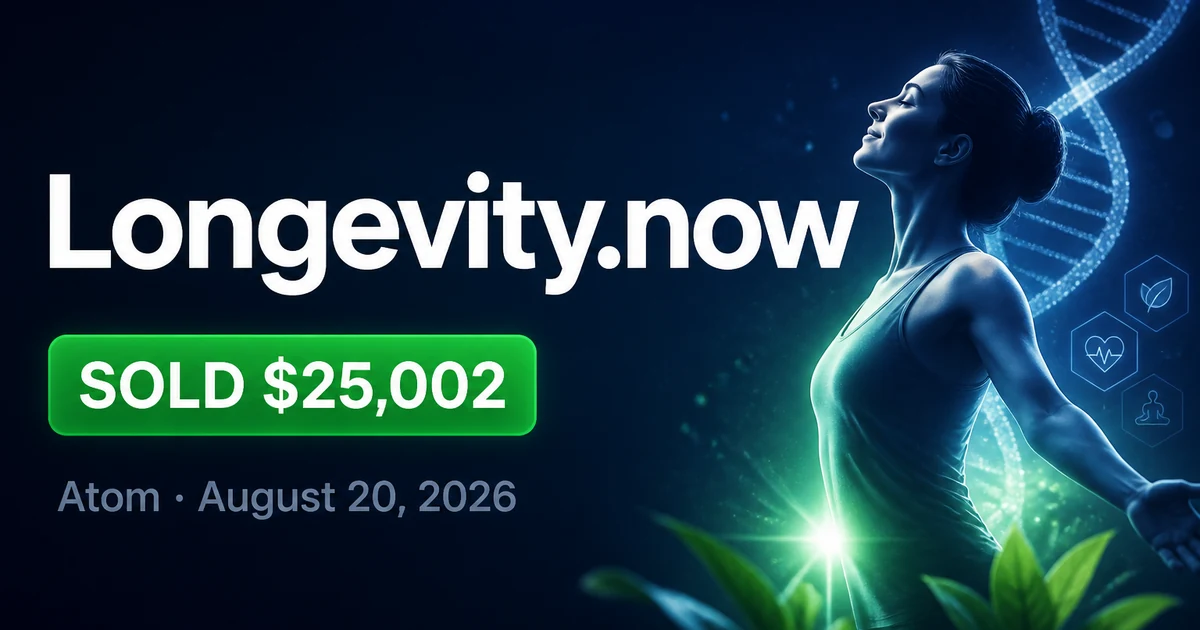
I used to treat new-gTLD category sales as background noise next to six-figure .coms. Then Longevity now showed up on the 20 August 2026 Atom chart at $25,002 and forced me to update that prejudice. Longevity.now is not trying to be Stan.com. It is a category keyword on a meaningful suffix for startups that sell time, healthspan, and aging science. Different buyer. Real check.
Full disclosure: I almost dismissed .now as a gimmick extension until I watched operators use it for campaign urgency and category landing pages. This close is smaller than the day's celebrity numbers — and more useful for founders who will never touch a $750K first name. I confirmed the sale band via NameBio day context and kept our midyear 2026 sales notes open for comparative texture.
$25,002 is another oddly precise Atom number. I trust precision more than round fantasy.
Why does Longevity.now make sense for a healthspan startup?
Because the word "longevity" is the category and ".now" adds urgency without forcing a clumsy .com workaround. The string reads like a mission line: longevity, now.
I've sat with biotech and wellness founders who cannot reach Longevity.com and should not burn runway pretending they can. A clean category + intentional TLD can be a rational plan B — sometimes plan A — when the brand story matches the suffix. .now is not generic trash when the product is about acting early on aging.
Is every .now worth $25K? No. Category strength did the heavy lifting. Longevity is a funded theme in 2026. Pairing it with a suffix that implies immediacy is clever positioning, not a TLD religion.
Should startups buy category.new-gTLDs instead of weaker .coms?
Sometimes yes — when the .com is unreachable or polluted and the gTLD strengthens the story. Often no — when a decent brandable .com/.app is available in budget and your buyers still default to .com trust.
My take is blunt. If enterprise procurement emails your team next quarter, test how .now feels in that inbox. If your buyers are consumers in a longevity community who already speak the category, Longevity.now can feel native. I've watched both outcomes. The TLD does not invent product-market fit. It either reduces or adds explanation cost.
Compare to coining a fresh brand on .com. Coinage can outrank a category.gTLD for trademark flexibility. Category.gTLD can outrank coinage for instant comprehension. Pick the pain you refuse to feel.
| Option | Approx. 2026 reality | Best when |
|---|---|---|
| Longevity.now | $25,002 Atom close (20 Aug 2026) | Category + urgency match the product |
| Premium longevity .com | Often far above early seed budgets | You can fund identity forever |
| Brandable .com / .app | Wide mid-market | You want flexible trademark room |
| Weak descriptive .com | Cheaper, forgettable | Almost never — save the cash |
How I'd evaluate a category gTLD purchase this week
I would run a spoken pitch test, a trademark screen, and a budget honesty check before I fell in love with the landing page mockup.
- Say the full hostname in a sentence — "Visit Longevity.now" should not make people ask which word is the domain.
- Confirm category demand — Longevity is a live funding theme in 2026. Obscure nouns on cute TLDs still flop.
- Price the alternative — What brandable .com/.app can you buy instead? If the alternative is stronger, buy that.
- Check venue norms — Atom closed this one; understand listing and transfer norms on Atom.com.
- Read broader sales context — DNJournal keeps gTLD and .com closes in perspective so one chart row does not rewrite your thesis.
- Plan content and email — If staff will resist @longevity.now addresses, you have a culture problem before a DNS problem.
Where does Longevity.now sit next to the day's bigger wires?
In the founder-budget lane — useful comps near $25K while Stan.com at $750K and TrueScan.ai at $120K will get more screenshots. Longevity.now at $25,002 is the founder-budget lesson — see also mid-band .com comps like Beel.com at $88,838. Most teams live closer to twenty-five thousand than three-quarters of a million. Ignoring mid-five gTLD category closes because they are not viral is how advisors give useless advice.
Honestly, I like this sale because it is humble and specific. Category word. Matching suffix. Atom liquidity. No mythology required. If you are building in healthspan, you now have a public comp that is not a fantasy .com ask.
For practical acquisition questions, use our FAQ. For comps workflows, tools. For live brandables in adjacent lanes, browse domains — and if you need a coined tech brand rather than a pure category host, Aifolio.app sits in that product-name lane.
I will keep watching .now and other purposeful new gTLDs when the left side of the dot carries real category weight. Empty dictionary words on random suffixes still look like 2015 hangover inventory to me. Longevity.now did not.
How longevity startups should think about naming in 2026
I've talked with early healthspan teams who want to sound scientific and human at the same time. Longevity as a category word does heavy lifting. Pairing it with .now adds a call to action without a second marketing line. That is efficient branding for companies that already spend enough explaining biomarkers to relatives at dinner.
Funding cycles in longevity and aging science have been loud enough in 2026 that category language is not obscure. Obscurity kills gTLD experiments. Category heat keeps them alive. If you register SleepyWidget.now for a random app, you are collecting suffixes. If you register a live category on a matching suffix, you are making a bet with a story.
Email culture remains the hidden veto. Some teams refuse anything but .com for staff addresses. Others happily run campaigns on .now while keeping a .com for corporate mail. Hybrid setups work when the roles are clear. Hybrid setups fail when every surface uses a different hostname and support tickets turn into detective novels.
I also push teams to test investor reactions. A partner who flinches at unfamiliar TLDs may still approve a category.now if the deck is strong. A partner who obsesses over URL optics may demand a .com even when the budget screams. Know your raise audience. Naming is fundraising packaging whether we like that or not.
Trademark and exact-match risk still apply. Longevity is a crowded word. Owning Longevity.now does not own the English language. It owns a hostname. Build distinct brand layers — product names, marks, visual identity — so the domain is a door, not your only IP. Doors matter. They are not the whole house.
Against the same-day $750K and $120K headlines, $25,002 looks modest. Modest is where most seed teams live. Advisors who only cite mega .com sales push founders into paralysis or debt. I would rather hand a founder a coherent mid-five gTLD category option than watch them stall for eighteen months chasing an unreachable .com while a competitor ships.
Practical next step if you are in this lane: list three naming paths with real prices — category gTLD, brandable .com/.app, and stretch premium .com. Pick one this month. Indecision is also a naming strategy. It just happens to favor whoever moves first.
I keep Longevity.now in the same notebook tab as other purposeful new-gTLD closes — not as proof that every gTLD is "back," but as proof that category fit still sells. Fit is the filter. Without fit, .now is just three letters after a dot. With fit, it can carry a $25,002 end-user story without apology.
If your team sells diagnostics, clinics, supplements, or software around healthspan, run the spoken pitch test this week with Longevity.now as a hypothetical. If it feels native, hunt comparable inventory. If it feels costume-like, stop forcing the suffix and buy a cleaner brand object instead.
Where .now fits next to .health, .life, and brandable .coms
I do not rank new gTLDs as a moral hierarchy. I rank explanation cost. .health can signal category. .life can signal lifestyle. .now signals urgency. Longevity.now pairs category noun with urgency suffix in a way that feels intentional. Longevity.life might feel softer. Longevity.health might feel clinical. None is automatically "better." Matching tone to offer is the job.
Brandable .coms still win when you need trademark flexibility and default trust in conservative buyer segments. Category gTLDs win when comprehension speed matters more than conservatism. Seed longevity companies often need speed. Later-stage companies sometimes refinance into a .com when the check sizes grow. Both moves can be smart in sequence. Pretending only one move exists is how advisors give cartoon advice.
If you buy Longevity.now-class inventory as an investor, underwrite end-user themes, not TLD fashion. Fashion fades. Themes with funding histories last longer. Longevity as a theme has history. That is the underwriting. The suffix is packaging.
One more founder note before the takeaways: if your scientific advisors love Longevity.now and your sales team hates saying it on calls, trust the sales team. Internal enthusiasm is not market enthusiasm. The Atom buyer who paid $25,002 presumably had alignment. Alignment is the underrated diligence item — cheaper than a bad rebrand, more predictive than a logo poll in Slack.
I will keep logging longevity now style category sales when they appear. Not because every new gTLD is a gold rush. Because founders deserve comps in their actual budget band, not only mythology from seven-figure .coms they will never buy.
I keep writing longevity now in my notes because that is the search phrase buyers use.
I keep writing longevity now in my notes because that is the search phrase buyers use.
My close: if your product is about acting early on aging, Longevity.now is a coherent brand object. If your product is unrelated and you just like the suffix, keep walking. Matching story beats collecting TLDs.