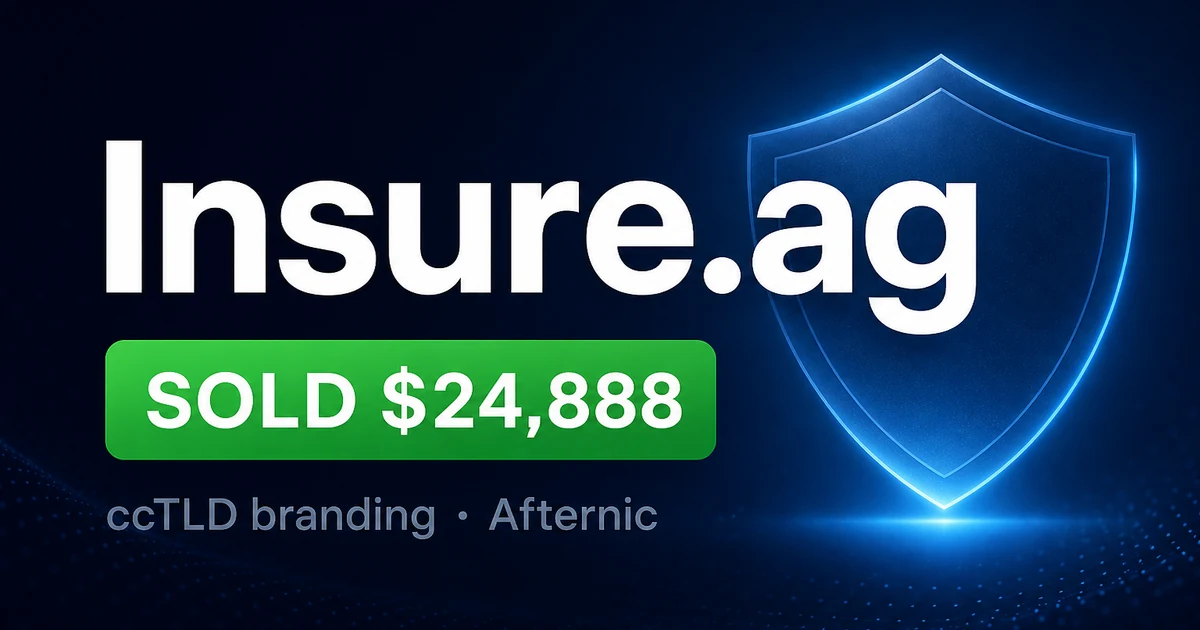
Insure.ag closed at $24,888 on Afternic on August 15, 2026 — and the first message I got from a founder was, "Wait, .ag is Antigua, right?" Yes. And it still worked as ccTLD branding for an insurance-category keyword because Insure.com will never be a startup line item. Full disclosure: I almost dismissed the sale as a typo until I pulled the Afternic listing history. Exact category word, credible extension hack, mid-five-figures. That's a real budget number for an insurtech seed team.
ccTLD branding gets a bad rap because most examples are lazy — slap .io on a SaaS and call it a day. Insure.ag is different: the second level is the entire category, the extension completes a pronounceable word pair, and the price sits where a funded seed company can actually write the check. I've been tracking insurance-domain sales since 2023; this one belongs in the "when ccTLDs make sense" folder, not the "desperate workaround" folder.
Macro context lives in the midyear 2026 domain sales report. Methodology for picking any name — ccTLD or not — is in the startup domain guide.
Why did Insure.ag sell for $24,888?
Because exact-match category keywords still convert, even on country-code extensions. Insure.ag sold for $24,888 on Afternic in mid-August 2026 — reported in industry sales roundups the same week. The buyer pool wasn't domainers flipping letter pairs; it was end users who understood that owning "insure" on any credible extension beats explaining InsureTech247.com to a policyholder. When a founder wants a shortcut I walk the boring parts first — fee schedules, renewal math, escrow timing, and the ugly middle where nothing feels exciting — because that middle is where most deals die.
.ag reads as "ag" — agriculture to domainers, "insure dot ag" as a spoken phrase to normal humans trying the name once. My take? The price reflects keyword strength discounted for ccTLD friction. Insure.com would be seven figures on any planet with oxygen. Insure.ag at ~$25K is the spreadsheet-friendly compromise.
NameBio's sales database shows similar category-keyword ccTLD closes in fintech and health — not identical, but directional. Check comps before you assume your Insure.ag bid is crazy.
When does ccTLD branding work for startups?
It works when three conditions align: the keyword is your category, the extension completes a speakable unit, and your buyers aren't enterprise procurement teams with hard .com policies.
It fails when you need global enterprise SSO whitelisting on day one, or when the ccTLD confuses your market (.ly still surprises people). Insure.ag passes the speakability test. RandomBrand.io does not pass the keyword test. Know which game you're playing.
| Scenario | ccTLD branding fit | Example |
|---|---|---|
| Category keyword unaffordable on .com | Strong | Insure.ag vs Insure.com |
| Coined brand, no keyword | Weak — prefer .com/.app | Made-up stem on .io |
| Regulated enterprise sales | Weak — compliance friction | Banking on .ag |
| Consumer insurtech, D2C | Moderate to strong | Insure.ag-style match |
| Geographic ccTLD mismatch | Risk — explain policy | .de without German ops |
How do you diligence a ccTLD purchase like Insure.ag?
Treat it like a .com acquisition with extra policy homework. ICANN's ccTLD overview is the starting point for registry rules — some ccTLDs have local presence requirements; .ag is relatively open, but verify current registry policy before escrow.
- Confirm registry transfer rules — Not all ccTLDs transfer like .com. Read the registrar FAQ for lock periods and auth codes.
- Check trademark clearance in insurance classes — "Insure" is descriptive; USPTO conflicts are likely. You need counsel, not a five-minute search.
- Verify Afternic or Sedo listing authenticity — Afternic reported the Insure.ag close; clone listings exist. Buy through verified marketplace flows.
- Model email and ads on the ccTLD — Run a small paid test landing page before you rebrand everything. Our domain tools page helps compare alternate strings if click-through disappoints.
- Escrow before wire — Our buyer FAQ covers escrow for marketplace acquisitions; same rules apply at $24,888 as at $248,888.
- Plan defensive registrations — If you buy Insure.ag, assume competitors register Insure.io variants. Budget defensively or accept confusion.
Should insurtech founders copy Insure.ag?
Only if your go-to-market matches — category-forward, consumer or SMB, tolerance for explaining the extension once. Don't copy the price as a budget anchor for unrelated words. Insure.ag at $24,888 is cheap relative to Insure.com; it's not cheap relative to a coined .app you could own for four figures.
If you're building AI-assisted underwriting or claims automation, a coined name like Aifolio.app may trademark cleaner than a dictionary keyword on .ag. Browse our premium domain marketplace for fintech-adjacent names if Insure.ag triggered FOMO but your product isn't insurance-core.
DNJournal logged the Insure.ag close in August's roundup — use it as a comp anchor, not a mandate.
What legal questions should insurtech ask about .ag?
Insurance is regulated state-by-state in the US. Your domain choice doesn't replace licensing, but vendor questionnaires ask about web presence stability. Document why Insure.ag is your canonical domain and how redirects from typo variants work. Compliance officers like written policies, not improvised answers on a call.
Also check whether your carrier partners block certain TLDs in email security gateways. Rare, but real at enterprise tier. Run a test message to a partner's security team before you rebrand everything.
What are the hidden costs after Insure.ag?
Sticker price is half the ccTLD branding story. Renewal on .ag runs higher than vanilla .com — budget multi-year, not year one alone. Some registries raise renewal faster than acquisition discounts. Read the fine print before you celebrate a $24,888 win.
Marketing explanation tax is real too. Every podcast host will say "Insure dot A G — Antigua?" once. You need a one-sentence answer that doesn't sound defensive. Practice it. If you can't say it without sighing, reconsider.
Compliance teams in insurance may ask about ccTLD registry jurisdiction during vendor review. Not a deal-killer for SMB insurtech, but enterprise carriers care. Know your buyer before you copy Insure.ag's playbook verbatim.
How does Insure.ag compare to other fintech ccTLD patterns?
Category keyword plus ccTLD hack shows up wherever .com is unreachable — Pay-related strings on .me, bank-adjacent words on regional codes, insure on .ag. The pattern works when spoken aloud sounds intentional, not accidental. Insure.ag sounds intentional. RandomVerb.io sounds like a placeholder that stayed too long.
Compare Insure.ag at $24,888 to a coined .com at $12,000 — not apples to apples. The keyword domain buys SERP clarity for navigational queries; the coined name buys trademark room. Pick the trade you're actually making.
I pull fintech comps on NameBio monthly. Keyword ccTLD closes cluster lower than keyword .com but higher than random brandables on the same extension. Insure.ag sits high in its niche because "insure" is the business, not decoration.
Should you negotiate below reported close?
Reported Afternic closes aren't always BIN full asks. List prices often sit 20–40% above settled cash. Bring comps, bring patience, bring escrow. Sellers who just saw August headlines may anchor high — your job is to separate Insure.ag's keyword value from your unrelated project's wishful thinking.
If negotiation fails, walk to coined alternatives. Insure.ag solved a problem for an insurance-forward brand. If you're building cross-industry workflow software with an insurance module, forcing "insure" into the domain is category lock-in you may regret at Series B.
My close on ccTLD branding: respect the Insure.ag close as proof that smart ccTLD choices still clear mid-five figures in 2026. Don't respect it as proof that any ccTLD will. Registry, keyword, speakability, buyer persona — all four must align.
Can Insure.ag scale to enterprise brokers?
Maybe — with expectations set. Enterprise brokers care about E&O coverage, data handling, and whether your domain looks "established." ccTLD can work if product credibility backs it. I'd expect longer sales cycles and more security questionnaires than a .com twin would face.
Build redirect discipline early: insure.com typos will hit your support queue even if you don't own .com. FAQ pages that explain your domain choice reduce ticket volume. Boring ops work, real money saved.
If enterprise is core GTM, model .com upgrade path even after Insure.ag purchase. Some teams treat ccTLD as staging, not destination. Honest planning beats pretending one domain serves every segment forever.
One founder asked me whether Insure.ag hurts programmatic ad approval. In my experience, ad platforms care about landing page quality and licensing disclosures more than TLD — but insurance vertical ads get manual review regardless. Fix compliance copy first; domain second.
ccTLD branding also affects partnership decks when carriers logo-stack their vendors. A weird TLD won't kill a pilot, but expect one slide explaining domain choice. Prepare that slide once; reuse it every time.
Finally, compare Insure.ag against coined alternatives before you FOMO-buy. A $24,888 ccTLD only wins when the keyword is your GTM — not when it's a side module in a broader platform play. I've passed on two Insure-adjacent strings this year because the product wasn't insurance-core enough to justify the explanation tax.
My honest line: Insure.ag isn't a trend — it's a trade. You trade .com prestige for keyword clarity at a price you can afford. If that trade matches your cap table and customer, take it seriously. If not, walk away without guilt.