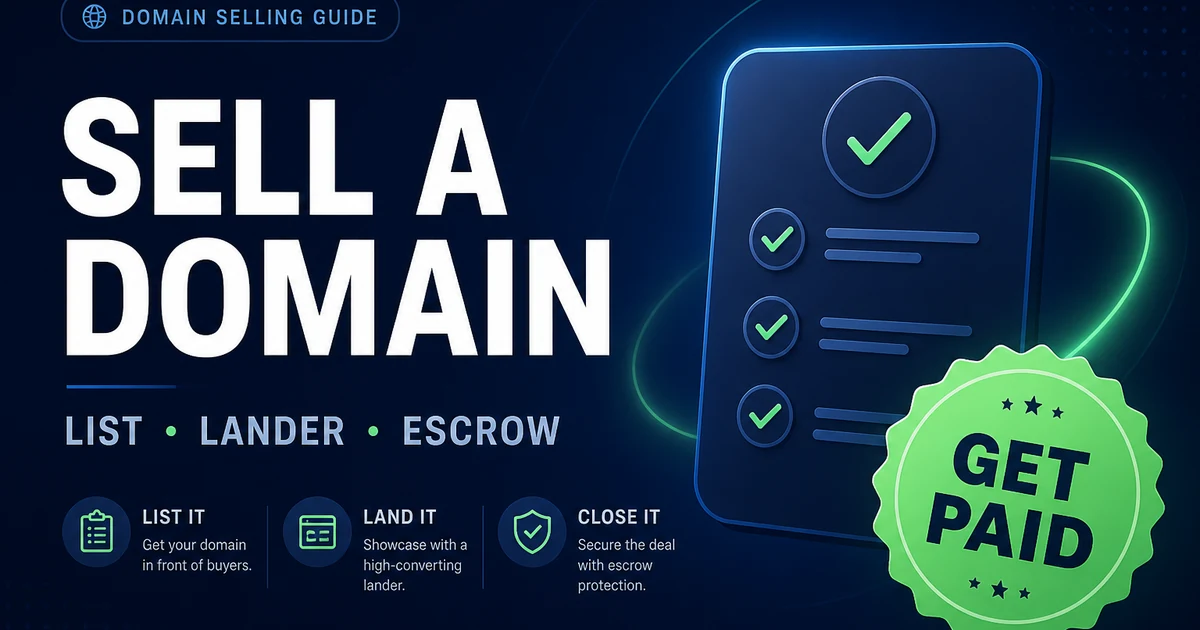
I used to answer “how to sell a domain” with “put a BIN on it and wait.” That sentence cost me weeks of dead inquiries and one almost-disaster where a buyer asked me to push the name before payment finished clearing. Full disclosure: I refused, they stalled, and the deal later closed through proper escrow anyway. If you want how to sell a domain in 2026 without folklore, here is the sale → money loop I trust: comps, BIN, Afternic list, lander, Fast Transfer, escrow, transfer only after funds clear.
I price with NameBio, I list distribution names on Afternic, and I keep Escrow.com in the conversation whenever someone wants to freestyle a wire. For market context while you set expectations, read our midyear 2026 domain sales notes. Selling is process. Process is what gets paid.
My confession: I once underpriced a decent name because I was scared of silence, then watched a similar string clear higher a month later. Fear is not a pricing model.
What does a clean domain sale look like end to end?
You prove a defendable ask with comps, you publish a BIN (and maybe Make Offer), you make the name purchasable through a trusted marketplace or escrow path, you keep Fast Transfer eligibility if you use Afternic’s network, you collect payment through escrow or marketplace checkout, and only then you transfer or push the domain.
That order is the whole article. Everything else is detail that keeps the order intact.
| Stage | Owner action | Tooling I use | Fail mode |
|---|---|---|---|
| Price | Comps → BIN floor after fees | NameBio | Fantasy ask / panic ask |
| List | Afternic + lander/NS | Afternic Fast Transfer setup | Invisible listing |
| Negotiate | BIN or Make Offer replies | Written floor | Talking yourself down live |
| Pay | Marketplace or Escrow.com | Escrow.com / Afternic checkout | Off-platform “friend escrow” |
| Transfer | Push only after funds clear | Registrar + platform | Pushing early |
How do you sell a domain step by step without getting burned?
Follow this ordered list exactly the first time. Customize later.
- Pull comps on NameBio — match extension, length, and quality. Note dates. Old comps need humility.
- Set a BIN that survives commission — if Afternic network takes ~20%, a $5,000 BIN is not $5,000 net. Write the net floor.
- Decide BIN vs Make Offer — BIN for clarity; add Make Offer if you can respond fast without emotional discounting.
- List on Afternic — complete the listing fields like a retailer, not like a forum post.
- Point nameservers / lander for Fast Transfer eligibility — distribution dies when DNS setup is half-done.
- Respond to inquiries with process, not vibes — share checkout path, escrow path, and timeline.
- Open escrow or marketplace payment — Escrow.com or Afternic’s flow. No creative payment theater.
- Transfer or Fast Transfer push only after funds clear — this rule is not optional.
If a buyer hates that sequence, they are asking you to finance their risk. You are not a bank.
Should you use lease-to-own when selling?
Sometimes. Lease-to-own (installments) can unlock buyers who cannot wire the full BIN today. It also adds default risk, admin work, and “who controls DNS during the plan” questions. I only offer lease-to-own when the platform supports it cleanly or when escrow terms are explicit. Handshake installment plans are how friendships and domains both disappear.
For beginners selling sub-$3,000 names, I usually prefer a clean BIN checkout over a custom lease. Complexity helps less often than sellers hope.
What price psychology actually moves domain buyers?
Clarity. A BIN says the name is for sale. A vague “make offer” with no guidance invites lowballs and ghosts. I still use Make Offer on higher names, but I keep a private floor and a first-reply template that restates process.
End users buy jobs: email credibility, category clarity, brand speakability. Domainers buy margin. Your lander copy should speak to end users first. Domainer-to-domainer wholesale can happen on community boards, but the tone differs. I keep wholesale and retail mental models separate so I do not accidentally wholesale a retail name in panic.
When I need a second venue for global negotiation, I add Sedo. When the asset is a curated brandable, I study presentation patterns on Atom. Venue follows asset class.
How do Fast Transfer and escrow fit together?
Fast Transfer is about speed of control change after a successful purchase on supported paths. Escrow is about money safety. They are teammates, not rivals. Marketplace-native checkout often wraps both ideas. Direct deals should still use Escrow.com or an equally serious provider.
Never confuse “buyer seems nice” with “funds cleared.” Nice is free. Cleared funds are not.
- Confirm buyer identity and legal name on the escrow order — match contracts to accounts.
- Confirm the exact domain string — typos happen when people are excited.
- Confirm payment method and timeline — wire, card, whatever the escrow supports.
- Wait for escrow’s clear-to-transfer signal — platform language differs; the idea does not.
- Push/transfer and confirm receipt — then complete the escrow release steps.
- Save records — you want a paper trail if anything gets weird later.
Our buyer FAQ covers sticky transfer questions I still see weekly. Selling side mirrors most of them.
What if someone emails you off-marketplace?
Stay polite. Move them onto Afternic checkout or Escrow.com. Off-platform is fine when process stays professional. Off-platform becomes dangerous when payment instructions arrive from a new email domain you do not recognize. Slow down. Verify. Adults do not take offense at verification.
I also refuse to transfer before payment for “trust building.” Trust building is escrow. Pushing early is gambling.
If you are still learning acquisition so you have something to sell, the flipping and auction pieces in this art08 pack pair with this guide. For a premium coined example of end-user positioning, see Aifolio.app. Tools I actually run live under domain tools, and broader browsing sits on premium domains.
Commission math you should do before you celebrate
Example: BIN $2,500 on an Afternic network-style sale at ~20% commission → about $500 in marketplace fees → roughly $2,000 before any other friction. If your acquisition was $1,700, your “win” is thin after time. Price acquisition with exit fees visible or you will flip for sport instead of profit.
Make Offer accepts can be worse if you negotiate down without recomputing the net. I keep a tiny calculator note: offer × (1 − fee%) − basis = real outcome. If the outcome is tiny, I decline politely.
Listing hygiene that quietly sells domains
Accurate whois contacts where required. Unlocked status only when transferring. Clear lander that states the name is for sale. No broken parking pages full of unrelated ads that make corporate buyers bounce. Fast replies during business hours in your buyer’s timezone when you can.
Silence after an offer is how deals die. Even a short “received, reviewing, escrow path is X” keeps adults engaged.
Community noise on NamePros can help you sanity-check whether your ask is in a live band — not to photocopy someone else’s bravado.
Scripts I use when a buyer asks to skip escrow
My short reply is boring on purpose: I sell through Afternic checkout or Escrow.com, and transfer happens after funds clear. I do not debate personality. How to sell a domain safely is mostly refusing improvisation. If the buyer is real, they recognize standard process. If they push harder for an unusual payment path, I slow down further. Speed requests paired with novel escrow websites are a pattern I do not reward. I also keep a one-paragraph explanation of Fast Transfer for corporate buyers who have never bought a domain before. Education closes deals. Suspicion without explanation stalls them.
For Make Offer threads, I answer within one business day even if the answer is no. Silence reads like abandonment. A clear no keeps respect and sometimes invites a better number later.
Documentation that makes corporate buyers comfortable
When teaching how to sell a domain to a non-domainer buyer, I lead with documents: proof of control, escrow steps, transfer timeline, and what happens if payment fails. Corporate buyers are not trying to be difficult. They are trying not to look foolish internally. Give them language they can forward to finance.
I keep a simple timeline template: day 0 agreement, day 0 to 2 funding, clear-to-transfer signal, push or transfer window, confirmation, escrow release. Exact days vary by method. The template still reduces anxiety. Anxiety kills deals more often than price gaps do at the mid levels beginners usually sell into.
If a negotiation stalls, I ask one clarifying question: is the blocker budget, timing, or process trust? Budget needs a different response than process trust. Offering a discount when the real issue is escrow fear solves nothing. Offering Escrow.com when the real issue is budget also solves nothing. Diagnose before you discount. Keep every answer consistent with the rule that DNS moves only after funds clear.
Store every closed deal folder with escrow IDs, auth-code timestamps, and final net proceeds. Future you will need those comps when someone asks how to sell a domain at a similar quality level.
My close: if you remember only one line about how to sell a domain, remember the order — money hardens first, DNS moves second.