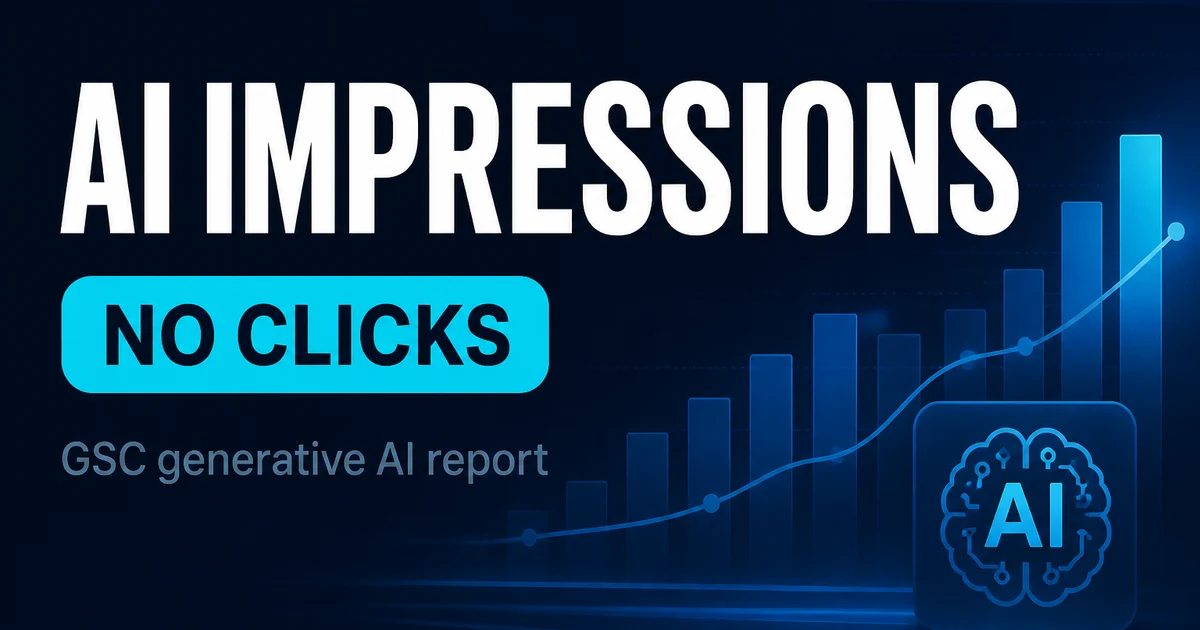
On August 11, 2026, the Generative AI performance report finally showed up in full for most of the Search Console properties I manage. I opened it expecting the usual comfort food — clicks, CTR, average position, query strings I could sort. Instead I got AI impressions with pages, countries, devices, and dates. No clicks column. No CTR. No query table. I stared at the screen longer than I want to admit.
Full disclosure: I tried to calculate CTR anyway. Old habit. You can't. Google hasn't shipped click-level AI attribution in this report as of August 2026. The June 2026 announcement previewed the gap. The August rollout made it real for marketplace operators who need to know whether AI Overviews are helping or hollowing out listing traffic.
My take: AI impressions without clicks is not a bug you can hack around with a spreadsheet formula. It's a measurement boundary. Your job is to pair GSC's AI segment with analytics events you control — branded search lifts, form fills, marketplace outbound clicks — instead of pretending the missing column will arrive next Tuesday.
What does the GSC AI report actually show in August 2026?
It shows generative-surface impressions tied to URLs in your property, broken down by page, country, device, and date. That's it for engagement metrics inside the report itself. You can see which listing pages or blog posts appeared in AI contexts and how often. You cannot see which queries triggered those appearances, and you cannot see clicks attributed to AI surfaces in this UI as of mid-August 2026. When a founder wants a shortcut I walk the boring parts first — fee schedules, renewal math, escrow timing, and the ugly middle where nothing feels exciting — because that middle is where most deals die.
Google introduced the report in June 2026 with a staged rollout. By August 11, 2026, most verified sites I work with had the full-ish experience — the impressions grid populated, filters responsive, export working. Still no query dimension. Still no CTR. I've bookmarked the AI optimization guide for the qualitative guidance Google offers while the quantitative side catches up.
For a domain marketplace, the first useful read is inventory versus editorial. Our AiFolio.app listing picked up steady AI impressions on fintech-and-AI use-case queries in the first week of full reporting. Generic blog posts about escrow mechanics saw a different country mix. Same report, different stories. Without clicks, you infer intent from page type and corroborate elsewhere.
Why are there AI impressions but no clicks in Search Console?
Because Google hasn't released click attribution for generative surfaces in this report yet — not because your site is broken. AI Overviews often satisfy the question inside the SERP. A user reads the summary, never expands sources, never lands on your site. Even when your URL is cited, the visit may not flow through a trackable click path Search Console can attribute to the AI segment today.
That's frustrating if you grew up on query-level SEO reporting. It's also consistent with what publishers have been describing since Overviews expanded in 2025 and 2026. Impressions measure presence. Clicks measure visits. Presence without visits is the whole zero-click conversation — we'll get to marketplace impact in a minute, but the GSC UI is honest about what it can see.
| Metric | Available in GSC AI report (Aug 2026) | Not available yet |
|---|---|---|
| Impressions | Yes — by page, country, device, date | — |
| Clicks | — | No AI-attributed clicks in this report |
| CTR | — | Cannot compute without clicks |
| Queries | — | No query strings in AI segment |
| Classic Performance overlap | Partial — compare manually | No unified blended CTR view |
How should you measure AI impressions without click data?
You build a secondary stack. I use a weekly routine — not glamorous, but it beats guessing.
- Export AI impressions by page from the Generative AI performance report every Monday. Store CSVs with dates in the filename so you can trend later.
- In Google Analytics (or your analytics tool), chart branded searches for domain names with rising AI impressions. A lift on
AiFolio.appqueries alongside AI impression growth is a plausible assist signal. - Track marketplace outbound clicks and contact form submissions on listing templates. Tag them by page slug. Compare week-over-week when AI impressions spike.
- Watch classic Performance report for the same URLs. If AI impressions rise and classic clicks fall on informational posts, you may be getting summarized instead of clicked. On for-sale pages, branded click stability matters more.
- Log manual spot checks: search your top AI-impression queries in an incognito window, screenshot whether you're cited, note if the answer is complete without a visit.
- Document changes — price updates, FAQ schema deploys — next to impression spikes so you don't confuse causation with rollout noise.
The Generative AI performance report guide walks the UI basics. This piece is the "what now" layer when the UI stops. Our domain tools include export templates I use for the Monday CSV habit.
Do AI impressions matter if you can't see clicks?
Yes — as a leading indicator, not a revenue line. Rising AI impressions on a listing page means Google trusts that URL enough to reference it in generative answers. That trust feeds branded discovery even when the click doesn't happen immediately. I've had buyers email "I saw your domain in Google's AI answer" without a clean analytics trail. The impression row was the only corroboration in GSC.
Where AI impressions mislead: vanity counts on thin pages. A thousand impressions on a 200-word placeholder sounds impressive until you realize the Overview quoted your title and nothing else. Pair impressions with page quality audits. The SEO vs AEO listing guide is my checklist for pages that deserve those impressions.
Read our FAQ for acquisition mechanics — when AI surfaces send buyers, they still ask the same escrow questions. Impressions are top-of-funnel; your listing still has to close.
What changes when Google adds clicks or queries?
You'll rebaseline everything. I expect query data to arrive in stages — maybe assisted clicks first, full query strings later. When that happens, resist the urge to delete your secondary measurement stack. Assisted metrics will still undercount direct-type navigational visits from buyers who memorize a domain name after seeing it cited once.
Until then, treat AI impressions like billboard foot traffic estimates. Useful for placement decisions. Not a substitute for register receipts. Browse our domain portfolio and compare which listing templates show up in your own AI impression exports — the pattern usually rewards specificity over hype.
Which pages should you prioritize in the AI impressions report?
Start with money pages — active for-sale listings with real price bands. Sort by AI impressions descending. The top five URLs tell you what Google thinks you're authoritative about in generative contexts. If a $9,500 .app listing outranks your blog on "AI portfolio domain" queries, that's a signal to reinforce that listing's FAQ and internal links, not to write another think piece.
Second pass: country and device breakdowns. I've seen US-mobile dominate AI impression rows on .app inventory while desktop-led classic clicks still come from EU buyers on .com names. Same portfolio, different surfaces. Without query strings you infer audience from geo splits and corroborate with inquiry email domains.
Third pass: date spikes aligned with deploys. When we shipped FAQ schema on a batch of twelve listings in July 2026, AI impressions climbed over the next ten days on nine of them. Three flatlined — two had schema mismatches, one was still opted out from a draft phase. The report is a QA tool if you treat it that way.
Can you compare AI impressions to classic Performance data?
Yes, manually. Export the same date range from both reports. Join on page URL in a spreadsheet. I add columns for classic clicks, AI impressions, and a simple ratio. There's no official blended CTR, so don't publish one to clients. Use the join to spot divergence: classic clicks falling while AI impressions rise on educational URLs is the zero-click pattern. Both rising on a listing URL is the citation-assist pattern.
Search Console help docs update faster than SEO Twitter. When in doubt, re-read the release notes from the June announcement before you rebuild dashboards around metrics Google hasn't shipped yet.
What should domain sellers do while waiting for click data?
Don't freeze your content program. Keep improving listing FAQs, schema, and internal links. The AI impressions you earn today become the citation history Google measures tomorrow when richer metrics arrive. I tell sellers to treat August 2026 as a baseline quarter — export everything, label it "pre-click," and move on.
Invest in buyer-side tracking: UTM parameters on marketplace outbound links, unique inquiry forms per listing template, post-purchase surveys. None of that requires Google to ship AI clicks. All of it makes you less dependent on a single GSC column that may not land until 2027.
Key Takeaways
- As of August 2026, the GSC AI report shows AI impressions by page, country, device, and date — not clicks, CTR, or queries.
- The August 11-ish full rollout made the gap visible for most properties; plan around missing click attribution instead of waiting.
- Pair AI impression exports with branded search trends, form fills, and marketplace clicks you control.
- Rising AI impressions on polished listing pages can signal citation trust even without click rows.
- Keep weekly CSV exports — you'll want baselines when Google eventually adds richer metrics.
What's your workaround for the missing click column? I'm testing assisted conversion imports this month and I'll share what holds up.