I woke up to a Domain Name Wire headline that made me spill coffee on my keyboard - and not because someone paid a record price for a single-letter .com.
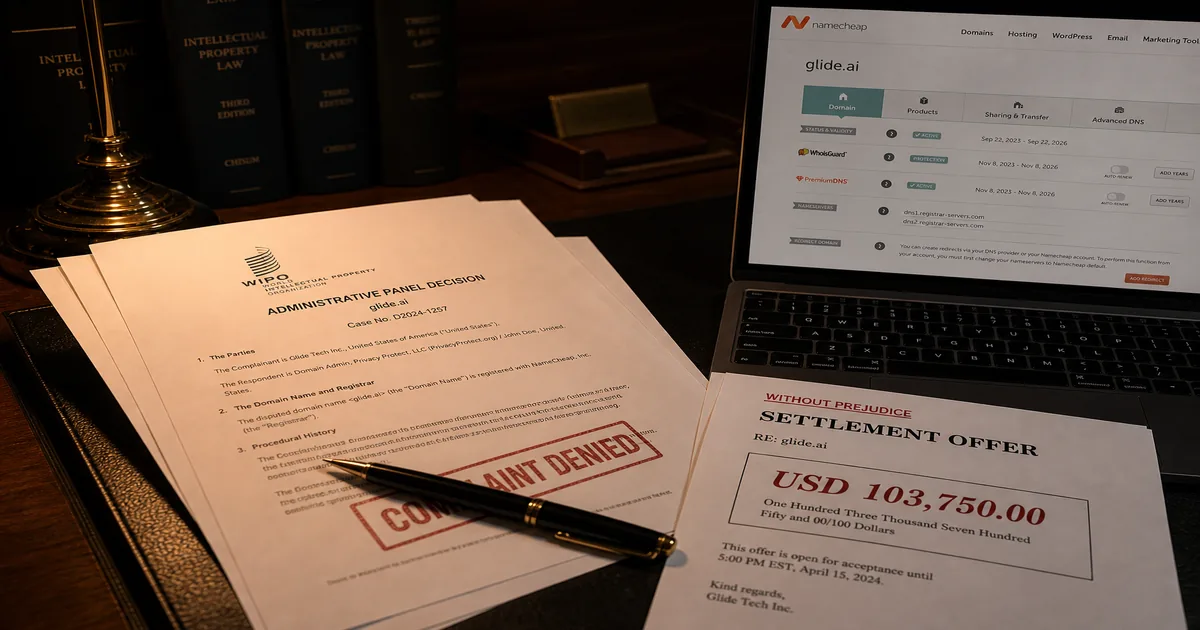
Glide (the company behind GlideApps.com) offered $103,750 for glide.ai through a GoDaddy broker. The registrant didn't counter. Glide filed a UDRP anyway. The panel found Reverse Domain Name Hijacking.
I've watched hundreds of UDRP filings. This one is a textbook lesson in what not to do when you already have a perfectly good brand on another extension - and when your opening offer was six figures.
What happened in the glide.ai UDRP?
According to Andrew Allemann's report at Domain Name Wire, the complainant is Typeguard, Inc., doing business as Glide. They build no-code spreadsheet-to-app software and operate on GlideApps.com - not glide.ai.
The registrant acquired glide.ai in 2023. Glide approached through GoDaddy's brokerage channel with a $103,750 offer. The owner declined. There was no counter-offer from the registrant's side in the brokerage thread that became evidence.
Instead of continuing negotiation - or walking away - Glide filed a UDRP at WIPO. They argued the domain was registered and used in bad faith, leaning on trademark rights tied to the GLIDE mark and the confusing similarity between glide.ai and their brand.
The three-member panel disagreed. Decisively. They found the complaint was brought in bad faith and constituted an attempt at reverse domain name hijacking.
RDNH is the UDRP equivalent of getting caught trying to grab someone else's wallet after you already offered to buy it at a fair price.
That's my plain-English summary. Panels don't hand out RDNH findings lightly. When they do, it usually means the complainant had a weak case, ignored obvious alternatives, or used the policy process as a cheap acquisition lever.
Why did the panel call this Reverse Domain Name Hijacking?
Several facts stacked against Glide. First, they already operate a well-known product on GlideApps.com. The panel had room to question whether glide.ai was truly indispensable - or whether this was a power move to eliminate a short, premium string in the hottest TLD on earth.
Second, the $103,750 offer is not a nuisance bid. It's a serious number that signals the complainant knew the domain had real market value. Filing UDRP after that offer failed looks less like trademark enforcement and more like forum shopping when negotiation didn't go their way.
Third, .ai domains carry category meaning now. "Glide" is a common English word. The registrant's use of glide.ai for an AI-related project - or as a valuable digital asset - doesn't automatically equal cybersquatting just because a spreadsheet company also likes the word.
I've seen brands win UDRPs on clearer facts: identical strings, obvious impersonation, passive holding of a famous mark. This wasn't that pattern. The panel's RDNH finding tells you they thought Glide should have kept negotiating - or accepted that glide.ai and GlideApps.com can coexist in a crowded namespace.
What should domain investors learn from this case?
If you hold premium .ai inventory, this case is oddly comforting. A six-figure offer followed by a failed UDRP and an RDNH tag is about as strong a validation as you get without a signed purchase agreement.
But don't get cocky. RDNH doesn't pay your renewal fees. It doesn't transfer the domain. It just embarrasses the complainant and may strengthen your position if they come back to the table - which smart companies often do after cooling off.
For buyers and corporate counsel, the lesson is sharper: UDRP is not a discount brokerage service. If you open at $103K, you're signaling you understand market pricing. Pivoting to a policy complaint when the owner says no can backfire publicly and legally.
I tell founders the same thing I tell investors: buy the name, lease the name, or build on a variant you already own. Using WIPO as a bat when you whiffed on price negotiation is a reputational risk - especially in AI, where every engineering blog will screenshot the decision.
Practical checklist if you receive a UDRP
- Document your registration date, development plans, and any legitimate use - even a landing page counts.
- Preserve brokerage emails. An opening offer near six figures helps your narrative.
- Respond on time. Default wins for complainants are real.
- Hire counsel if the domain is worth five figures or more. This is not DIY territory.
- Do not trash-talk the brand on the domain. Panels notice.
If you're building a legitimate AI brand and want a clean acquisition path, browse our AI domain collection - names with clear positioning, not trademark tightropes.
Could Glide have bought glide.ai another way?
Almost certainly. Six-figure offers rarely die on the first "no." Brokers exist to counter, structure earn-outs, or split payments. Glide chose the policy route instead - and lost face.
They still have GlideApps.com, which is a strong, descriptive brand for their category. Many successful SaaS companies never own the exact match on every extension. Notion doesn't own notion.ai. Plenty of unicorns live on compound domains forever.
That doesn't mean glide.ai wouldn't be a nice cherry on top. It does mean the UDRP filing read like impatience, not necessity. Panels reward complainants who exhaust reasonable commercial channels. Glide had started commercially - then swerved.
For the registrant, the next chapter is interesting. RDNH findings sometimes precede a higher settlement. Sometimes they poison the well. If I owned glide.ai, I'd keep the domain developed, keep records clean, and let the market come back - on my terms.
Names like AiFolio.app show how AI brands can launch without fighting incumbents over a single dictionary word on .ai. Sometimes the smarter move is building equity on a defensible string you fully own.
How does GoDaddy brokerage factor into UDRP evidence?
Enterprise buyers love brokered acquisitions because they create a paper trail without public WHOIS drama. That trail cuts both ways. When Glide opened at $103,750, they effectively stamped a market value on glide.ai before any panel saw the complaint.
Registrants sometimes assume brokerage silence protects them. It doesn't. Declined offers become exhibits. Panels read them as proof the complainant tried commerce first - and when commerce fails, policy filings look opportunistic.
If you're selling premium .ai names, keep broker threads professional. Don't taunt. Don't ghost without a clear "not for sale at any price" if that's your position. Ambiguity invites UDRP. Clarity - with documentation - is armor.
Buyers should treat brokers as ongoing negotiations, not one-shot ultimatums. A six-figure opening bid is a conversation starter in this market, not a closing argument. Glide's mistake was treating rejection as a trigger for WIPO instead of a cue to restructure the deal.
What are the real costs of an RDNH finding for a brand?
Reverse Domain Name Hijacking doesn't transfer the domain. It doesn't impose automatic damages in every forum. The costs are softer and still painful: forum posts, SEO articles, investor diligence questions, and internal embarrassment for legal teams.
In AI, where trust is currency, showing up in industry press as the company that tried to policy-grab a domain after a six-figure offer is a bad look. Competitors will screenshot the decision. Domain investors will remember the mark.
Some registrants use RDNH findings to negotiate higher settlements. Others simply hold and develop. Either way, the power dynamic shifts. The domain owner is no longer the nervous defendant - they're the holder a public panel said was wronged by process abuse.
For portfolio owners, archive these decisions. They're comps for buyer behavior and for your own outbound pricing. When a corporate counsel lowballs you after reading about Glide, send the link - politely - and resume business.
I've said it before: the domain industry runs on deals, not threats. Glide just paid tuition in public. If you're eyeing premium .ai names - or want a brand without the drama - start with curated listings and escrow-backed transfers on our acquisition desk.
- DN Detector editorial