If you're about to wire five figures for a domain, stop and read this first. Domain escrow is the single cheapest insurance policy in this entire business — and the number of buyers who skip it still amazes me.
I've bought and brokered enough deals to have a simple rule: over $10,000, escrow is non-negotiable. Under $10,000, I still use it most of the time. Here's exactly why, and how to do it right.
What is domain escrow and how does it work?
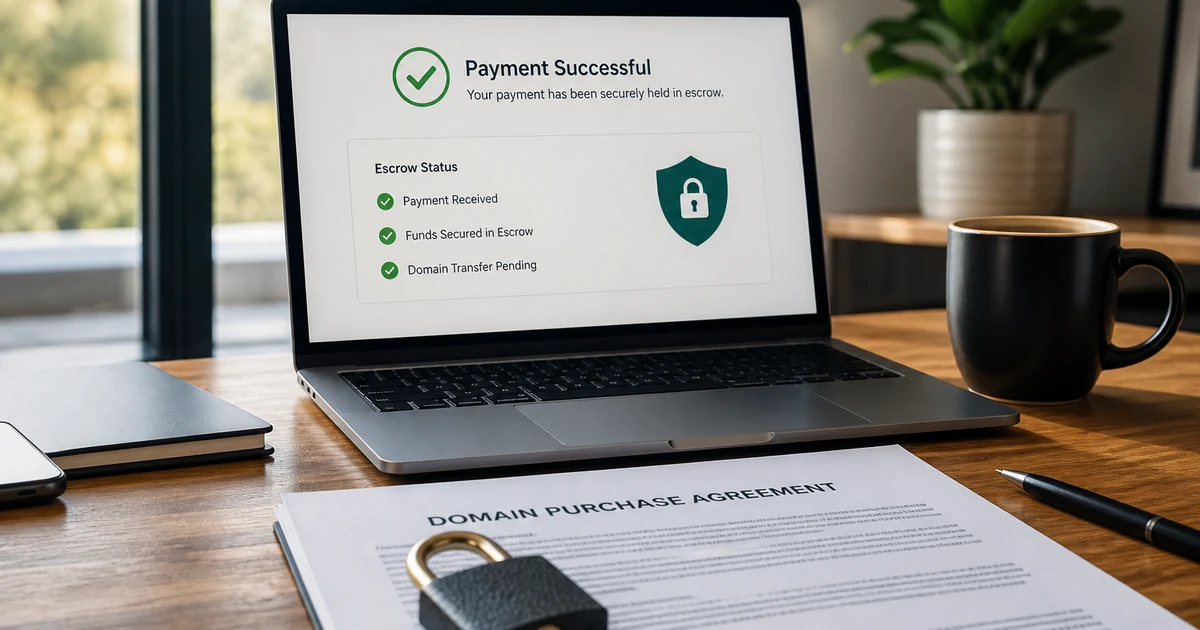
Escrow is a neutral third party that holds the buyer's money until the domain is safely transferred. The buyer funds the escrow account, the seller pushes the domain, the buyer confirms receipt, and only then does the money release.
No trust required between strangers. That's the entire point. Services like Escrow.com — the one most of the industry defaults to — sit in the middle so neither side can run off with both the name and the cash.
The flow looks like this:
- Buyer and seller agree on terms and who pays the fee.
- Buyer deposits funds into escrow.
- Escrow verifies the money is real, then tells the seller to transfer.
- Seller initiates the domain transfer or pushes it within the registrar.
- Buyer confirms they control the domain.
- Escrow releases funds to the seller.
Simple. Boring. And boring is exactly what you want when $10,000 is on the line.
The reason this structure works is that it removes trust from the equation entirely. You're not hoping the seller is honest. You're relying on a process where neither side can cheat without the middleman noticing. That's a fundamentally different thing than a good feeling about a stranger on the other end of an email.
The most expensive domain deals I've seen go wrong all had one thing in common: someone wired money directly to a stranger. Don't be that person.
Why can't I just wire the money directly?
Because a wire is final and a stranger is a stranger. Once that transfer clears, your bank cannot claw it back. If the seller vanishes, or never controlled the domain in the first place, your money is simply gone.
The scams are creative. Sellers listing names they don't own. "Sellers" who take the deposit and disappear. Domains with hidden liens, pending UDRP complaints, or registrar locks that make transfer impossible. Escrow doesn't solve every one of these, but it stops the biggest failure mode: paying before you possess.
For the full walkthrough of how a clean transaction should feel start to finish, I'd point you to our acquisition FAQ — it maps out the safe path step by step.
How much does escrow cost, and who pays?
Less than you'd think. On a domain in the low five figures, escrow fees typically run a fraction of a percent to a couple of percent depending on the amount and payment method — often a few hundred dollars or less on a $10,000 deal.
Compare that to losing the entire principal. The math isn't close.
Who pays is negotiable. Common splits:
- Buyer pays — standard when the buyer initiated the approach.
- Seller pays — common on marketplace-brokered deals where the seller builds it into the price.
- 50/50 split — the fairest default when neither side has the upper hand.
Marketplaces like Sedo and Afternic bake escrow-style protection into their transaction flow, which is one reason I steer newer buyers toward brokered deals rather than raw private sales.
What should I verify before releasing funds?
This is where buyers get lazy and pay for it. Before you click "release," confirm the domain is genuinely, fully in your control:
- You can log into the registrar account that holds the name — or it's pushed to your own account.
- WHOIS reflects your ownership (allowing for privacy settings).
- No registrar lock is preventing you from managing the domain.
- The exact domain matches the deal — watch for sneaky typos or a different extension.
- No pending disputes or transfer holds are attached.
Only when all of that checks out do you release. A name like AudioNames.com should transfer cleanly with a verifiable paper trail — if a seller resists escrow or rushes you to release early, that hesitation is your answer. Walk away.
A quick word on payment methods
Wire transfer through escrow is the gold standard for large deals. Avoid irreversible peer-to-peer payment apps for anything meaningful — they offer zero protection and no recourse. The whole reason you're using escrow is to keep a reversible, verifiable trail until the asset is truly yours.
What about lease-to-own and installment deals?
Five-figure names increasingly sell on payment plans, and escrow-backed lease-to-own has become common on the major marketplaces. It's a great way to land a name you couldn't pay for in a single lump — but it adds moving parts you have to understand.
In a typical arrangement, the domain sits in a neutral holding account while you make monthly payments. You get to use the name (often pointed at your site) but you don't own it outright until the final payment clears. Miss payments and you can lose both the name and, depending on terms, some of what you've paid in.
My advice: read the default terms before you sign anything. Know exactly what happens if you miss a payment, who controls the DNS during the term, and when title actually transfers. A good lease-to-own deal is transparent about all three. A bad one buries them.
Installment deals aren't riskier than lump-sum purchases by nature — they're just riskier when you don't read the fine print. The escrow principle still applies: don't assume ownership until the paperwork confirms it.
The seller's side of escrow
If you're the one selling, escrow protects you too — and skipping it can burn you just as badly. Sellers who transfer a domain before payment clears sometimes watch a "buyer" reverse a payment or simply vanish with the asset.
The neutral third party protects both directions. The buyer doesn't pay before receiving; the seller doesn't transfer before getting paid. That symmetry is exactly why escrow has become the default for serious deals rather than a nice-to-have.
Red flags that should end a deal
Over the years I've built a mental checklist of behaviors that mean walk away. A counterparty who pushes to skip escrow entirely. Pressure to release funds "just this once" before you've confirmed control. A story about why the transfer is delayed that keeps changing. Any of those, and the deal is over — no exceptions.
The best domain transactions are almost boring. Money in, name transferred, confirmation, money released. If a deal starts feeling dramatic or rushed, that drama is the risk announcing itself.
Buying a premium name should feel exciting, not nerve-wracking. Do the boring part right and it will. When you're ready, browse our curated inventory and read the FAQ so your first five-figure deal is your smoothest one.
- DN Detector editorial