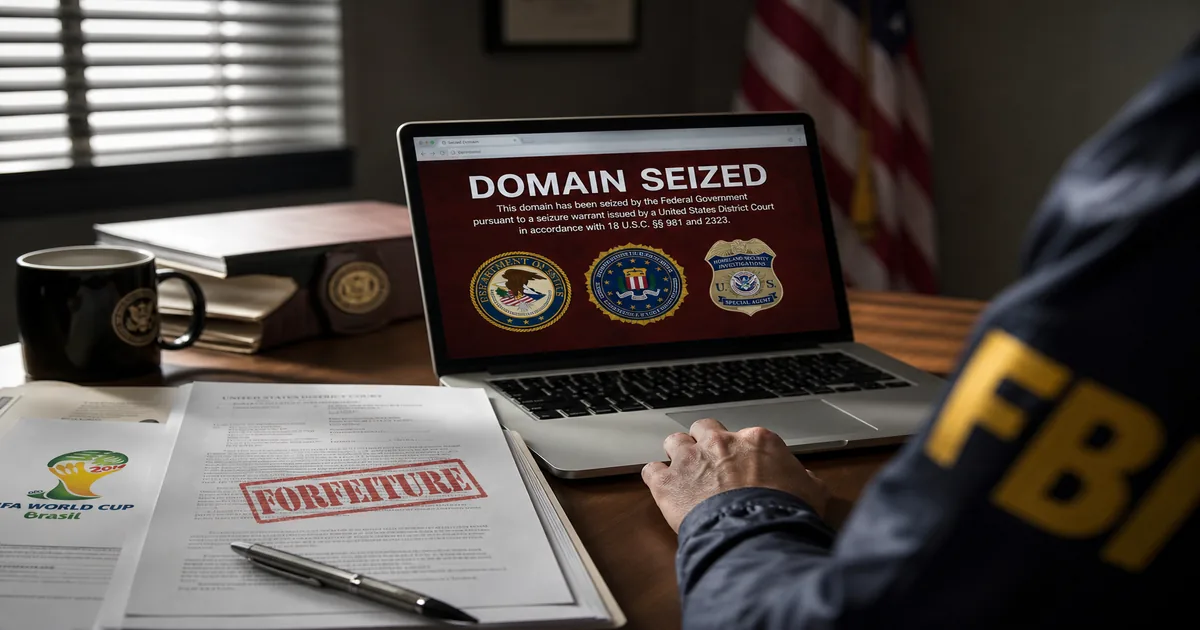
More than 1,000 domains just got yanked by the U.S. Department of Justice - and no, this isn't another trademark spat over a brandable .com.
It's a sports-piracy crackdown tied to the 2026 FIFA World Cup. The operation is called Operation Offsides. And if you own, buy, or park names for a living, you should care - even if you've never streamed a match in your life.
I almost scrolled past the headline. "DOJ seizes domains" shows up every few months. Then I saw the number. A thousand. In three waves. Across a single tournament. That's not a one-off takedown. That's a template.
What actually happened in Operation Offsides
According to reporting carried by Yahoo / Complex, federal agents seized domains used to broadcast World Cup matches without authorization.
The first wave landed June 26 - nearly 400 names. Two more rounds followed. By July 20, the total had crossed 1,000.
Homeland Security Investigations (Washington Field Office) and the National Intellectual Property Rights Coordination Center ran the U.S. side. Warrants went through the Eastern District of Virginia. Agents said the sites were actively carrying live World Cup streams without a license.
FIFA, beIN Media Group, NBCUniversal, the Motion Picture Association's ACE coalition, UFC, and Warner Bros. all helped identify targets. That's a stacked rights-holder list. When that many majors line up, registries and registrars tend to move fast.
And it didn't stop at the U.S. border.
A parallel push - Operation Red Card - ran through the DOJ's International Computer Hacking and Intellectual Property program across Argentina, Brazil, Chile, Colombia, the Dominican Republic, Ecuador, Paraguay, and Peru. Colombia alone blocked 1,140 illegal streaming sites. Brazil: 309. Dominican Republic: 256. Ecuador: 223.
Colombia went further. Raids in Bogotá and other cities led to arrests tied to a group called Los Ciberinfiltrados - accused of selling pirate World Cup access through fraud credentials, VPNs, and corporate system tricks. Separate apparel counterfeit raids added more arrests.
One more number that stuck with me: the DOJ's Computer Crime and Intellectual Property Section says it has secured more than 180 cybercrime and IP convictions since 2020, plus court orders returning over $350 million to victims. Domain seizures sit inside that broader enforcement machine.
Why would the DOJ seize a domain name?
Because a domain is infrastructure. Not "just a string."
If your site is the front door for unauthorized live streams, the domain is how users find you, how malware gets distributed, and how payment pages get dressed up as legitimate. Assistant Attorney General A. Tysen Duva framed Operation Offsides as both copyright enforcement and consumer protection - pointing at malware and stolen payment data on illicit streamers.
HSI's Matthew Millhollin said operators "might also be planning to inject malware or steal your payment information." That's the pitch courts hear now: this isn't only about FIFA's rights. It's about users getting burned.
My take: once an agency can tell a judge "these domains are active crime tools," seizure becomes cleaner than chasing every backend server across three continents. Kill the pointer. Break the audience. Repeat.
That's exactly why this matters to legitimate investors. Seizure power is real. And the bar for "harmful domain use" keeps getting clearer in public messaging - copyright, malware, fraud, payment theft.
What this means for domain buyers and sellers
If your portfolio is clean brandables and curated marketplace inventory - like the names we list on DN Detector - you're not the target. Good.
But the aftershock still hits the aftermarket. Here's what I'd tighten immediately:
- Use history checks - Before you buy, look for piracy, streaming, phishing, or malware mentions on the name. Wayback + safe browsing + basic reputation tools. Five minutes now beats a locked domain later.
- Watch "traffic" that looks too good - Sudden spikes around sports events, adult live streams, or "free [event] watch" patterns are a red flag. Cheap traffic is rarely clean traffic.
- Avoid "streamer" brandables with illegal intent cues - Names built around "freehd," "watchlive," or tournament-plus-stream combos attract the wrong buyers - and the wrong attention.
- Keep ownership records tidy - Accurate WHOIS / RDAP, real contact paths, escrow-backed transfers. When enforcement asks questions, messy paperwork makes you look like a soft target.
- Don't park next to poison - If a name previously hosted unauthorized streams, rebuild carefully or walk away. Some buyers chase residual type-in. I don't. Not worth the seizure risk.
If you're evaluating security-focused brands instead, look at category inventory like our cybersecurity domains - names built for legitimate products, not pirate funnels. ExploitGym.app is the kind of positioning that belongs in a training/product story, not a stream farm.
Can a seized domain come back to the open market?
Sometimes. Not quickly. And not cleanly.
Government seizures can lock a name at the registry or registrar level while a case runs. Outcomes vary: forfeiture, return to a rights holder, long limbo, or eventual drop years later with a toxic history baked in.
I've watched investors chase "ex-seizure" names thinking they're bargains. Usually they're buying a reputation problem. Search engines remember. Brands remember. Payment processors remember.
If a World Cup piracy domain ever hits auction after this crackdown, ask yourself: do you want that string associated with Operation Offsides in every diligence memo forever?
Most of the time, the answer should be no.
The bigger pattern for 2026 domain risk
Operation Offsides isn't isolated. Rights holders are coordinating across borders. Latin American blocking numbers alone dwarf the U.S. seizure count. That tells me enforcement is getting operational - not symbolic.
For premium domain investors, the lesson isn't "never touch sports names." Sports brands and clean fan media projects still need strong domains.
The lesson is narrower: intent and use history matter as much as the string.
A great brandable used for fraud can become a liability overnight. A solid brandable used for a real product, with escrow checkout and verified ownership, stays an asset. That's why our acquisition FAQ stresses escrow-protected transfers and verified listings - boring process is protective process.
Also watch the consumer-protection angle. When agencies sell seizures as malware and payment-theft prevention, they get broader political cover. Expect more waves around Olympics, major leagues, pay-per-view combat sports, and live concert streams.
If you're building or buying in media, security, or streaming-adjacent SaaS, assume diligence standards will keep rising - not easing.
Full disclosure: I don't feel sorry for pirate stream farms. I do feel protective of ordinary investors who buy a "high traffic" name without asking where the traffic came from.
Ask. Every time.
If this crackdown made you rethink a purchase you're eyeing, good. Slow is cheap compared to a locked domain and a legal letter. And if you're hunting a clean security or product brand instead of a sketchy streamer name, start with verified inventory - not a mystery drop with last month's World Cup spike still glowing in the analytics.
- DN Detector editorial