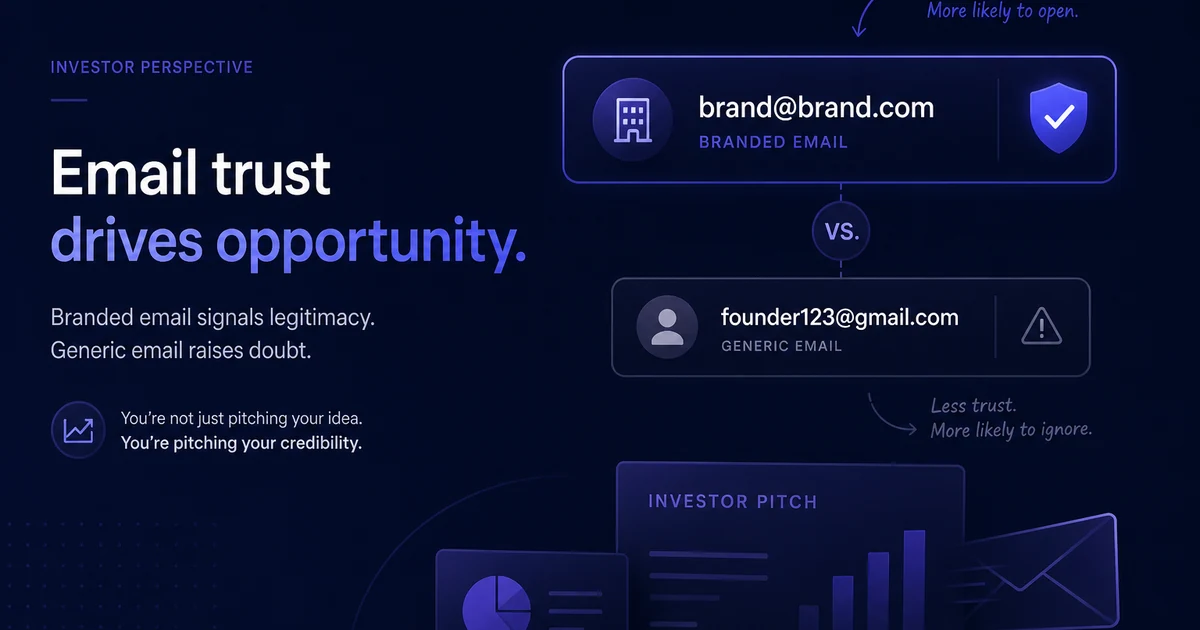
I'll say it plain: email trust is the thread I keep coming back to. email trust shows up in every deal conversation I have about this. If you only remember one phrase from this piece, make it email trust. I've watched a pitch email from a Gmail address get dismissed before anyone read the deck. Not by every investor — most VCs are reasonable people who look at the content, not the sender line. But the one investor who mattered for that round was old-school. "If they haven't figured out the domain yet, what else haven't they figured out?" That's a real quote, from a real conversation, relayed to me afterward by the founder. He had $200,000 in ARR. He was pitching on founder@gmail.com. He didn't get a meeting from that email.
The brand.com email question in fundraising isn't purely about optics. It's a signal in a signal-dense process. VCs read dozens of cold emails per week. Every element of your message — subject line, sender name, sender domain — is data they're processing in milliseconds. Your sender domain tells them where you are in the company-building timeline. And in 2026, a $6-per-month Google Workspace subscription is the delta between "this founder is serious" and "this founder is pre-committed." I think that's a ridiculous way to evaluate a company. I also think it's the world we're operating in.
I've tracked this pattern for years. My take is blunt. I'd rather be wrong in public than polish a empty framework. Honestly, the messy version is the useful one. That's the point. Not a theory. I've seen it fail the soft way. Hard truth. Buyers notice. Sellers forget. Period.
Quick note on scope: if you're still evaluating which domain to build on at all, our buyer FAQ covers the acquisition mechanics end to end. If you're comparing name options across price points, our premium domain marketplace has names available for immediate transfer. This piece is specifically about the investor trust signal — what it means, when it matters, and how to fix it in under two hours.
For primary sources I keep coming back to DNJournal, Google's Search docs.
What does a Gmail address signal to a VC in 2026?
Depends heavily on stage. At pre-idea — two people with a Google Doc and a vision — nobody cares. At pre-seed with $50,000 committed from friends and family, investors expect you to have a domain. At seed with a product and paying customers, pitching from Gmail is a yellow flag. At Series A, it reads as a credibility gap. The signal scales with the round you're raising and the investor profile you're targeting.
What investors specifically read from a Gmail sender: either (a) the founder hasn't committed to a company name yet, or (b) they have the domain and haven't set up professional email, which raises questions about operational basics. Neither interpretation is favorable. The first suggests you're pre-name, which is fine at idea stage but out of place at seed. The second suggests you're moving fast without handling fundamentals — a real concern at a stage where "operational maturity" enters the diligence conversation explicitly.
Full disclosure: I sent pitch emails from a personal Gmail account once, early in my own company-building. The feedback I got — indirectly, through a mutual connection — was identical to the quote above. I set up Google Workspace on my domain the same afternoon. The emails I sent afterward read identically in content. But the sender line said what I needed it to say. That was the only change. I can't prove it moved the needle. But I stopped getting that feedback.
When is a .app or .io email address actually fine for fundraising?
For most pre-seed rounds, yes. The investor community has largely accepted .app and .io as legitimate signals for technical founders building in those categories. A founder@yourproduct.app from a YC batch company raising pre-seed is not going to get dismissed because of the extension. It signals that the founder prioritized shipping over waiting for the perfect .com — which is often a positive signal at early stage, especially with technically-oriented investors.
The nuance: .app and .io email works better for technical product rounds than for enterprise-facing or consumer pitches. If you're raising an enterprise SaaS round and your email is founder@yourproduct.io, the enterprise-focused VCs on your list will notice. Not because .io is bad — because their LPs and portfolio CXOs still read .com as the "committed company" extension in 2026. That signal exists whether it's fair or not. Know your audience before you stress about the sender domain.
My honest take on extension priority: get the .com if you can, even if you ship the product on .app. Set up email on .com for investor comms specifically. Use the product domain for everything else. The fundraising and domain credibility guide goes deeper on how domain choice reads across the entire investor cycle — worth reading alongside this piece before your next round.
How much does email domain actually matter compared to everything else?
Less than you think. More than you'd like. Email domain is a small signal in a very large signal system. A brilliant demo and strong ARR from a Gmail address beats a mediocre pitch from a brand.com address, every time. The sender domain doesn't get you funded. It removes one piece of friction in the first impression — and in a process where investors are making pattern-matching decisions under time pressure, removing friction is real value, even if it's small.
What matters more than your email domain in 2026: your subject line, your first sentence, whether the deck attached is under 10MB, whether you addressed the email to a specific person or sent a blast to a generic contact address, and whether your ARR or traction number is in the body of the email or buried on slide eight. Fix those first. Then fix the email domain. Both matter. The order matters too.
For what domain names actually cost before you commit — because most founders overestimate the premium by 60% or more — NameBio's sales data has transaction history on .com and .app names across categories. Real closes, real prices, not appraisal inflation.
How do you set up a professional email on your domain?
This takes under two hours, costs $6–$12 per month on Google Workspace, and you keep the same Gmail interface you're already using. Here's the actual process.
- Own the domain first — You need the domain registered in your name before you can set up email on it. If you're evaluating premium names, our AI domain collection has names with immediate transfer. For an AI product that needs a strong identity from day one, Aifolio.app is worth considering — coined, clean trademark profile, immediately transferable.
- Set up Google Workspace — Business Starter is $6 per user per month. You get Gmail, Drive, Calendar, and Meet under your domain. Setup takes roughly 30 minutes if you've done it before; budget an hour if you haven't.
- Verify domain ownership — Google will ask you to add a DNS TXT record to confirm you own the domain. Copy the TXT record from the Google admin panel, paste it into your domain registrar's DNS settings, and verify. DNS propagation takes 5–60 minutes depending on your registrar.
- Configure MX records — After verification, Google provides the MX records that tell the internet where your email lives. Add them to your DNS settings. Another 5–10 minutes of work, 30–60 minutes of propagation.
- Set up SPF, DKIM, and DMARC — These three records authenticate your email so receiving servers know you're not a spammer. Missing them means your professionally-sent emails land in spam folders — which defeats the point. The DMARC setup guide walks through it cleanly. Google Workspace's admin panel handles SPF and DKIM in a few clicks; DMARC is one additional step but it protects your domain from spoofing by bad actors.
What does the email domain signal across different investor types?
Yes — it signals seriousness before the deck opens. Angels care less than Series A partners. Family offices notice first. That's the pattern I've watched in 2026.
| Sender domain | Stage fit | Enterprise-focused VC signal | Technical/early VC signal |
|---|---|---|---|
| founder@gmail.com | Pre-idea only | Red flag at seed and above | Yellow flag at seed and above |
| founder@product.io | Pre-seed through seed | Yellow flag at Series A | Neutral |
| founder@product.app | Pre-seed through seed | Neutral to slight yellow | Positive (shows shipping culture) |
| founder@product.com | All stages | Positive signal | Neutral to positive |
My honest close on this: email domain is not a deal-maker. It's a friction-reducer. In a process where investors are making pattern-matching decisions under time pressure, removing a small obstacle is real value even if it's invisible to you afterward. At $6 a month, that's probably the highest-ROI infrastructure decision you'll make this quarter — and the one most founders defer until someone asks about it in a meeting.